
Higgsfield AI Review 2026: Is the All-in-One AI Video Platform Worth Your Money?
If you’ve spent any time in AI creator circles this year, you’ve probably seen Higgsfield mentioned alongside Runway, Kling, and Sora. It markets itself as a single subscription that unlocks a whole shelf of the industry’s best image and video models — Kling, Seedance, Veo, Sora, Nano Banana, and more — instead of making you juggle five separate accounts and five separate bills.
That pitch is compelling on paper. But “one subscription, every model” is also exactly the kind of claim that deserves a closer look before you hand over your card details. So this review digs into what Higgsfield actually is, what it costs once you get past the headline numbers, and what people who’ve actually paid for it are saying.
What Higgsfield AI Actually Is
Higgsfield is a browser-based creative platform founded in 2023 by a team with Google Brain backgrounds. Rather than training its own foundation model to compete head-to-head with OpenAI or Google, Higgsfield built an aggregation layer: you buy Higgsfield credits, and those credits can be spent across a long list of third-party and in-house models — image generators like Nano Banana Pro, video models like Kling 3.0, Seedance, Veo, and Sora, plus tools for lip-syncing, camera-angle manipulation, and short-form “Explainer” style video creation.
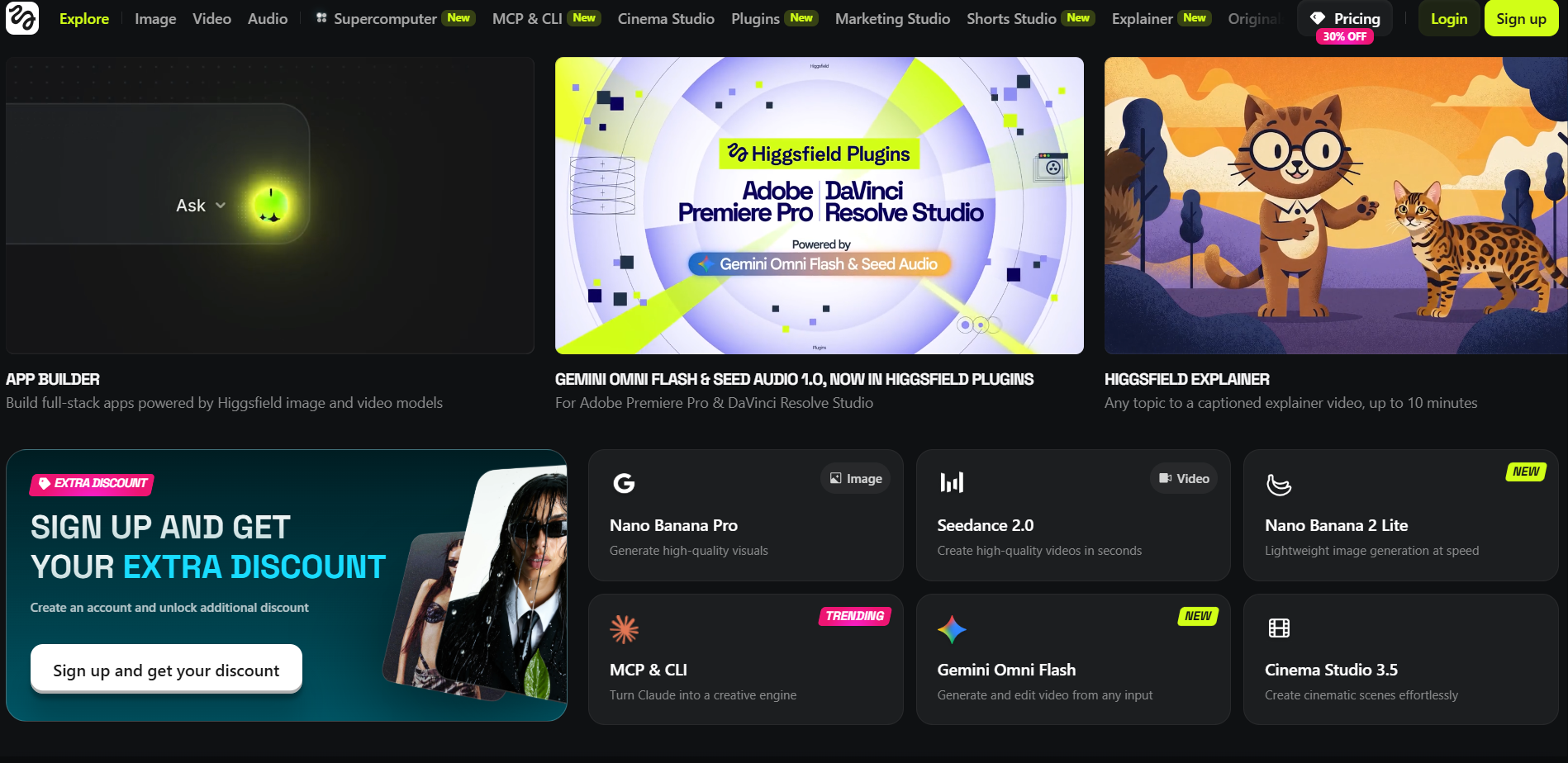
Around it, Higgsfield has built a fairly serious production ecosystem: plugins for Premiere Pro and DaVinci Resolve, an MCP integration for use with Claude and similar assistants, a command-line interface, and features like Cinema Studio and Shorts Studio aimed at people producing content at volume. The company has raised significant venture funding, and recent reporting places its valuation somewhere in the $1–1.3 billion range following a Series A extension in early 2026 — so this isn’t a scrappy weekend project, it’s a well-capitalized bet on becoming the default hub for AI video production.
Core Features Worth Knowing
Model variety. This is Higgsfield’s biggest selling point. Instead of separate subscriptions to Kling, Runway, and an image generator, you get access to 15-plus models from one dashboard, with new ones added on a rolling basis.
Angles and camera control. Tools like Angles let you upload a single photo and generate the same subject from different camera positions — useful for storyboarding, product shots, and thumbnail variations, controlled through a drag-to-rotate interface rather than manual prompting.
Cinema Studio and Shorts Studio. These are geared toward longer-form and social-first output respectively, letting creators sequence generations into more complete video projects.
Editing plugins and MCP/CLI access. For teams already working in Premiere or Resolve, Higgsfield can plug directly into the edit rather than living as a separate browser tab.
Higgsfield Originals. The company has also used its own tools to produce short AI-generated episodic series, which functions as both a showcase and a stress test of what the platform can do at scale.
Also Read: Facebook’s AI Mode: Public Posts Now Power Search Answers
Pricing: What You’ll Actually Pay
This is where Higgsfield gets genuinely confusing, and it’s worth spending real time on before you subscribe. The plan names, prices, and credit allotments have shifted more than once since the platform’s 2025 launch, and multiple independent trackers report different numbers depending on when they checked — a sign that promotional pricing rotates frequently rather than staying fixed.
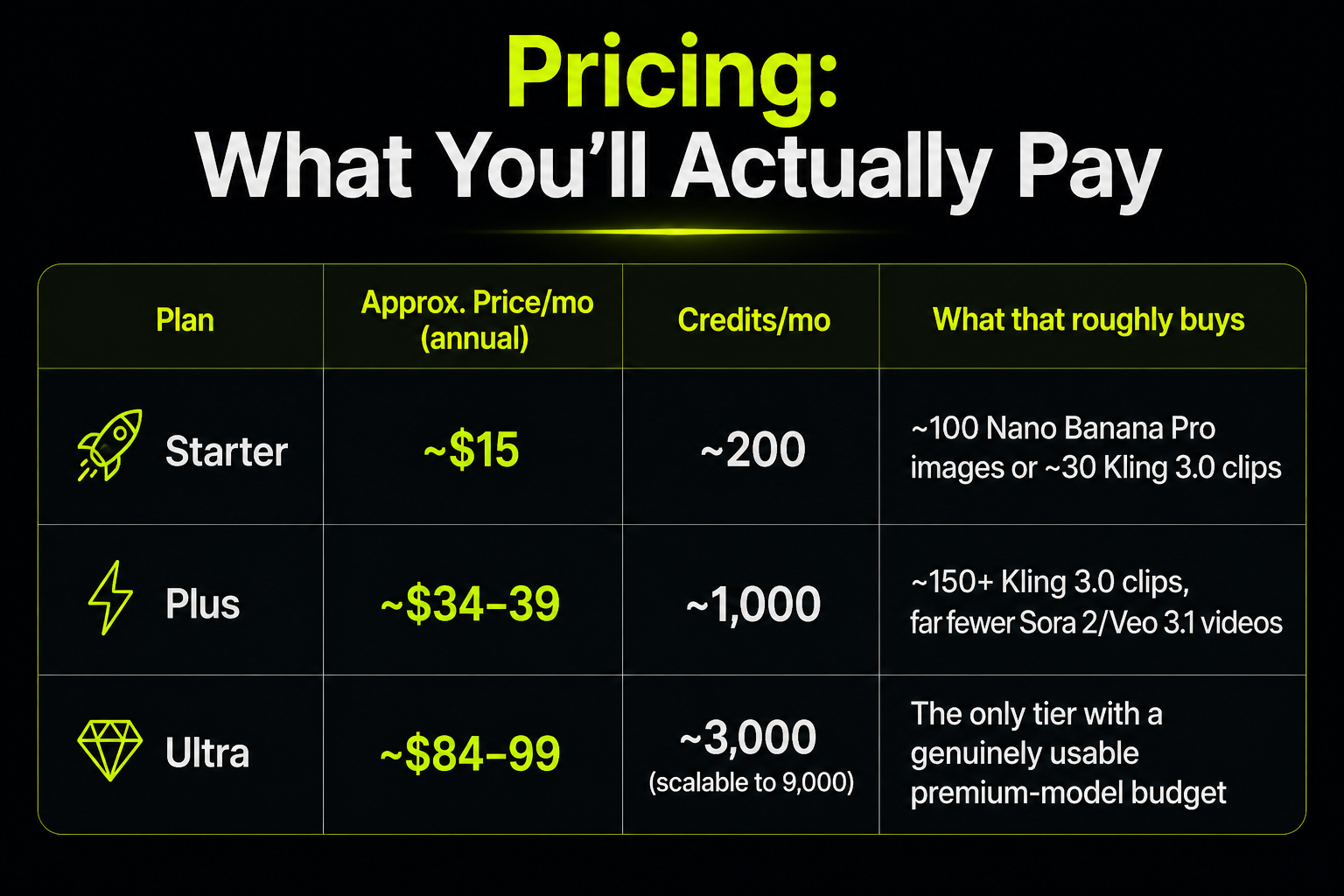
As of mid-2026, the general shape of the pricing (billed annually, which is the default the checkout page nudges you toward) looks roughly like this:
| Plan | Approx. Price/mo (annual) | Credits/mo | What that roughly buys |
|---|---|---|---|
| Starter | ~$15 | ~200 | ~100 Nano Banana Pro images or ~30 Kling 3.0 clips |
| Plus | ~$34–39 | ~1,000 | ~150+ Kling 3.0 clips, far fewer Sora 2/Veo 3.1 videos |
| Ultra | ~$84–99 | ~3,000 (scalable to 9,000) | The only tier with a genuinely usable premium-model budget |
A free tier exists, offering a small daily credit drip (around 10 credits/day) on basic models only — enough to poke at the interface, not enough to seriously evaluate premium models like Sora 2, Veo 3.1, or Kling 3.0.
A few things matter more than the headline numbers:
- Credit costs aren’t flat. A Kling 3.0 clip might cost around 6–14 credits, while a Sora 2 or Veo 3.1 generation can run 40–70 credits. That means your “1,000 credits” evaporate very differently depending on which model you actually want to use.
- Credits expire. Monthly plan credits typically don’t roll over, and purchased top-up credits commonly expire around 90 days after purchase.
- Real output is lower than it looks. Because AI video generation often takes several attempts to get a usable clip, independent cost breakdowns suggest the effective cost per usable video — after retries — runs several times higher than the sticker price implies.
- Refunds are narrow. Refund windows are generally short (around 7 days) and typically void the moment any credit has been used, which limits your ability to properly trial a plan before committing.
- Annual billing is the default. Monthly billing exists but usually costs meaningfully more, and the checkout experience tends to default you toward the annual option.
None of this makes Higgsfield a scam — but it does mean the plan you should budget for is not the number in the biggest font on the pricing page. It’s worth doing the credits-per-model math against your actual planned usage before you commit to a year.
What Real Users Say
Looking across review platforms gives a more balanced picture than either the marketing page or a single test session would.
Trustpilot sentiment is mixed but leans positive overall, with a rating generally sitting in the high 3s to low 4s out of 5 across thousands of reviews. Fans consistently praise having so many models under one login and point to strong output quality from models like Seedance and Kling. The recurring criticism cluster is just as consistent: credits burning faster than expected, pricing that changes without clear notice, and frustration when refund requests get denied because a credit was already spent. Higgsfield’s support team is frequently singled out — even in critical reviews — as unusually responsive for a company at this scale.
G2, which skews toward professional and studio users rather than casual one-time buyers, rates the platform more favorably, often above 4.5 out of 5. Reviewers there focus on workflow value: having one platform to handle an entire AI film or ad production pipeline instead of stitching together five tools. The main shared complaint, even among enthusiastic reviewers, is the same one Trustpilot users raise — credit consumption on ambitious or longer projects outpaces expectations.
Capterra doesn’t yet have a meaningful independent review base for Higgsfield, so Trustpilot and G2 remain the two most useful sources if you’re researching sentiment before subscribing.
The Honest Pros and Cons
Where Higgsfield earns its reputation:
- Genuinely broad model access — one of the deepest catalogues available under a single subscription
- Individual tool interfaces (like Angles) are clean, fast, and show cost upfront
- Serious production ecosystem: editing plugins, MCP/CLI support, Cinema and Shorts Studio
- Support team gets consistently good marks even from unhappy reviewers
- Backed by real funding, shipping new models and features quickly
Where it loses trust:
- Pricing and credit allocations shift often enough that third-party guides disagree with each other
- Credit consumption on premium models (Sora 2, Veo 3.1) eats through allotments fast
- Both plan credits and purchased top-ups expire, with no rollover
- Refund policy is narrow and voided by any usage, making it hard to properly evaluate before paying
- Check out defaults and promotional discounts create pressure to commit to annual billing quickly
Who Higgsfield Actually Makes Sense For
It’s a good fit if you’re a working creator or small studio who will realistically use several hundred credits a month, values having every trending model in one place, and is willing to read the fine print on refunds and credit expiry before committing to an annual plan.
It’s worth waiting on if you’re a casual or occasional user, you wanted a real trial before paying, or you specifically need heavy use of top-tier models like Sora 2 or Veo 3.1 — the credit math on those gets expensive quickly outside the highest tier.
Final Verdict
Strip away the pricing gymnastics, and Higgsfield is a legitimately capable product: the model aggregation is hard to match anywhere else, the individual tools are well designed, and the surrounding ecosystem (plugins, MCP, studio features) shows real engineering investment. The company is well funded and moving fast, which shows in how often new models get added.
The friction is almost entirely on the business side — pricing that moves, credits that expire, a refund policy that closes the moment you actually try the product, and a checkout flow that nudges you toward annual billing before you’ve had much chance to evaluate fit. None of that is unusual for a fast-growing SaaS company, but it means the burden is on you to do the math before subscribing rather than trusting the number in the largest font on the page.
Bottom line: if you already know you’ll use it heavily, Higgsfield’s model breadth is genuinely hard to beat. If you’re still deciding, start with the lowest tier or the free daily credits, track exactly how fast you burn through an allotment on the models you actually care about, and only step up to an annual plan once you’ve done that math yourself.
This review is based on publicly available pricing pages, independent pricing trackers, and aggregated user reviews from Trustpilot and G2 as of mid-2026. Pricing and credit allocations at AI platforms change frequently — always confirm current numbers on Higgsfield’s official pricing page before subscribing.
Investment Guide Dismoneyfied: A Simple, No-Jargon Way to Start Investing - Team disquantified.org
October 9, 2026[…] this guide, “dismoneyfied” means making money topics easy to understand. You don’t need to read balance sheets or watch markets all day. You […]