

What Is a War Room and How to Use It in Project Management
A project management war room is one of those things that sounds crazy, but it’s really just a centralized space — physical or virtual — where teams solve problems more quickly and visually track progress for quick decision-making. Today’s project teams don’t just use war rooms during crises but also for events like product launches, sprint execution, stakeholder alignment, risk control and deadline recovery. Recent project management data shows that 50% of organizations still lack access to real-time KPIs, while 42% spend at least one full day manually collating reports, which makes a war room approach even more valuable in 2026.
The idea behind a war room is simple: instead of letting updates go their separate ways — across emails, Slack threads, spreadsheets and disconnected meetings — you bring people, data, priorities, blockers and decisions into one shared environment. Sort of like a pilot’s cockpit for an airplane.
The pilot does not want instruments spread across ten different rooms. Everything critical must be visible at once. That is exactly how a project war room works.
Understanding the War Room Concept
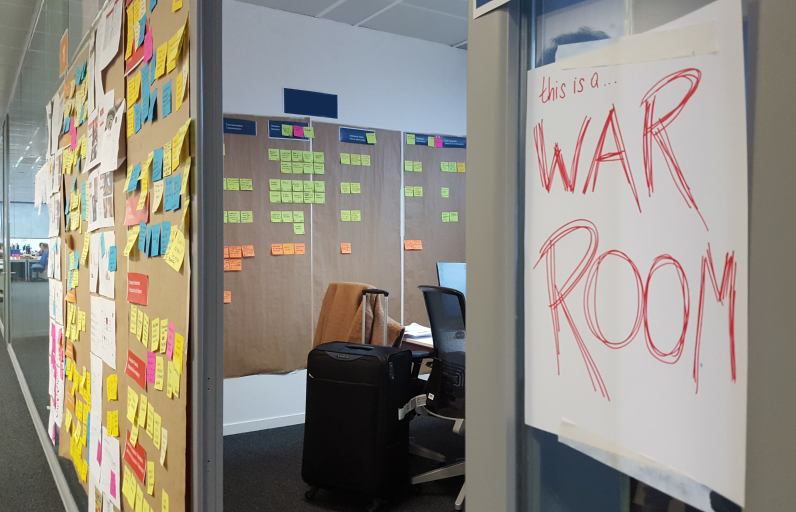
This leads to the creation of a project war room which is an environment where everything that is crucial for execution is visible and actionable. This could be a physical room with whiteboards, kanban boards, milestone charts, risk logs and stakeholder maps taped up on the walls. Or a virtual workspace such as tools like Jira, Asana, Miro, Monday or Microsoft Teams dashboards. This isn’t decoration, though; this is speed and visibility and alignment. Any person walking into the room should get a sense of the current status of the project in a matter of minutes.
The idea originated with military strategy rooms in which leaders took stock of maps and intelligence along with tactical options. The same principle holds true in project management: get the right people in the room, display the right data and create a situation where it becomes second nature for decisions to be
made on a regular basis. When a software launch delays, a construction deadline is at risk, or a cross-functional team is stuck due to dependencies, the war room becomes where momentum returns. (ActiveCollab)
What makes this especially powerful today is the rise of hybrid work.
The method no longer requires teams to have a physical room. With a digital war room, sprint boards, issue logs, KPI dashboards, meeting recordings, decision trackers and escalation channels can all sit together in an always-on space. It turns chaos into clarity.
Also Read: AI Project Management Tools to Try in 2026
Core Elements of a Project War Room
The first building block of an effective war room is people. Not everyone needs to be in the room. Only decision-makers, task owners, SMEs, and key stakeholders should participate. Too many voices can slow execution. Think of the war room like an emergency operating theater: only the people who directly improve the outcome should be there.
The second element is visual project intelligence. Your room should display sprint velocity, task completion, deadlines, unresolved risks, issue severity, budget burn, and resource allocation. Real-time visibility matters because project delays often happen when teams rely on outdated reports. If half your day is spent asking, “Where are we on this task?” the room is failing its purpose.

The third element is structured communication rituals. Daily standups, escalation huddles, issue triage sessions, and milestone reviews keep the war room alive. Without rhythm, it becomes just another meeting space. The best teams use the room as a heartbeat for execution, where every session ends with owners, due dates, and visible next steps.
| War Room Element | Purpose |
|---|---|
| Team Leads | Faster decision ownership |
| KPI Dashboard | Real-time visibility |
| Risk Board | Immediate mitigation |
| Issue Tracker | Blocker resolution |
| Meeting Cadence | Consistent momentum |
Benefits of Using a War Room in Project Management
The biggest benefit is faster decision-making. Instead of waiting 24 hours for email approvals, stakeholders can align in real time. This is critical because project delays often come from slow decisions, not slow work. A developer may be blocked for three days by a missing requirement, but a 15-minute war room discussion can remove that blocker instantly.
The second major advantage is risk visibility. A hidden risk is like a crack in a dam. Small at first, but dangerous if ignored. In a war room, risks remain visible on boards, dashboards, and escalation logs. Teams can spot patterns early, whether it is scope creep, vendor delay, budget overrun, or test failures. PMI’s recent agility and enterprise execution research also reinforces that visibility and adaptability are now major differentiators for high-performing organizations.
Another huge gain is team accountability. When everyone sees tasks, deadlines, and ownership in one place, excuses disappear. It becomes harder for work to hide in private inboxes or isolated spreadsheets. Teams become more responsible because ownership is public and transparent. This visibility creates a subtle but powerful social pressure that keeps projects moving.
Finally, war rooms dramatically improve cross-functional collaboration. Designers, developers, QA, finance, compliance, and operations can solve interdependent issues together instead of tossing tasks over the wall. This reduces handoff friction and speeds up execution.
Also Read: How to Build a Strong and Productive Team in 2026
How to Set Up a War Room for Project Success
The first step is defining the mission of the room. Is this war room for a delayed software release, a new product launch, sprint execution, enterprise migration, or crisis recovery? The clearer the objective, the better the structure. A vague war room becomes a vague conversation.
Next, decide whether the room should be physical, virtual, or hybrid. Physical rooms work best for colocated teams handling high-stakes launches. Virtual rooms are ideal for global or remote teams. In 2026, many organizations prefer hybrid models where dashboards are digital but decision meetings still happen synchronously.
Then establish meeting cadence and governance. Daily 15-minute execution standups, twice-weekly leadership reviews, and instant escalation channels create momentum. Every issue raised must be tagged as:
- Owner
- Priority
- Deadline
- Dependency
- Escalation path
The last step is the most important: make everything visible. If decisions happen in side chats, the room loses power. Every blocker, milestone, and change request should appear on the shared board. Visibility is the oxygen of a war room.
Best Use Cases in Project Management
War rooms are incredibly effective in Agile sprint delivery. During sprint weeks, the room becomes the central point for backlog review, dependency removal, test issue resolution, and stakeholder demos. Teams can quickly pivot when priorities shift.
Another perfect use case is crisis recovery. Imagine a SaaS platform outage before a major client demo. A war room allows engineering, DevOps, product, customer success, and leadership to align instantly. Incident response teams increasingly use this exact method because the first 30 minutes of coordination often determines whether the issue escalates or gets contained.
War rooms also shine during product launches and transformation projects. Large launches involve marketing, engineering, finance, legal, sales enablement, and support teams. Without a central decision hub, launch friction multiplies. The war room acts like the command bridge of a ship moving through stormy waters.
Common Mistakes to Avoid
One common mistake is treating the war room like a status meeting factory. If the room becomes a place where people simply repeat updates, it loses strategic value. The focus should always remain on decisions, blockers, and execution.
Another mistake is inviting too many stakeholders. More people does not always mean better outcomes. Overcrowding slows focus and creates noise. The room should remain lean and purpose-driven.
A third major issue is poor documentation discipline. Decisions made verbally but not captured on the board create confusion later. Every action must be documented with clear ownership.
The final mistake is running the room forever. A war room should support critical phases, launches, incidents, or transformation cycles, not become permanent micromanagement.
Conclusion
A war room in project management is not about pressure or drama. It is about clarity, speed, visibility, and execution discipline. Whether you manage Agile sprints, enterprise migrations, crisis recovery, or product launches, the war room approach creates a single source of truth where decisions happen faster and teams stay aligned.
In today’s project landscape, where visibility gaps still hurt performance and real-time KPIs remain missing in many organizations, war rooms provide a practical competitive edge. They help teams move from scattered updates to focused execution, like replacing a maze of side streets with a high-speed expressway. If your projects often stall because of blockers, unclear ownership, or delayed approvals, implementing a war room may be the simplest way to regain control.