
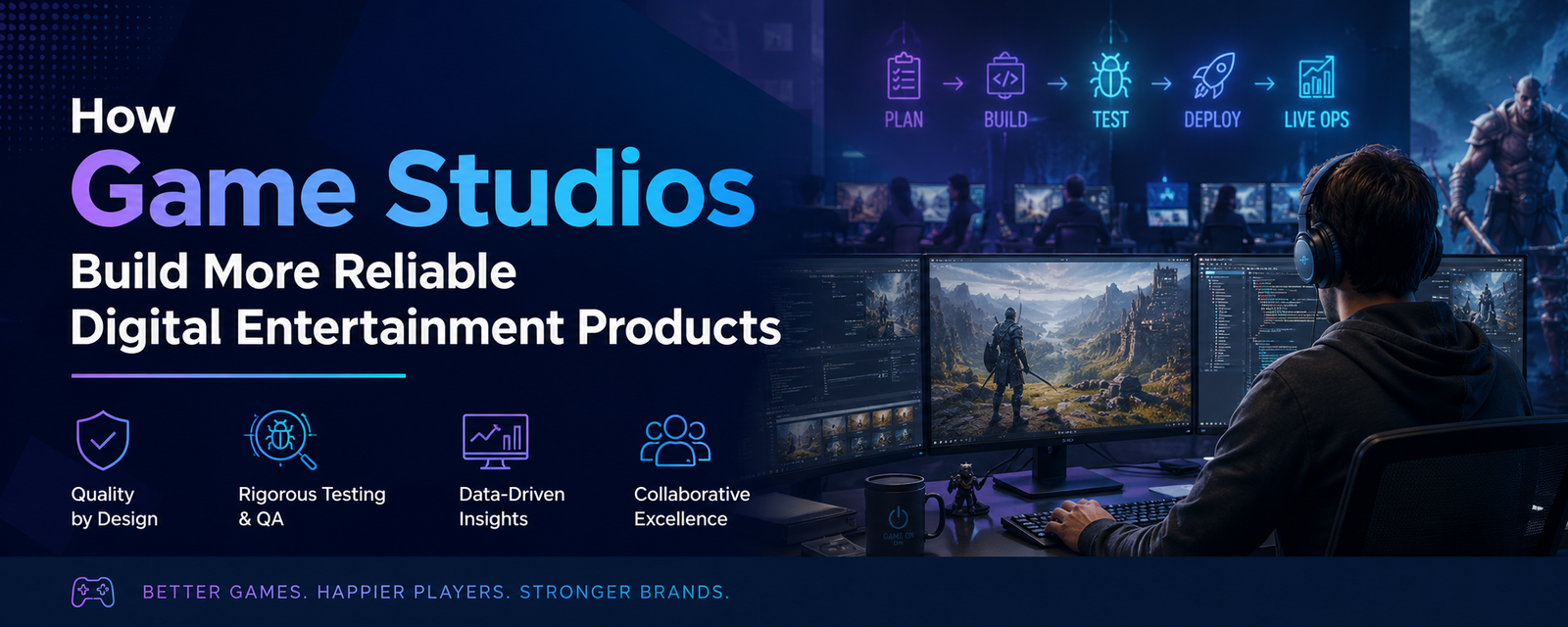
How Game Studios Build More Reliable Digital Entertainment Products
There’s a moment every gamer knows. You’re deep in a session — focused, immersed, fully locked in — and then it happens. A stuttering frame rate. A crash that swallowed your progress. A UI so confusing you spend five minutes hunting for the exit button. Just like that, the spell is broken.
That moment costs studios far more than a single frustrated user. It costs reviews, word-of-mouth, long-term retention, and sometimes the reputation of an entire product line. Reliability, then, isn’t a technical checkbox — it’s the invisible backbone of every digital entertainment product that earns and keeps a loyal audience.
So how do the studios that consistently ship high-quality products actually do it? The answer isn’t one magic tool or one genius developer. It’s a deliberate system that runs from the first design meeting all the way through post-launch support. Let’s break it down.
Reliability Is Designed In — Not Patched In Later
One of the most expensive mistakes in game development is treating quality as something you fix at the end. Teams sprint through production, hit a deadline, and then spend the following months pushing emergency patches. Users get a broken product at launch. Studio engineers get burnout from firefighting avoidable problems. Partners lose confidence.
The studios that avoid this cycle share a common discipline: they define what “reliable” means for their specific product before a single line of code is written.
This means sitting down — before production begins — and answering hard questions:
- What devices and operating systems must this product perform flawlessly on?
- What’s the maximum acceptable load time on a mid-range mobile device?
- How will the product behave when a user’s connection drops mid-session?
- What does graceful failure look like — for crashes, for errors, for edge cases?
Teams that answer these questions early build those answers into their architecture. Those that don’t discover the answers the hard way during QA, or worse, after launch.
Also Read : AKOOL AI vs VEED: Best Tool for AI Videos and Avatars
The Structure Behind Consistent Quality
High-performing studios don’t rely on individual brilliance to carry their products. They build processes that make quality the default output — even on tight timelines, even when key team members rotate out.
What does that structure look like in practice?
Creative direction documented before development begins. Vague creative briefs are a leading cause of mid-production rework. When the visual style, tone, audience, and core experience pillars are captured in writing and signed off by every department lead, teams spend less time arguing about direction and more time executing it.
Technical specifications that exist as living documents. Not a PDF that collects dust after kickoff, but a document that gets updated as the project evolves — tracking changes to scope, platform targets, and performance benchmarks. This single artifact prevents the kind of “I thought we already decided this” conversations that quietly drain weeks from a schedule.
Testing that happens in every sprint, not just at the end. Continuous integration and automated test suites catch regressions the moment they’re introduced. A bug caught on day three costs a fraction of what the same bug costs on day ninety. This isn’t a new idea — it’s just one that some studios still resist because it feels slow at first, even though it saves enormous time overall.
Structured communication rituals between creative and technical teams. Designers and developers often speak different professional languages. Without structured sync points — not optional Slack threads, but scheduled reviews with shared outputs — the gap between what was designed and what was built quietly widens until it becomes a redesign project.
Also Read : Can AI Build an Entire Advertising Campaign Without Human Designers?
The Design-Performance Paradox
Here’s a tension every game studio navigates: players want beautiful products, and beautiful products can be expensive to run.
High-polygon environments. Complex particle effects. Layered audio. Smooth 60fps animations. These things cost processing power. On a flagship desktop with a dedicated GPU, they sing. On a three-year-old mid-range phone with a warm battery, they stutter.
The studios that solve this don’t choose between quality and performance — they engineer both. Their approach usually involves a few key practices.
Asset tiering. High-resolution textures and effects load for users whose hardware supports them. Lighter versions of the same assets automatically serve to lower-spec devices. Done properly, this is invisible to the player — the experience feels consistent, even though the technical delivery differs.
Animation budgets. Not every animation needs to play at full fidelity in every context. Studios that define animation “budgets” — maximum frame costs per screen, per interaction type — prevent the cascading slowdowns that happen when every designer independently adds “just one more effect.”
Sound design with fallback paths. Audio is frequently underestimated as a performance variable. Compressed audio formats, dynamic mixing that reduces track counts on lower-end hardware, and clearly defined audio priority hierarchies all contribute to a product that sounds great without demanding premium hardware.
The underlying principle is this: design sets the creative target, and engineering builds the delivery system that hits that target across the widest possible device range.
Also Read : Best Social Media Advertising Services in 2026
What a Pre-Launch Quality Review Actually Covers
Many teams treat the pre-launch review as an extended bug hunt. That’s not wrong — but it’s incomplete.
A thorough pre-launch review examines the product from two distinct perspectives: the technical and the experiential.
Technical review checks:
- Load performance on the slowest device tier the product officially supports
- Consistent behavior across the full matrix of target operating systems and browsers
- Memory management under extended play sessions (memory leaks show up at the two-hour mark, not the ten-minute mark)
- Crash logging and error reporting pipelines verified and active
- Network failure handling: what happens when connectivity drops, degrades, or fluctuates?
Experiential review checks:
- First-time user flow: can someone who has never seen the product complete the core loop without external guidance?
- Navigation clarity: are all menus, prompts, and calls-to-action immediately legible and logically placed?
- Visual consistency: do fonts, colors, icon styles, and animation rhythms feel like they belong to the same product?
- Audio balance: do sound effects, music, and UI feedback feel cohesive rather than layered by three different contractors who never spoke to each other?
- Accessibility baseline: does the product meet minimum contrast ratios? Can core functions be completed without sound? Are text sizes legible on small screens?
Studios that conduct both reviews before launch ship products that feel finished. Those that skip the experiential layer often ship products that are technically stable but feel rough — and players notice.
Documentation: The Infrastructure Nobody Wants to Write
Documentation has a credibility problem in game development. It feels like overhead. It doesn’t show up in the demo. It doesn’t generate excitement in a trailer. And yet, studios that treat documentation as a first-class deliverable consistently outperform those that don’t.
Here’s why it matters more than most developers admit.
Integration partners depend on accurate docs. If another platform, publisher, or operator is integrating your product into their ecosystem, they are working from your documentation. Errors in that documentation become their integration errors — and those errors damage relationships that can take years to build.
New team members onboard faster. Turnover is real. Markets shift. People leave. A product with solid internal documentation can absorb a key departure without catastrophic knowledge loss. One without it loses months to re-discovery every time the roster changes.
Future updates become less risky. A well-documented codebase and architecture makes it dramatically easier to understand the ripple effects of any change. This is the difference between a studio that ships quarterly updates confidently and one that dreads every patch because anything could break anything.
Post-Launch Isn’t the End — It’s a Different Phase
The digital entertainment products that earn lasting reputations are almost never the ones that were perfect at launch. They’re the ones that improved consistently after launch, in ways that felt responsive to how real people were actually using them.
This requires a post-launch infrastructure that most studios underinvest in:
Performance monitoring dashboards that surface real user data — not just crash reports, but session lengths, drop-off points, latency distributions, and device-specific behavior patterns.
Structured feedback intake from players, partners, and operators — not just a support inbox, but a triage system that categorizes issues, identifies patterns, and routes them to the right team with appropriate priority.
A cadenced update cycle that players and partners can anticipate. “We release meaningful updates on the first Tuesday of every month” builds more trust than “we push fixes whenever they’re ready,” even if the total output is identical.
A post-mortem culture that treats each major update as a learning opportunity. What worked? What created new problems? What did the data show that the team didn’t predict? Studios that ask these questions after every cycle get measurably better at shipping reliable updates over time.
The Human Factor in Technical Reliability
All of this — the architecture decisions, the testing pipelines, the documentation standards — is executed by people. And people work better when the systems around them reduce friction and clarify accountability.
The most technically sophisticated studio on earth will ship an unreliable product if its teams are siloed, its expectations are ambiguous, or its culture treats quality as someone else’s job.
Reliable products come from teams where:
- Every department understands the product’s reliability targets, not just the engineering leads
- QA is treated as a partner in building quality, not a filter at the end of the assembly line
- Design decisions are evaluated for technical feasibility before they’re finalized, not after they’re built
- Post-launch data is shared across the full team, so everyone can see the real-world impact of their decisions
Culture isn’t soft. It’s the operational system that either reinforces or undermines every technical investment a studio makes.
Closing Thought
Reliability in digital entertainment isn’t glamorous. Players rarely celebrate a product for loading quickly, staying stable during a two-hour session, or handling a dropped connection gracefully. They simply enjoy the experience without interruption — which is the whole point.
The studios that consistently deliver that experience aren’t doing so through luck or exceptional individual talent. They’re doing it through deliberate process, clear standards, honest post-launch learning, and a shared understanding that quality is everyone’s responsibility from day one.
Build reliability into the foundation. Protect it through rigorous testing. Extend it through responsive post-launch support. And treat every shipped product as both an achievement and a starting point for what comes next.