
Best Social Media Advertising Services in 2026: Top Companies, Pricing & Free Tools Compared
Quick Answer
The best social media advertising services companies in 2026 combine paid media execution with creative testing and revenue-based reporting, not just follower growth. Budgets typically run $750–$2,500/month for small business starter packages, $5,000–$15,000/month for mid-market programs with paid + organic + creative testing, and $15,000–$50,000+/month for enterprise retainers — ad spend is always billed separately. For tight budgets, free tools like Buffer, Metricool, and Canva can cover basic scheduling and design, but they don’t replace strategic ad management. The right choice depends on your budget, platform priorities, and whether you need a full agency or just creative/scheduling support.
Picking a social media advertising partner in 2026 feels a lot harder than it used to. Every agency website claims to be “data-driven,” every pricing page is vague about what’s actually included, and the gap between a $750/month package and a $25,000/month retainer can feel impossible to justify from the outside.
This article breaks that down. Below, you’ll find a side-by-side comparison of the top social media advertising services companies operating today, an honest look at what social media management services packages actually include at each price point, where free social media advertising services genuinely make sense, and dedicated picks for eCommerce sellers, content creators, in-house marketers, and small businesses. We’ve also covered the career and salary side of the industry, since “social media advertising services jobs” is one of the most-searched terms tied to this space.
Also Read : White Label Web Design Services
How We Evaluated These Social Media Advertising Companies
Rather than ranking agencies purely on size or name recognition, we looked at five things that actually predict whether a partnership will work out:
- Pricing transparency — do they publish ranges, or make you guess?
- Platform depth — real experience across Meta, TikTok, LinkedIn, Pinterest, and YouTube, not just one channel dressed up as “full service”
- Creative testing process — a structured way to test and refresh ad creative, since stale creative is the single biggest driver of rising costs
- Reporting that ties to revenue — not just impressions and likes
- Fit by business size — whether the agency actually serves your stage, instead of treating a $3,000/month client like a rounding error
Top Social Media Marketing Companies Compared
| Agency | Founded | Headquarters | Best For | Starting Price/Month* |
|---|---|---|---|---|
| Silverback Strategies | 2007 | Washington, DC | Mid-market/enterprise brands needing paid social tied to measurement | $10,000+ |
| Sociallyin | 2011 | Atlanta, GA | Visual-first brands needing in-house creative production | $1,500–$10,000 |
| LYFE Marketing | 2011 | Atlanta, GA | Small businesses on a tight budget | $750–$3,000 |
| Fresh Content Society | 2014 | Northfield, IL | Brands needing high-volume content operations | $10,000+ |
| NoGood | 2017 | New York, NY | Startups/scaleups wanting growth-marketing rigor | $10,000–$25,000 |
| Ninja Promo | 2017 | New York, NY | Tech, crypto, and global brands wanting one full-service vendor | $5,000–$25,000+ |
| Sculpt | 2012 | Iowa City, IA | B2B and SaaS brands prioritizing LinkedIn | $5,000–$15,000 |
| WideFoc.us | 2007 | Denver, CO | eCommerce and Pinterest-heavy catalogs | $3,000–$10,000 |
| Viral Nation | 2014 | Toronto/Global | Large-scale influencer and creator campaigns | $25,000+ |
| Quimby Digital | — | Avon Lake, OH | CPG, wellness, and SaaS brands wanting senior-led strategy | $10,000+ |
*Management fee ranges only. Ad spend, tools, and production add-ons are billed separately by almost every agency on this list.
10 Best Social Media Advertising Services Companies in 2026
1. Silverback Strategies
Silverback built its reputation on pairing paid social with a dedicated measurement and CRO team, which matters once a brand outgrows “post and pray” advertising.
- Features: Paid social across Meta, TikTok, LinkedIn, and YouTube; performance creative; incrementality testing; technical SEO add-ons
- Pricing: Enterprise-leaning retainers, generally starting at $10,000+/month
- Pros: Strong attribution and testing infrastructure; works well alongside other paid channels
- Cons: Pricing isn’t published upfront; likely overkill for very small budgets
- Best use case: A mid-market or enterprise brand that needs paid social connected to a broader revenue model
2. Sociallyin
Sociallyin operates its own photo and video studio, which is the main reason brands hire them instead of a generalist shop — they don’t outsource creative.
- Features: Social strategy, community management, in-house production, influencer coordination, paid social
- Pricing: Roughly $1,500–$10,000/month depending on platforms and production needs
- Pros: Strong on visually driven platforms like Instagram and TikTok; one vendor for content and ads
- Cons: Strategic depth can feel lighter than performance-first agencies
- Best use case: Beauty, fashion, and lifestyle brands where creative quality drives ad performance
3. LYFE Marketing
LYFE built its whole model around the businesses that bigger agencies reject — accounts with a few thousand dollars a month to spend, not a few hundred thousand.
- Features: Bundled organic + paid social, short-form video management, PPC, email marketing
- Pricing: Entry packages from around $750/month, scaling to roughly $3,000/month for combined content + ads
- Pros: Genuinely affordable; transparent reporting; dedicated account manager even on smaller plans
- Cons: Less depth on advanced measurement or enterprise-scale creative testing
- Best use case: Small businesses that need both content and paid ads without a five-figure commitment
4. Fresh Content Society
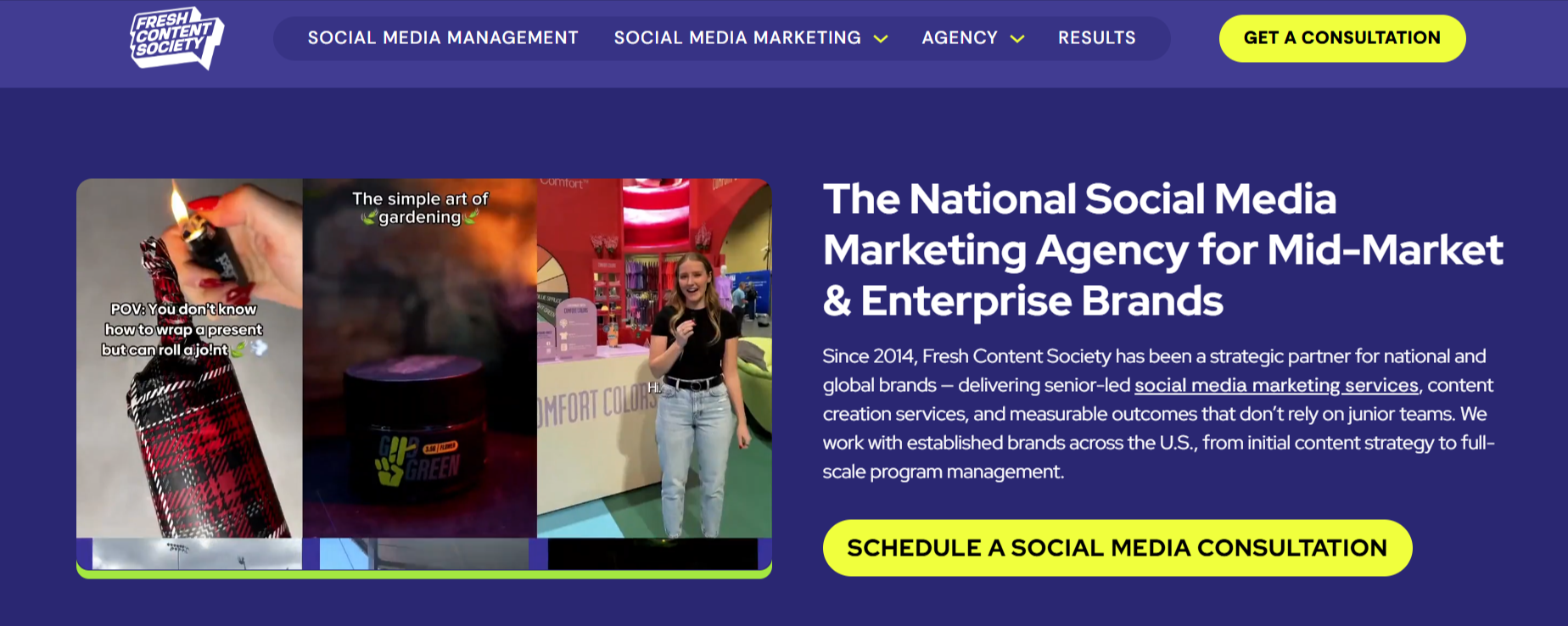
This agency is built for operational consistency — brands like KFC and American Apparel hire them when they need repeatable, governed content output, not just creative bursts.
- Features: Content strategy and production, influencer coordination, community engagement, paid social
- Pricing: Mid-market to enterprise, typically $10,000+/month
- Pros: Strong process and governance for multi-stakeholder approval chains
- Cons: Better suited to brands with existing budget than early-stage startups
- Best use case: Established brands that need consistent content volume across several platforms
5. NoGood
NoGood positions itself as a growth team rather than a traditional social shop, blending creative, media buying, and experimentation into one sprint-based process.
- Features: Performance creative, paid social and search, conversion rate optimization, rapid experimentation
- Pricing: Mid to high five figures monthly
- Pros: Strong for brands that want speed and iteration over polished, slow-moving campaigns
- Cons: Pricing puts it out of reach for small businesses
- Best use case: Funded startups and scaleups in SaaS, healthcare, or fintech that need to move fast
6. Ninja Promo
Ninja Promo runs as a global, full-service shop — social, SEO, PR, design, and development under one roof — which appeals to brands that don’t want to manage five vendors.
- Features: Paid and organic social, influencer marketing, SEO, content marketing, CRO, development
- Pricing: Custom, generally $5,000–$25,000+/month depending on scope
- Pros: Broad capability set; strong track record with tech and blockchain clients
- Cons: Breadth can come at the cost of deep specialization in any one channel
- Best use case: Tech and global brands that want one agency handling multiple marketing functions
7. Sculpt
Sculpt has carved out a clear lane: B2B and SaaS brands that need LinkedIn (and increasingly Reddit) to actually generate qualified leads, not just impressions.
- Features: Organic and paid LinkedIn, executive/employee social programs, Reddit marketing, community management
- Pricing: Roughly $5,000–$15,000/month
- Pros: Genuine B2B specialization; strong on conversion-oriented creative for technical audiences
- Cons: Not the right fit for consumer or B2C brands
- Best use case: B2B and SaaS companies prioritizing LinkedIn pipeline over consumer-platform reach
8. WideFoc.us Social Media
WideFoc.us is a boutique shop with an unusually strong track record in Pinterest advertising, which makes it a sleeper pick for catalog-driven and visual eCommerce brands.
- Features: Paid social, community management, influencer marketing, thought leadership content
- Pricing: Roughly $3,000–$10,000/month
- Pros: Personalized account management; documented success with low-cost Pinterest clicks
- Cons: Smaller team means less capacity for very high-volume enterprise accounts
- Best use case: eCommerce and DTC brands that want Pinterest and Instagram shopping treated as first-class channels
9. Viral Nation
When influencer marketing isn’t a side tactic but the entire growth engine, Viral Nation’s scale is the differentiator — they run creator programs as their core product, not an add-on.
- Features: Influencer sourcing and management, talent representation, large-scale creator campaigns, social commerce support
- Pricing: Enterprise-level; usually $25,000+ per campaign or as an ongoing retainer
- Pros: Massive creator network; direct platform relationships
- Cons: Pricing and minimums put it out of range for small and mid-sized businesses
- Best use case: Enterprise brands running coordinated, multi-creator campaigns at scale
10. Quimby Digital
Quimby’s pitch is simple: senior strategists stay on the account after the contract is signed, instead of handing it off to a junior team.
- Features: Paid and organic social, creator programs, community management, full-funnel reporting tied to CAC and revenue
- Pricing: Typically $10,000+/month depending on scope
- Pros: Senior-led execution; strong fit for regulated or sensitive categories like wellness and femtech
- Cons: Premium pricing limits accessibility for smaller budgets
- Best use case: CPG, wellness, and SaaS brands that have been burned by junior-staffed agencies before
<iframe width=”560″ height=”315″ src=”https://www.youtube.com/embed/SPN13aY5O-4″ title=”Social Media Marketing Strategies That Will Rule 2026″ frameborder=”0″ allowfullscreen></iframe>
A quick look at where social platforms and ad formats are heading in 2026, useful context before you brief any agency on this list.
Social Media Management Services Packages: What’s Actually Included
This is where most confusion starts. Two agencies can both call their offer “social media management,” and mean completely different things. Here’s how the most common social media marketing services list breaks down by tier in 2026:
| Package Tier | Monthly Range | Typically Includes |
|---|---|---|
| Starter | $750 – $2,500 | 1–2 platforms, basic content calendar, light community management, monthly reporting |
| Small Business Growth | $2,500 – $6,000 | 2–4 platforms, original content creation, basic paid ad management, biweekly reporting |
| Mid-Market | $6,000 – $15,000 | Paid + organic across multiple platforms, creative testing cadence, influencer support, dedicated strategist |
| Enterprise | $15,000 – $50,000+ | Full account team, advanced measurement/CRO, high-volume video production, crisis and PR integration |
A few things to confirm before signing anything, regardless of tier:
- Is ad spend included in the quote, or separate? Almost always separate — a $2,000/month management fee plus $1,500 in ad spend is really a $3,500/month commitment.
- How many platforms and posts are actually in scope? “Social media management” can mean 12 static posts on two channels, or daily multi-platform video.
- Is pricing a flat retainer, hourly, or a percentage of ad spend? Percentage-of-spend models (commonly 10–20%) align agency incentives with your budget but can get expensive fast as you scale spend.
- Who runs the account after month one? Ask specifically whether a senior strategist stays involved or whether the account gets handed to a junior coordinator.
Free Social Media Advertising Services & Tools Worth Using
Not every business needs (or can afford) an agency on day one. If you’re bootstrapping, these free social media advertising services and tools can cover the basics:
- Buffer (free plan): Connect up to 3 social accounts and schedule 10 posts per profile — enough for a solo founder testing consistency before paying for anything.
- Metricool (free plan): One brand, scheduling, and roughly three months of analytics history, which is unusually generous for a free tier.
- Canva (free plan): Drag-and-drop design for ad creative and organic posts, no design background required.
- Meta Business Suite: Native, free scheduling and basic ads management directly inside Facebook and Instagram.
- CapCut: Free short-form video editing built for Reels, TikTok, and YouTube Shorts.
- Google Analytics & Microsoft Clarity: Both completely free, and essential for tracking whether social traffic is actually converting once it reaches your website.
The honest limitation: free tools handle scheduling, design, and basic tracking, but they don’t replace strategy, paid media expertise, or creative testing at scale. Most businesses graduate from a free-tool stack to a paid tool (often $15–$50/month) or a small agency retainer once social starts driving measurable revenue.
Best Social Media Advertising Picks by Who You Are
For eCommerce Sellers
Social commerce stopped being a “nice to have” — US social commerce sales crossed roughly $87 billion in 2025 with double-digit year-over-year growth, and TikTok Shop alone is generating tens of billions in annual sales. If you’re running a Shopify or marketplace store, prioritize agencies with documented experience in product feed integration, Instagram/Facebook Shop setup, and TikTok Shop management. WideFoc.us and Sociallyin both have strong catalog-driven experience; LYFE Marketing is the better fit if your ad budget is still under $5,000/month.
For Content Creators & Solo Brands
If you’re a creator building your own audience rather than hiring a full agency, you likely don’t need a $10,000/month retainer — you need lean tools and possibly a freelancer for editing or paid ad setup. A free Buffer or Metricool plan plus a part-time freelance video editor often outperforms a full agency relationship at this stage, both on cost and creative authenticity.
For Marketers & In-House Teams
If you already have a marketing team but need extra capacity, look for agencies offering white-label fulfillment or fractional support rather than a full retainer — this lets your existing team keep strategic control while outsourcing production or paid media execution. This is also where enterprise tools like Sprout Social or Hootsuite earn their higher price tags, since they integrate social data directly into broader reporting dashboards.
For Small Businesses & Local Brands
Local service businesses (contractors, clinics, restaurants) generally do better with bundled local marketing packages that combine social ads with Google Business Profile management and review generation, rather than a social-only specialist. Expect to pay $1,000–$5,000/month for this kind of bundle, or $80–$150/hour if you go the freelancer route instead.
<iframe width=”560″ height=”315″ src=”https://www.youtube.com/embed/yau81o9ovew” title=”5 Best Marketing Strategies For Small Business 2026″ frameborder=”0″ allowfullscreen></iframe>
A practical look at budget-friendly marketing tactics small businesses are using in 2026, including paid social.
Careers in Social Media Advertising: Jobs, Salaries & Skills in Demand
If you’re researching social media advertising services jobs rather than hiring an agency, here’s the current picture. Entry-level social media specialists typically earn somewhere in the $43,000–$54,000 range, with the broader market average landing closer to $55,000–$65,000 once you include a few years of experience. Specialists working inside larger companies or in industries like pharma, finance, or tech often report total compensation well above $85,000, and senior social media marketing specialists at large organizations can clear $100,000+.
The U.S. Bureau of Labor Statistics projects faster-than-average growth for advertising, promotions, and marketing management roles through the early 2030s, with tens of thousands of openings expected annually. The skills commanding the biggest pay premiums right now:
- Short-form video editing and scripting (Reels, TikTok, Shorts)
- Paid social platform certifications (Meta Blueprint, TikTok Ads, LinkedIn Marketing Labs)
- AI-assisted content workflows — prompt writing, campaign automation, and analytics interpretation
- Cross-platform analytics and attribution, not just posting and scheduling
How to Measure Performance: KPIs That Actually Matter
A social media advertising company is only as good as the metrics it reports on. Watch for these instead of vanity numbers:
- ROAS (Return on Ad Spend): Revenue generated per dollar spent on ads
- CAC (Customer Acquisition Cost): Total cost to acquire one paying customer through the channel
- CPM trends: Average cost per 1,000 impressions has climbed in recent years across most platforms, making creative efficiency more important than ever
- MER (Marketing Efficiency Ratio): Total revenue divided by total marketing spend, useful for judging overall channel health
- LTV:CAC ratio: Whether the customers you’re acquiring are worth more than it costs to get them, over time
If an agency’s monthly report leads with reach, likes, and impressions and stops there, that’s a red flag — not because those numbers are meaningless, but because they don’t tell you whether the spend is working.
Alternatives to Hiring a Social Media Advertising Agency
An agency isn’t the only path. Depending on your stage:
- DIY with free/low-cost tools: Best for very early-stage businesses with more time than budget
- Freelancers: Typically $25–$100+/hour depending on specialization; good for businesses needing specific skills (paid media setup, video editing) without a full agency commitment
- In-house hire: A dedicated social media manager runs roughly $55,000–$95,000 in salary plus benefits — worth it once social becomes a primary growth channel
- Fractional/part-time specialists: A middle ground between a freelancer and a full agency, often billed hourly or on a small retainer
- Full-service agency: The right call once you need multi-platform strategy, paid media expertise, and creative testing running simultaneously
Common Mistakes Businesses Make When Buying These Services
- Comparing management fees without comparing scope. A $1,500/month quote and a $6,000/month quote aren’t competing offers if one includes paid ads and the other doesn’t.
- Ignoring ad spend minimums. Some agencies won’t take you on below a certain monthly ad budget — ask upfront.
- Skipping a trial period. A 60–90 day pilot tied to a specific metric (leads, CAC, revenue) protects you from a year-long contract with an underperforming partner.
- Assuming bigger always means better. A boutique agency with senior staff often outperforms a large firm where your account is a rounding error.
Frequently Asked Questions
How much do social media advertising services typically cost in 2026? Most small businesses spend $750–$6,000 per month on management fees, mid-market brands spend $6,000–$15,000, and enterprise programs run $15,000–$50,000+. Ad spend is billed on top of all of these ranges in almost every case.
What’s included in a standard social media management services package? At minimum: content planning and scheduling, basic community management, and monthly reporting. Paid advertising, video production, and influencer coordination are usually separate line items or higher-tier add-ons.
Are free social media advertising services actually usable for a real business? Yes, for basic scheduling, design, and light analytics — tools like Buffer, Canva, and Metricool’s free tiers cover real ground. They won’t run paid ad strategy or creative testing for you, though.
What’s the difference between social media marketing and social media advertising? Social media marketing covers organic content, community management, and strategy. Social media advertising specifically refers to paid campaigns — boosted posts, Meta/TikTok ad campaigns, and similar paid placements. Most agencies on this list offer both.
Can a small business realistically compete with bigger brands on paid social? Yes, especially on platforms like Pinterest and TikTok where costs per click can still be low relative to Meta. Tight audience targeting and consistent creative testing matter more than raw budget size.
What kind of jobs and salaries exist in social media advertising? Roles range from entry-level social media coordinators (roughly $43,000–$54,000) to senior specialists and managers at larger companies (often $85,000–$120,000+), with strong demand for short-form video and paid media skills.
How long before I see results from a new social media advertising company? Expect 30–60 days for onboarding, audience research, and initial creative testing. Meaningful, repeatable results usually show up in the 60–90 day window, assuming budget and creative supply are sufficient.
Should I choose an agency by location or by specialization? Specialization almost always matters more than geography. A remote agency with deep eCommerce or B2B experience will usually outperform a local generalist, unless your business depends heavily on local search and community presence.
Final Verdict
There’s no single best social media advertising company for everyone — the right pick depends entirely on budget and business model. For most small businesses, LYFE Marketing offers the clearest path to affordable, bundled service. eCommerce brands leaning on visual platforms should look hardest at Sociallyin or WideFoc.us. B2B and SaaS companies belong with a LinkedIn specialist like Sculpt, while funded startups chasing growth metrics should talk to NoGood. Enterprise brands that need measurement built into every campaign are better served by Silverback Strategies or Quimby Digital, and anyone running creator-led campaigns at scale should start with Viral Nation.
If you’re not ready for any retainer yet, that’s a legitimate stage too — start with the free tools above, prove out what content and ad formats actually convert for your audience, and bring that data to an agency conversation once you’re ready to scale. That single step tends to produce far better agency relationships than walking in with budget but no baseline.