
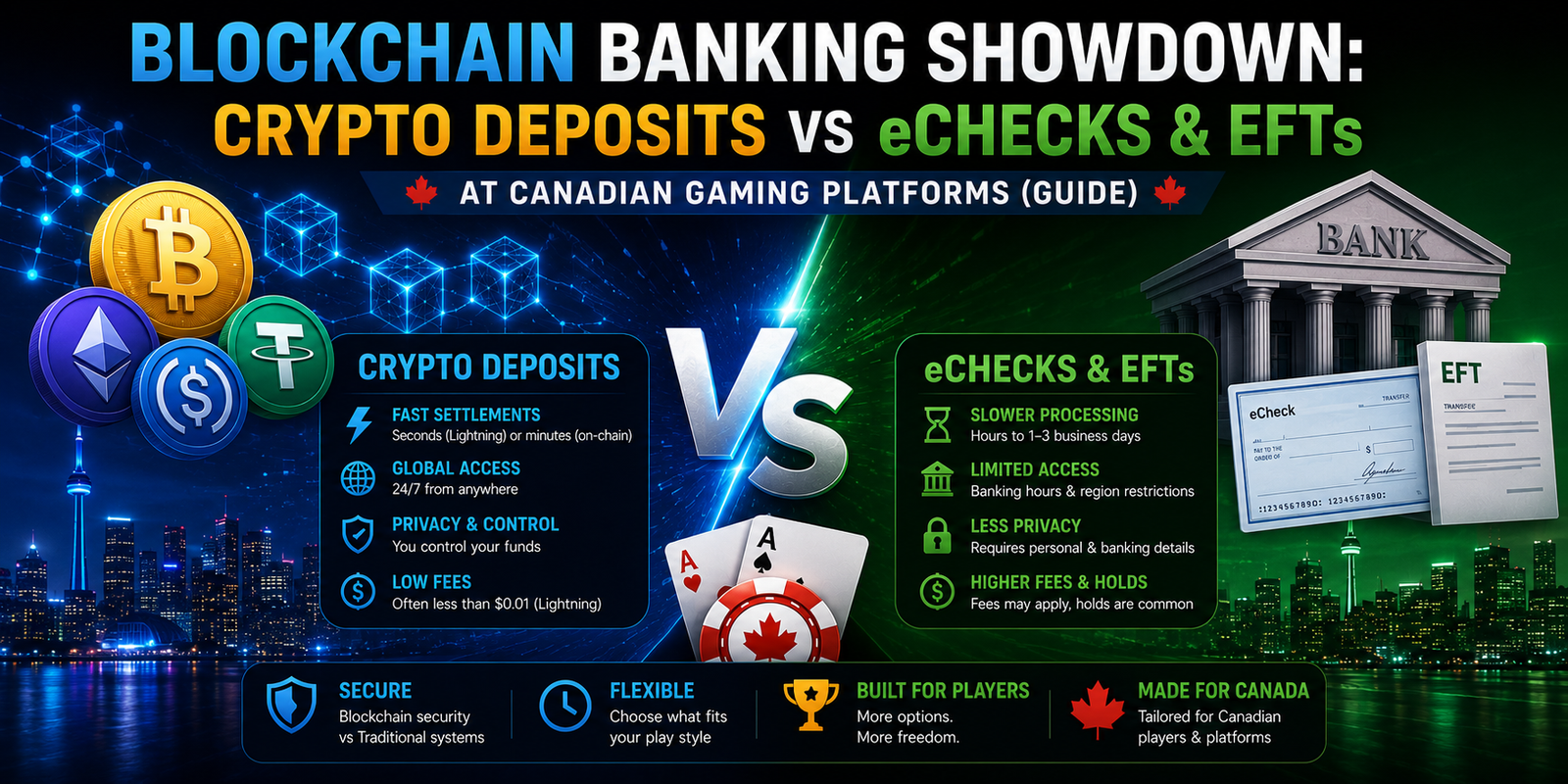
Blockchain Banking Showdown: Crypto Deposits vs eChecks & EFTs at Canadian Gaming Platforms (2026 Guide)
Quick Answer (AI Overview Style): Blockchain banking refers to moving money using decentralized, cryptographically verified networks (like Bitcoin, the Lightning Network, or stablecoins) instead of routing it through a bank’s core system.
At Canadian gaming platforms, crypto deposits settle in seconds for fractions of a cent, but Ontario’s regulated AGCO/iGaming Ontario market does not permit licensed operators to accept cryptocurrency at all. Instead, only eChecks and EFTs, including Interac e-Transfer, Loonio, and Gigadat, are allowed.
Offshore and Kahnawake-licensed crypto casinos fill the gap for players who prefer digital-asset banking. Meanwhile, Canada’s new Real-Time Rail (RTR), launching in phases through 2026–2027, is expected to narrow the speed gap between traditional banking systems and blockchain payment networks even further.
Introduction
If you’ve deposited money at a Canadian online casino or sportsbook in the last year, you’ve probably noticed the cashier page looking more crowded than it used to. Interac e-Transfer sits next to Bitcoin. Visa sits next to USDT. A “Loonio” button has appeared out of nowhere. And somewhere in the terms and conditions, there’s usually a line about which province you’re playing from — because that, more than almost anything else, decides which of these payment rails you’re actually allowed to use.
This is the real story of blockchain banking in Canadian iGaming in 2026: it isn’t a simple “crypto vs. banks” fight. It’s a patchwork shaped by provincial regulation, bank infrastructure modernization, and a genuine technology race between Bitcoin’s Lightning Network and Canada’s long-awaited Real-Time Rail. This guide breaks down how crypto deposits actually compare with eChecks and EFTs at Canadian gaming sites — fees, speed, security, regulation, and who each method is really built for — using the most current 2026 data available, not recycled 2022-era assumptions.
What Is Blockchain Banking, Exactly?
Blockchain banking describes any financial activity — deposits, withdrawals, settlement, custody, even loan issuance — that runs on a distributed ledger instead of a centralized bank database. Instead of your bank’s server being the single source of truth, a network of independent computers verifies and timestamps every transaction using cryptography, and the resulting record is extremely difficult to alter after the fact.
In a gaming context, this mostly shows up as:
- Direct cryptocurrency deposits (Bitcoin, Ethereum, Litecoin, and increasingly stablecoins like USDT and USDC)
- Layer-2 settlement networks, especially the Bitcoin Lightning Network, which routes payments off-chain for near-instant, near-free transfers
- Tokenized fiat and tokenized deposits, an institutional trend where banks themselves are starting to represent CAD or USD balances as on-chain tokens for faster interbank settlement
Outside of gaming, blockchain banking is also reshaping mainstream finance — major banks are piloting tokenized bonds, tokenized money-market funds, and blockchain-based interbank settlement rails. But for the average Canadian player deciding how to fund a casino account, the practical question is simpler: does crypto get my money in faster and cheaper than my bank does, and is it even legal to use where I live?
How Crypto Deposits Actually Work at Canadian Gaming Sites
When you deposit Bitcoin or a stablecoin at a crypto-friendly gaming platform, the casino’s cashier generates a unique wallet address or, increasingly, a Lightning invoice. You send funds from your own wallet, the network confirms the transaction, and your casino balance updates automatically.
Two architectures dominate in 2026:
- On-chain transactions — the traditional way crypto moves. Bitcoin on-chain transfers typically need one to several block confirmations, which can take anywhere from a few minutes to over an hour during network congestion, with fees that fluctuate from under a dollar to $20+ depending on traffic.
- Lightning Network transactions — an off-chain Layer-2 protocol that has matured rapidly through 2025–2026. Production deployments now report end-to-end settlement averaging under two seconds, with routing fees frequently below one cent per transaction regardless of the amount sent. A growing share of crypto casinos — industry trackers put it at roughly two-thirds of major Bitcoin-accepting operators by mid-2026 — now support Lightning for at least deposits, with several offering bidirectional Lightning withdrawals as well.
Stablecoins add a third wrinkle: because Tether (USDT) and USD Coin (USDC) are pegged to the US dollar, players get blockchain-speed settlement without the price-swing anxiety of holding Bitcoin between a deposit and a cash-out. Some Lightning implementations now even carry stablecoin balances over Lightning rails via protocols like Taproot Assets, combining dollar stability with sub-second settlement.
Also Read : Jilo Viral Exposed: Free Streaming Sensation, Hidden Risk, or Both?
How eChecks and EFTs Actually Work
Electronic Funds Transfers (EFTs) and eChecks are the digital descendants of paper banking. An EFT moves money directly between bank accounts through established clearing networks; an eCheck authorizes a one-time electronic debit from your account, mimicking a paper check without the mail delay.
In Canada specifically, this category is dominated by a few well-known names:
- Interac e-Transfer — by far the most widely used method, built on infrastructure that most major Canadian banks (TD, RBC, BMO, Scotiabank, CIBC, Desjardins) support natively. Deposits are typically near-instant; withdrawals usually take one to three business days. Daily sending limits commonly sit around $3,000 at major banks, with Desjardins allowing up to $5,000.
- Loonio, Gigadat, and Payper — third-party processors that sit on top of Interac’s rails to streamline the casino-specific experience. Loonio, for example, presents a simplified “Pay by Bank” interface instead of requiring manually typed routing numbers, and its deposits generally can’t be charged back — a meaningful upgrade over older eCheck flows.
- Traditional eCheck — now a shrinking niche. Industry trackers estimate fewer than 15% of Canadian-facing online casinos still support true eCheck processing in 2026, as operators prioritize faster Interac-based rails instead.
Crypto vs eCheck vs EFT: Side-by-Side Comparison
| Factor | Crypto / Blockchain Deposits | EFT (Interac e-Transfer / Loonio) | Traditional eCheck |
|---|---|---|---|
| Typical deposit speed | Seconds (Lightning) to ~60 minutes (on-chain BTC) | Near-instant to ~30 minutes | Minutes, but account verification can add delay |
| Typical withdrawal speed | Seconds to a few minutes (Lightning); slower for on-chain BTC | 1–3 business days (sometimes 30 min–24 hrs via Loonio) | Up to 3 business days |
| Typical fees | Under $0.01 (Lightning) to $2–$20 (on-chain, congestion-dependent) | Often free at major banks; $1.00–$1.50 per send at BMO/CIBC | Usually free at the bank level |
| Available at iGO/AGCO-licensed Ontario sites | No — not permitted under current Funds Management Standards | Yes — primary supported method | Rarely offered |
| Available at offshore/Kahnawake-licensed sites | Yes, widely | Yes, widely | Limited, declining |
| Identity verification depth | Often more scrutiny above CAD $1,000 (Travel Rule) | Standard KYC tied to your bank login | Standard KYC, plus account “vetting” period at many sites |
| Chargeback risk for the operator | None — irreversible once confirmed | Low with modern rails (Loonio is chargeback-proof); some legacy eCheck risk | Possible, though uncommon |
| Currency stability | Volatile unless using a stablecoin | Stable (CAD) | Stable (CAD) |
| Best for | Privacy-conscious players, frequent depositors, those outside Ontario’s regulated market | Mainstream Canadian players wanting bank-grade familiarity | Players who specifically prefer bank-routed withdrawals |
Updated 2026 Pricing & Fee Breakdown
Fee structures shifted meaningfully over the past 18 months, and a lot of older comparison articles are now out of date. Here’s where things actually stand:
Crypto / Lightning Network:
- Lightning routing fees: typically under $0.01 per transaction, independent of the amount sent (production pilots report figures as low as 0.0029% of transaction value).
- On-chain Bitcoin fees: roughly $2–$20, scaling with network congestion — this is why most casinos now push smaller deposits and withdrawals toward Lightning rails specifically.
- Minimum economical deposit: as low as $5–$10 via Lightning versus $50–$100 minimums often imposed on-chain to avoid fees eating the deposit.
Interac e-Transfer:
- TD eliminated e-Transfer fees in July 2025; RBC, Tangerine, and Simplii offer free unlimited transfers.
- BMO charges roughly $1.00 per send, CIBC around $1.50, though premium account tiers waive this.
- Casinos themselves generally absorb processing costs and don’t pass on a separate deposit fee.
Loonio / Gigadat / Payper (modern EFT processors):
- No conversion fees, since everything stays in CAD.
- Some platforms still levy a small fee on cancelled or refunded transactions, so confirming details before submitting matters.
Traditional eCheck:
- Typically fee-free at the bank level, but increasingly hard to find as a supported option at newer casino launches.
The directional trend for 2026 is clear: both rails are converging toward “fast and nearly free” — crypto via Lightning, traditional banking via Interac’s flat-fee shift and the incoming Real-Time Rail.
Performance Analysis: Speed, Uptime, and Reliability

Numbers tell the story better than marketing copy here:
- A 30-day production pilot of Lightning-based casino payouts processed 88.2 BTC across 237,000 payments with a 99.94% success rate and an average end-to-end settlement of 1.86 seconds.
- On-chain Bitcoin remains comparatively slow: confirmations of 10–60 minutes are still normal during busy network periods, and withdrawal minimums of $50–$100 are common specifically to offset fixed miner fees.
- Interac e-Transfer deposits are described by most Canadian operators as “instant” once automated cashier integration is in place, with manual fallback processes adding up to 30 minutes.
- Interac withdrawals still typically run 1–3 business days, the same window traditional EFTs have used for years — this is the single biggest performance gap crypto currently wins on for cash-out speed.
- Failure rates differ too: Lightning routing failures hover around 2–4% in independent testing (almost always resolved by an automatic retry within 60 seconds), while bank-rail failures are rarer but resolve far more slowly when they do occur (often requiring support tickets).
The practical takeaway: crypto — specifically Lightning-enabled crypto — currently wins decisively on raw withdrawal speed. Traditional banking wins on reliability predictability and on requiring zero technical setup.
Security: Two Very Different Trust Models
Traditional banking security rests on regulatory oversight, deposit insurance frameworks, fraud monitoring, and the ability to reverse a fraudulent transaction after the fact. Your bank, not you, carries much of the operational security burden.
Blockchain security rests on cryptography and irreversibility. Once a confirmed transaction settles, it cannot be undone — which eliminates chargeback fraud entirely but also means a mistyped wallet address or a compromised private key can mean permanently lost funds, with no customer service line to call.
Neither model is objectively “safer” in every scenario. Centralized systems concentrate risk into large institutions that are attractive, well-defended targets. Decentralized systems push security responsibility onto the individual user — which is empowering for some and genuinely risky for others, particularly anyone new to managing seed phrases and wallet backups.
Pros and Cons
Crypto Deposits
✅ Near-zero fees via Lightning Network ✅ Fastest withdrawal speed available at offshore/Kahnawake-licensed sites ✅ No chargebacks for operators, which often translates into fewer account restrictions for players ✅ Greater financial privacy — transactions don’t appear on a bank statement ✅ Not subject to Canadian bank gambling-transaction blocks
❌ Not legal at iGaming Ontario/AGCO-licensed operators ❌ Price volatility unless using a stablecoin ❌ Requires wallet management know-how; lost keys mean lost funds ❌ Can trigger more identity verification above CAD $1,000 under FINTRAC’s Travel Rule ❌ Large transactions ($5+ on Lightning) have a meaningfully higher failure rate
eChecks and EFTs
✅ Fully supported at every regulated Ontario operator ✅ Familiar, no new software or wallets required ✅ CAD-native — zero currency conversion exposure ✅ Strong consumer protection and dispute resolution through your bank and the AGCO ✅ Increasingly fast deposits thanks to Loonio/Gigadat-style processors
❌ Withdrawals still typically take 1–3 business days ❌ Daily sending limits ($3,000–$5,000) can frustrate high-volume players ❌ Some banks still charge small per-transfer fees ❌ True eCheck support is disappearing from Canadian casino cashiers
The Canadian Regulatory Reality Most Articles Miss
Here’s the detail that changes the entire conversation for Canadian players, and it rarely gets mentioned: Ontario’s regulated iGaming market does not allow crypto deposits at all. The AGCO’s Funds Management Standards state plainly that cryptocurrency is not legal tender at registered operators and cannot be accepted. As of early 2026, only one iGO-registered operator (Toppz) even attempted a crypto-adjacent identity, and it accepts CAD exclusively.
This isn’t a minor footnote — it’s the reason Canada is “conspicuously absent” from global Lightning Network casino adoption leaderboards despite the technology’s explosive growth elsewhere. Mainstream Ontario players are, by regulatory design, funneled toward Interac-based fiat rails. Players who want blockchain banking at a Canadian-facing gaming site have to go outside the AGCO/iGO perimeter entirely — to operators licensed by the Kahnawake Gaming Commission, Malta Gaming Authority, or Curaçao, which legally serve Canadian residents in provinces without their own competitive licensing regime (everywhere except Ontario, essentially).
There’s a second twist that surprises a lot of players: a crypto deposit can actually involve more identity disclosure than an equivalent Interac transfer. FINTRAC’s Travel Rule applies to crypto transfers above CAD $1,000 in many operator setups, layering verification metadata onto transactions that a same-size bank transfer wouldn’t trigger. “Crypto equals more anonymous” is true relative to a card statement, but it isn’t automatically true relative to your existing banking relationship.
Outside Ontario, the picture fragments further. British Columbia’s PlayNow and Quebec’s Espacejeux are Crown-corporation monopolies that don’t accept crypto and show no signs of changing course. Alberta is the one to watch — its iGaming Alberta Act passed in 2025, with a competitive operator framework expected to open through 2026 that more closely resembles Ontario’s model than BC’s or Quebec’s.
The Real-Time Rail: Canada’s Answer to Blockchain Speed
While crypto has been winning on settlement speed, Canada’s traditional banking infrastructure isn’t standing still. Payments Canada’s Real-Time Rail (RTR) is a 24/7/365 instant-payments system built on the modern ISO 20022 messaging standard, with phased rollout expected through late 2026 and into 2027.
Once live, RTR promises to settle eligible bank-to-bank transfers in seconds rather than days — directly attacking the multi-day withdrawal wait that has long been EFT’s biggest weakness against crypto. It will run alongside Interac e-Transfer rather than replacing it, and early access is being extended to fintechs and payment service providers (including names like Wise, KOHO, and Float), not just the big banks.
Whether RTR closes the gap with Lightning Network speeds in gaming cashiers specifically depends on how quickly operators integrate it — historically, Canadian iGaming sites have lagged behind general payments infrastructure by a year or more. But the direction is unmistakable: 2026–2027 is shaping up as the period where traditional Canadian banking finally gets blockchain-competitive settlement speed, without requiring players to touch a crypto wallet at all.
Use Cases: Who Should Actually Use Which Method
- A casual Ontario-based player who wants a regulated, dispute-resolution-backed experience: Interac e-Transfer (or Loonio/Gigadat) is your only realistic option, and it’s a genuinely solid one in 2026.
- A privacy-focused player outside Ontario comfortable managing a wallet: a Kahnawake- or MGA-licensed crypto casino with Lightning support offers the fastest, cheapest withdrawals available anywhere in the market.
- A high-roller moving large sums regularly: traditional EFT rails currently offer more predictable large-transaction handling, since big crypto transfers (especially over Lightning) see higher failure rates.
- Someone who dislikes volatility but wants crypto’s speed: stablecoin deposits (USDT/USDC) split the difference effectively.
For eCommerce Sellers
Sellers operating storefronts that also process gaming-adjacent payments — affiliate payouts, prize fulfillment, digital goods tied to gaming platforms — increasingly see the same fork in the road. Crypto settlement (particularly stablecoins) eliminates cross-border card-processing fees and chargeback exposure, which matters enormously for sellers running thin margins on digital products. EFT rails remain preferable when a Canadian customer base expects familiar checkout language and dispute protections. The practical move for most sellers in 2026 is offering both and letting checkout conversion data decide where to invest further integration effort.
For Content Creators
Creators monetizing through tips, subscriptions, or platform payouts are watching the same blockchain-vs-bank tension play out in their own income streams. Crypto tipping and stablecoin payouts settle faster and sidestep platform payout delays, while EFT-based payout options (direct deposit, Interac) remain what most fans and most tax/accounting workflows expect. Creators with an international audience increasingly find that offering a crypto tipping option captures revenue that bank-only setups simply never see, without needing to fully migrate off traditional payouts.
For Marketers
For marketers promoting Canadian gaming platforms, payment-method messaging is itself a conversion lever. Audiences in Ontario respond best to messaging that foregrounds Interac, regulatory licensing, and AGCO-backed trust signals — pushing “crypto-friendly” language to Ontario traffic is not just ineffective, it can be actively misleading given the regulatory reality. Audiences in other provinces, by contrast, are far more receptive to crypto-speed messaging, since their access to a competitive regulated market doesn’t exist in the first place. Segmenting campaigns by province isn’t optional in this vertical — it’s close to a compliance necessity.
For Businesses and Operators
Operators weighing whether to build out blockchain banking rails face a genuinely different calculus depending on jurisdiction. An AGCO-bound operator gets zero benefit from crypto integration — it’s simply not permitted — so investment should go entirely toward Interac/EFT optimization (Loonio-style processors, RTR readiness) and into reducing the 1–3 day withdrawal window that remains the single biggest player complaint in the regulated market. An internationally licensed operator serving the rest of Canada, on the other hand, increasingly needs Lightning support specifically, not just generic on-chain crypto, to stay competitive on withdrawal-speed reputation — a metric crypto-native players now weigh as heavily as bonus size.
Alternatives Worth Knowing
Crypto and EFT aren’t the only two lanes. Canadian players and operators also commonly use:
- E-wallets (Skrill, Neteller, MiFinity) — faster than EFT in many cases, though they require a separate account and sometimes carry fees.
- Prepaid vouchers (Neosurf, Flexepin) — useful for strict spending control, with no bank link at all.
- Cards (Visa, Mastercard) — still widely accepted, though some Canadian banks block transactions to gambling merchants outright, a friction point Interac and crypto both avoid.
- Stablecoin-specific rails — a hybrid category growing fast in 2026, offering crypto’s speed with fiat’s price stability.
Watch: Blockchain Banking Explained
For readers who want a visual walkthrough of how blockchain-based banking actually works under the hood, two strong explainer resources are worth your time:
🎥 “What is Blockchain?” — J.P. Morgan Unpacked — a concise look at how banks themselves are using blockchain rails for settlement, separate from the cryptocurrency angle entirely.
🎥 CNBC Crypto World: What to Watch in 2026 for Digital Assets and Blockchain — a market-level view of where blockchain finance is heading this year, useful context for understanding why operators are investing in this infrastructure now.
Frequently Asked Questions
Is it legal to deposit crypto at an online casino in Ontario? No. Operators registered with iGaming Ontario and regulated by the AGCO are explicitly barred from accepting cryptocurrency as a deposit method under current Funds Management Standards. Ontario players are limited to fiat methods like Interac e-Transfer.
Can Canadians outside Ontario legally use crypto casinos? Generally yes, through internationally licensed operators (Kahnawake, MGA, Curaçao) that legally serve players in provinces without their own competitive iGaming framework. Always confirm an operator’s licensing before depositing.
Is crypto actually more private than Interac e-Transfer? It’s more private than a card statement, but not automatically more private than your bank. FINTRAC’s Travel Rule can require additional identity disclosure on crypto transfers above CAD $1,000, sometimes exceeding what an equivalent Interac transfer requires.
Why do crypto withdrawals sometimes fail? Lightning Network payments above roughly $5 have historically shown higher routing failure rates, and large on-chain transfers can also stall during network congestion. Most failures self-resolve with a retry, and funds are not lost in the process — they simply return to the sender’s wallet.
Will Canada’s Real-Time Rail make Interac obsolete? No — RTR is designed to run alongside Interac e-Transfer, not replace it. It targets the speed gap in larger, business-grade, and instant settlement scenarios, while Interac continues handling everyday consumer transfers.
Are eChecks still common at Canadian casinos in 2026? Not really. Fewer than 15% of Canadian-facing operators still support true eCheck processing, with most having shifted to Interac-based EFT processors like Loonio and Gigadat instead.
Which method has lower fees, crypto or EFT? Lightning Network crypto transactions are typically the cheapest option available, often under one cent per transaction. Interac e-Transfer is close behind, with several major banks now offering it for free and others charging $1.00–$1.50 per send.
Final Verdict
There’s no single winner here, because the two systems aren’t actually competing on a level playing field in Canada — regulation, not technology, is the deciding factor for most players. If you’re in Ontario, blockchain banking isn’t on the menu at any licensed operator, and Interac e-Transfer (especially through modern processors like Loonio) is a fast, low-fee, well-protected choice that’s only getting better as the Real-Time Rail comes online. If you’re elsewhere in Canada and comfortable managing a crypto wallet, Lightning Network deposits and withdrawals currently offer the fastest, cheapest settlement available anywhere in the gaming-payments space — provided you stick to reputable, properly licensed offshore or Kahnawake operators and treat private-key security with the seriousness it deserves.
The honest 2026 takeaway is that both rails are converging toward the same destination — instant, low-cost, 24/7 settlement — from opposite directions. Crypto got there first through Lightning. Traditional Canadian banking is getting there through the Real-Time Rail. Which one you should use today depends less on which technology you trust more, and almost entirely on which province’s mailbox your bank statement arrives in.