
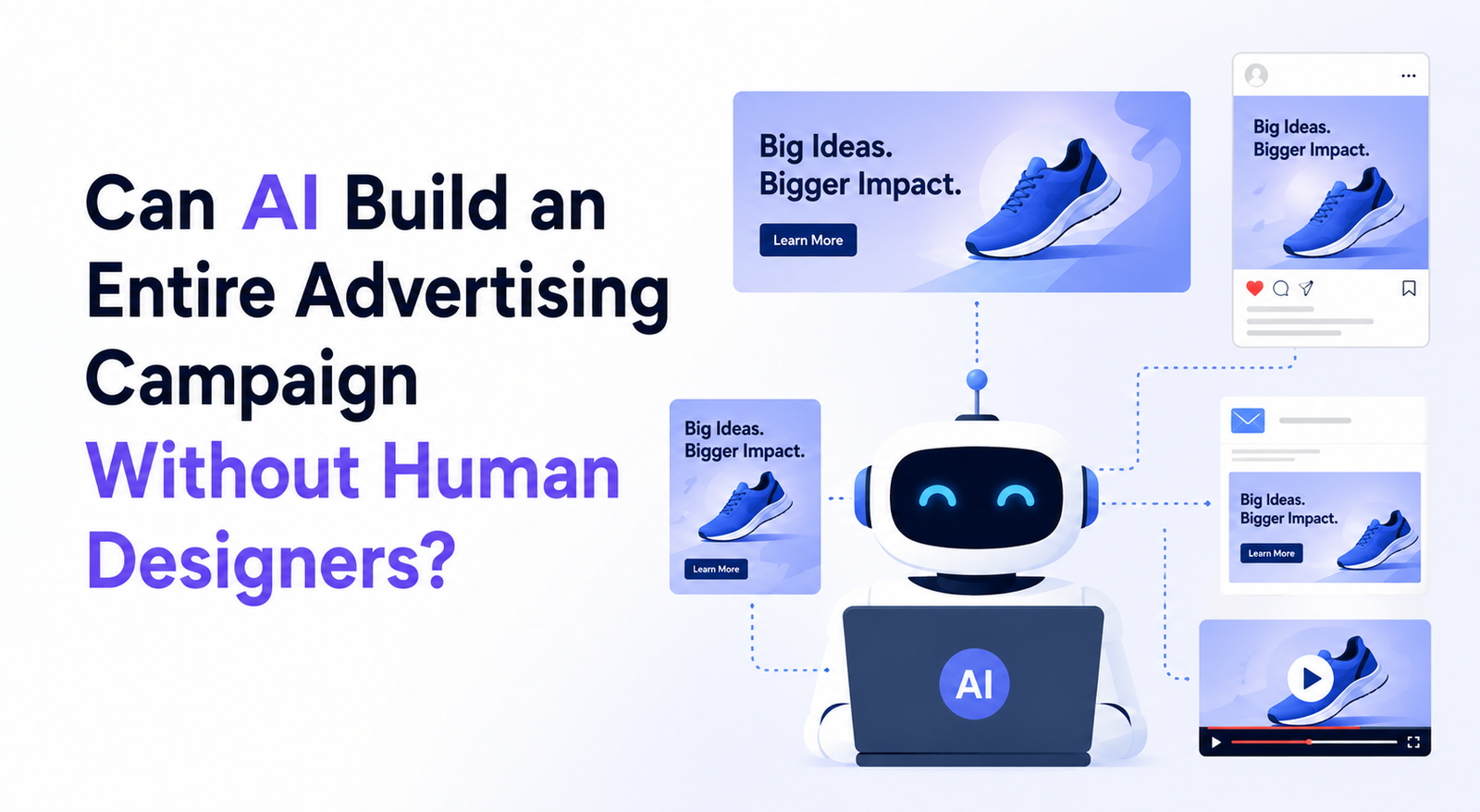
Can AI Build an Entire Advertising Campaign Without Human Designers?
Quick Answer (AI Overview Style) Yes, technically — AI can now write copy, generate images and video, build landing pages, select audiences, set budgets, and optimize spend with no human touching the workflow, and platforms like Meta’s Advantage+ are pushing toward true URL-to-campaign automation. But 2025–2026 data tells a more complicated story: AI-only campaigns perform well for direct-response and e-commerce formats, while brand-led, emotionally driven campaigns (Coca-Cola, McDonald’s, REI) have repeatedly backfired in public when AI replaced human creative judgment rather than supporting it. The honest answer is “AI can build the campaign, but it usually shouldn’t build it alone.”
Introduction
Eighteen months ago, “can AI replace the design team?” was a hypothetical posed at marketing conferences. In 2026, it’s a live operating decision being made inside ad accounts every day. Meta now says more than 4 million advertisers use its generative AI tools — up from 1 million just six months earlier — and the company is actively testing a system where you paste in a product URL, set a budget, and AI handles creative, targeting, and placement end to end. Google, TikTok, and Amazon are building toward the same destination from different directions.
At the same time, 2025 handed the industry a stack of very public cautionary tales. Coca-Cola’s AI-generated holiday ad was mocked as “soulless.” McDonald’s Netherlands pulled an AI holiday spot within three days after viewers called it “AI slop.” REI faced backlash this year over an AI-generated Instagram ad that gave a bicycle two handlebars. So the real question isn’t whether AI can build a campaign without a human designer — it clearly can, mechanically. The real question is when that’s a smart bet and when it’s a reputational landmine. This guide walks through the actual 2026 data on both sides.
What AI Can Now Do, Start to Finish
The honest scope of what’s technically possible has expanded fast. As of mid-2026, a single AI workflow can plausibly cover:
- Copywriting — headlines, body copy, and CTAs across dozens of tones and angles, generated faster than any human copywriter could draft them
- Static image creation — product photography-style visuals from text prompts or a single uploaded product photo
- Video production — native video models including Sora 2, Veo 3, and Runway’s Gen-4.5 can now write a script, assemble shots, add music, and layer voiceover into a finished ad with no editor in the loop
- Format multiplication — one creative brief automatically reformatted into a 9:16 Reel, a 1:1 carousel, a 16:9 YouTube cut, and a 4:5 feed ad
- Audience targeting and bidding — segmentation, placement selection, and budget allocation handled algorithmically
- Live optimization — performance data feeding back into the system in real time, reallocating spend toward winning variants without a media buyer touching it
This is what the industry now calls “agentic” advertising — AI that doesn’t just suggest, but plans, generates, ships, and iterates autonomously. Google is framing its entire Google Marketing Live 2026 keynote around this shift, and IAB research shows two-thirds of US ad buyers now say they’re paying closer attention to agentic ad buying specifically.
The Tools Actually Running These Campaigns
A genuinely AI-only campaign in 2026 usually runs through one or a combination of these platforms:
| Tool | What It Actually Automates | Starting Price (2026) | Best Fit |
|---|---|---|---|
| Meta Advantage+ | Full campaign creation, targeting, and budget from a product URL | Free within Ads Manager | Meta-first DTC and e-commerce brands |
| AdCreative.ai | Creative generation + pre-launch Creative Scoring (claimed CTR prediction) | From $39/month | Performance marketers optimizing for conversion lift |
| Predis.ai | Full social ad package — visuals, copy, hashtags in one pass | From $10–$14/month | Small businesses, solo marketers, creators |
| Smartly.io | Cross-channel creative generation + dynamic budget optimization | Custom/enterprise | Large multi-platform advertisers |
| AdStellar AI | Multi-agent system: strategy, targeting, copy, and launch in one flow | From $29/month | Agencies and DTC brands wanting full automation |
| Revealbot | Rule-based automated bidding and budget shifts (not creative) | From $49/month | Teams who want automation logic without ceding creative control |
| TikTok Symphony / Amazon Video Generator | Platform-native AI video generation | Free | Sellers already advertising on that specific platform |
Pricing has compressed meaningfully since 2024 — what used to require a $500+/month enterprise tool is now available from $10–$40/month for small businesses, while enterprise cross-channel orchestration (Smartly.io, Albert AI) remains a custom-quote category reserved for large ad budgets.
Also Read : DeepSeek AI Alternatives: 10 Best Tools to Use
Performance Analysis: Does It Actually Work?
The performance data is genuinely strong for a specific slice of advertising:
- Meta reports Advantage+ campaigns deliver 22% higher ROAS on average compared to manually managed campaigns, with the automation suite now generating roughly $60 billion in annualized revenue.
- Gartner’s 2026 CMO Survey found 78% of marketing teams now use generative AI in at least one stage of ad production, up from 41% in 2024.
- eMarketer projects global AI ad spend will surpass $190 billion in 2026.
- Advertiser Perceptions found 73% of US advertisers now use AI to create images for display and social ad creative, and IAB research shows 86% of media buyers use or plan to use AI-generated video specifically this year.
But the same research that shows AI adoption rising also shows why creative quality still matters more than the production method. A Nielsen meta-analysis of nearly 500 CPG campaigns found that creative quality drives roughly 47% of advertising sales lift overall — rising to 56% for digital campaigns, and as high as 89% of success for the strongest-performing digital ads. In other words: the channel doesn’t decide whether AI-only advertising works. The quality of the underlying idea does, and AI is currently far better at producing volume than at producing the original idea worth scaling.
Also Read : What Is Loop Engineering? The New Meta for AI Coding Agents
Where AI Hits a Wall: The 2025–2026 Backlash Data
This is the part most “AI vs. designers” articles skip entirely, and it’s arguably the most important data point in this whole debate.
By 2026, WARC estimates nearly four in ten digital video ads will be made using AI — a massive shift in production method. But a Washington State University study published in the Journal of Hospitality Marketing & Management found something brands aren’t fully reckoning with: simply mentioning AI involvement in a product or ad description measurably lowers emotional trust and purchase intent, with the effect strongest in high-risk categories like financial services, electronics, and medical products.
The real-world case studies back this up:
- Coca-Cola’s 2024 and 2025 AI holiday ads were both criticized as “soulless” and “creepy,” with viewers describing an uncanny-valley quality that broke the emotional warmth the brand’s classic holiday campaigns are built on.
- McDonald’s Netherlands pulled an AI-generated holiday spot within three days of launch after backlash calling it tone-deaf and depressing rather than festive.
- REI faced a 2026 controversy over an AI-generated Instagram ad showing a bicycle with two handlebars — a basic realism failure that struck a particular nerve given the brand’s outdoor-authenticity positioning.
- Duolingo’s “AI-first” company messaging drew backlash after it coincided with layoffs of contract translators, with users reading it as a dismissal of human labor.
- Selkie’s AI-designed Valentine’s Day collection was criticized by its own loyal fanbase for devaluing the human design process the brand had built its identity around.
The pattern across nearly every failure is the same: AI replaced human judgment on something emotionally significant (holidays, brand heritage, human craft) rather than supporting a human-led creative direction. Direct-response and catalog-style creative hasn’t triggered anywhere near the same backlash — because audiences aren’t bringing the same emotional expectations to a retargeting ad that they bring to a Christmas commercial.
The Counter-Trend: Brands Mocking AI on Purpose
One of the more interesting developments in early 2026 is brands turning the backlash itself into a creative strategy. Almond Breeze ran a campaign with the Jonas Brothers built entirely around poking fun at “cheesy, sloppily-made” AI ads. Equinox and Aerie have run similar campaigns explicitly positioning themselves as the human-made antidote to “AI slop.” Industry coverage describes this as brands “virtue signaling” their human craftsmanship — and whether or not that’s cynical, it’s a clear signal that being visibly anti-AI is itself becoming viable brand positioning in categories where authenticity is the product.
Pros and Cons of Fully AI-Built Campaigns
Pros
✅ Dramatically faster production — campaign turnaround down as much as 70% at brands piloting fully automated workflows ✅ Lower cost per asset, with production costs cut by up to 85% in some reported cases ✅ Format multiplication at no extra cost (one brief, every aspect ratio) ✅ Strong, measurable ROAS gains for direct-response and e-commerce formats specifically ✅ Real-time optimization that no human team can match at the same speed
Cons
❌ Higher emotional-trust risk, especially in categories where disclosure is required ❌ Repeated, well-documented public failures on brand-heritage and emotionally driven campaigns ❌ AI is strong at variation, weak at originating the pattern worth varying in the first place ❌ Consistency across a full campaign (not just a single asset) remains a known weak point ❌ Disclosure and labeling requirements now carry real legal exposure
The Legal Layer Most Marketers Are Underestimating
This part is genuinely new for 2026 and barely covered elsewhere: AI-generated advertising now carries real compliance obligations, not just reputational risk. TikTok auto-detects and labels AI-generated content using C2PA Content Credentials and invisible watermarking, and unlabeled AI content can receive an immediate platform strike with no warning. Broader disclosure laws expanded through late 2025 and into 2026, and some trackers cite potential penalties reaching into the tens of thousands of dollars per violation for non-compliant AI-generated advertising. Political AI advertising is now banned outright on several major platforms. If your team is running AI-only campaigns, “did we label this correctly” needs to sit next to “does this convert” on the pre-launch checklist.
Use Cases: When AI-Only Actually Makes Sense
- E-commerce retargeting, promotional offers, and lead generation — AI-only production is well-tested and performing strongly here; the creative ceiling matters less when conversion data is the primary feedback signal.
- Catalog and format-multiplication work — turning one product photo into a dozen sized, on-brand variants is exactly what current tools do best.
- Holiday, brand-heritage, and emotionally driven campaigns — repeated public failures suggest this remains the wrong place to remove human creative direction entirely.
- Anything requiring close-up human realism — current video models still struggle with faces, hands, and naturalistic dialogue at the level brand-defining campaigns demand.
For eCommerce Sellers
This is where AI-only advertising has the clearest, least controversial win. Tools like Amazon’s free Video Generator and TikTok Symphony turn a single product photo into multiple ready-to-run video ads in minutes, and Meta’s Advantage+ data shows a real, measurable ROAS lift over manual campaign management. For sellers running dozens or hundreds of SKUs, AI-driven format multiplication isn’t a creative compromise — it’s the only realistic way to keep every product adequately advertised across every platform and aspect ratio.
For Content Creators
Creators monetizing through brand deals are seeing AI cut both ways. On one hand, AI tools make it dramatically easier to produce sponsor-ready variants of a single piece of content for multiple brand partners. On the other, audiences increasingly distinguish “creator-made” from “AI-generated,” and creator-led, UGC-style ads continue to dramatically outperform polished studio (or AI) production across the platforms tracked in 2026 advertiser research. The practical move for creators is using AI to speed up editing and repurposing, while keeping the on-camera persona and voice unmistakably human — that authenticity is increasingly the entire value proposition.
For Marketers and Agencies
The role shift here is the most important takeaway in this whole piece: as AI absorbs production, the value of a marketer or designer moves upstream into creative direction, brand judgment, and review — not away. Teams reporting the strongest results aren’t the ones who fired their creative staff; they’re the ones who reassigned creative staff from producing fifty variants by hand to selecting and refining the best fifty an AI generated in minutes. Agencies should also budget for new line items that didn’t exist two years ago: AI disclosure compliance, brand-safety review, and governance — work that automation doesn’t eliminate, it relocates.
For Businesses and Enterprises
For larger organizations, the decision isn’t “AI or human” — it’s where to draw the line. The data supports a clear segmentation: let AI run end-to-end on always-on, performance-measured campaigns (retargeting, lead gen, promotional offers), and keep a human creative director setting direction, tone, and final approval on anything brand-defining or emotionally positioned. Enterprises should also budget for the legal and compliance layer now required around AI-generated advertising — platform labeling rules and disclosure laws are not optional extras in 2026, they’re operating requirements.
Alternatives: The Hybrid Model
The data increasingly points toward one dominant working model rather than a binary choice: humans set strategic and creative parameters, AI executes and optimizes within them. This isn’t a temporary compromise while the technology matures — multiple 2026 industry analyses now describe it as the likely long-term equilibrium. In practical terms, that means a human-approved brand kit, persona library, and creative brief feeding into an AI production pipeline, with human review as the final gate before anything brand-significant goes live — closer to how photography democratized image production without eliminating the photographer’s eye.
Watch: How AI Is Actually Changing Advertising
🎥 Ads and AI: Leveraging AI Creative in 2026 — Social Media Examiner — a practical look at how marketers are actually using Sora 2, Veo 3, and persona-based AI creative inside real campaigns today.
🎥 What is Blockchain? style explainer format aside, for a broader look at where AI-driven media buying is heading, IAB’s ongoing AI-Powered Video Outcomes webinar series breaks down agentic AI’s growing role in video advertising specifically — worth searching out on IAB’s channel for teams evaluating agentic tools.
Frequently Asked Questions
Can AI really build an entire ad campaign with zero human involvement? Mechanically, yes — Meta, Google, and several third-party platforms now support end-to-end automation from a product URL to a live, optimized campaign. Whether it should run with zero human review depends heavily on the campaign type; direct-response formats tolerate this well, brand-defining campaigns historically have not.
Why do AI-generated holiday and brand ads keep failing publicly? Research points to a mismatch between AI’s current strengths (variation, speed, volume) and what emotionally driven campaigns require (originality, cultural nuance, consistent brand voice). Audiences also report an uncanny-valley reaction to AI-generated faces and human movement, which is especially damaging in nostalgia-driven formats like holiday ads.
Is it legal to run AI-generated ads without disclosing it? Increasingly, no. Platforms including TikTok now auto-detect and label AI-generated content, and disclosure laws expanded through late 2025 and 2026 in several jurisdictions, with real financial penalties for non-compliance. Always confirm current platform and regional requirements before launching undisclosed AI creative.
Does disclosing AI use hurt ad performance? Some research suggests yes — a Washington State University study found that AI disclosure measurably reduces emotional trust and purchase intent, particularly in high-risk product categories. This doesn’t mean disclosure should be skipped (it’s often legally required), but it’s a real factor to plan messaging around.
What’s the actual ROI difference between AI-built and human-built campaigns? Meta reports a 22% average ROAS lift for its AI-driven Advantage+ campaigns versus manual management, but this is for performance-format advertising specifically. There isn’t comparable public data showing AI-only outperforming human-led work on brand-building metrics like favorability or recall.
Are human designers actually losing their jobs to AI in advertising? The clearest pattern in 2026 industry reporting is role transformation rather than wholesale elimination — designer time is shifting from asset production toward creative direction, curation, and review of AI-generated output. That said, production-heavy roles focused purely on output volume are under real pressure.
Which platforms offer free AI ad generation tools? Meta’s Advantage+ creative tools, TikTok Symphony, Amazon’s Video Generator (for Amazon sellers), and Google’s AI-assisted asset tools for Performance Max and Demand Gen are all available at no cost within their respective ad platforms as of 2026.
Final Verdict
AI has crossed the threshold from “can it build a campaign” to “it already does, every day, at scale” — that part of the debate is settled. What 2025 and 2026 made clear instead is that the technology’s biggest risk isn’t capability, it’s misapplication. AI-only production is a genuinely strong, well-validated choice for direct-response, e-commerce, and catalog advertising, where speed and volume directly translate into measurable returns. It remains a real liability for brand-defining, emotionally positioned campaigns, where the public record of failures — Coca-Cola, McDonald’s, REI, and others — is too consistent to dismiss as bad luck.
The winning model emerging from the data isn’t “AI replaces designers” or “designers resist AI.” It’s designers and strategists moving upstream into direction and judgment while AI absorbs production at a volume no human team could match — the same shift photography caused a century ago, just compressed into a couple of advertising cycles instead of a couple of decades.