
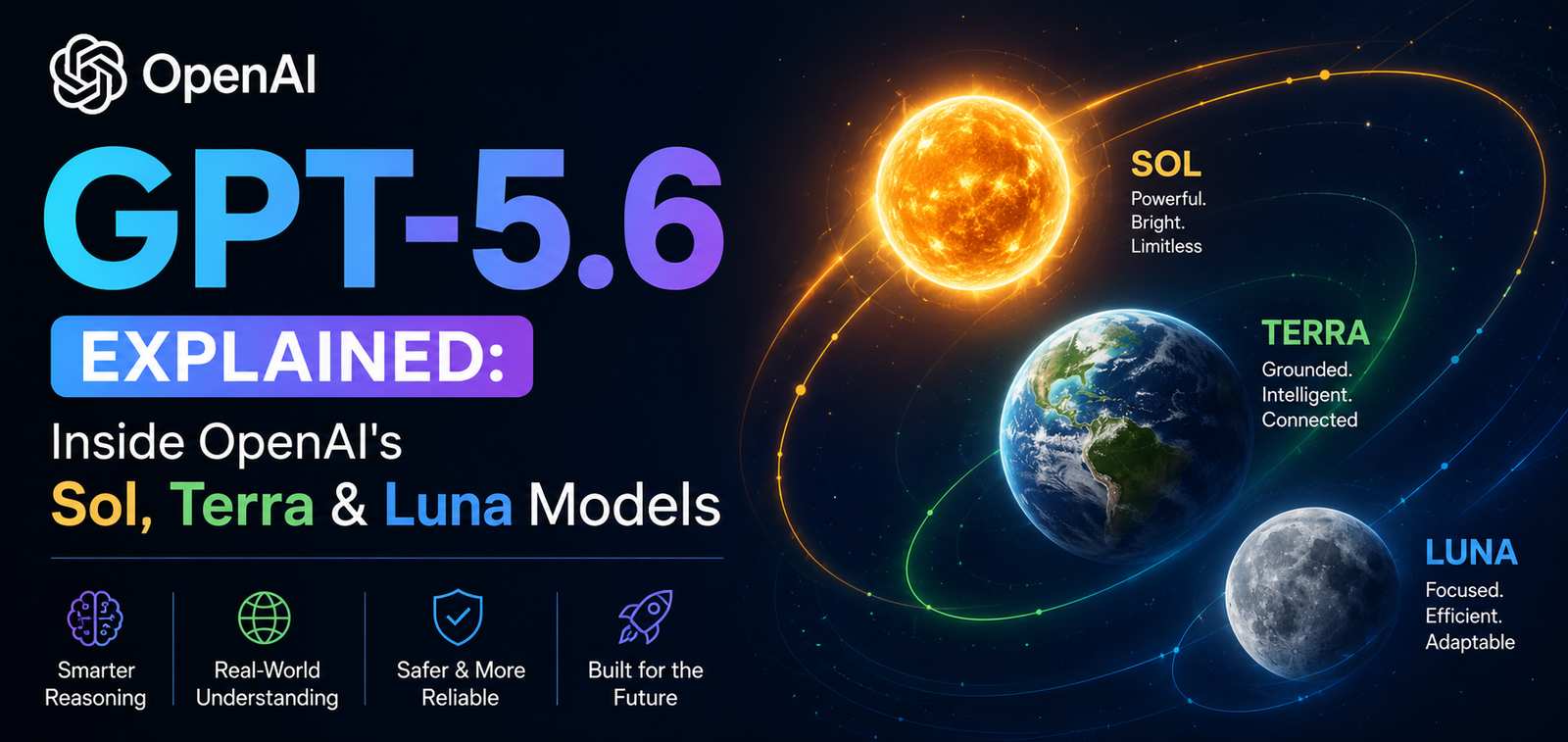
GPT-5.6 Explained: Inside OpenAI’s Sol, Terra & Luna Models
OpenAI just changed how it names, prices, and ships AI models — and the shift is bigger than a version bump. On July 9, 2026, OpenAI moved GPT-5.6 out of limited preview and into general availability, launching not one flagship model but three: Sol, Terra, and Luna. Alongside them came ChatGPT Work, a new agent built to complete entire office tasks rather than just answer questions.
If you’re a developer choosing an API model, a business leader budgeting for AI tools, or a security team evaluating risk, this launch directly affects your decisions. Below is a complete, data-backed breakdown of what GPT-5.6 actually is, how it performs against Claude and Grok, what it costs, and how to decide which tier fits your workload — plus the safety and governance context that most coverage has glossed over.
Also Read : Looking Beyond DeepSeek? Explore These Top AI Tools
Key Takeaways
- GPT-5.6 is a three-tier family — Sol (flagship), Terra (balanced), Luna (budget) — not a single model, replacing OpenAI’s old “mini/nano” naming with capability-based tiers.
- Sol leads the Artificial Analysis Coding Agent Index at 80.0, roughly 2.8 points ahead of Claude Fable 5, while using under half the output tokens and about one-third the cost.
- Pricing ranges from $1/$6 to $5/$30 per million input/output tokens, roughly half the cost of the prior GPT-5.5 generation at comparable performance tiers.
- All three tiers are rated “High risk” for cyber and biological/chemical misuse under OpenAI’s own Preparedness Framework — the discount tiers are not lightweight from a safety standpoint.
- A new “ultra” mode runs four agents in parallel on hard tasks, and Programmatic Tool Calling lets the model write and execute JavaScript to orchestrate tools.
- GPT-5.4 retires on July 23, 2026, so teams on the previous generation have a hard migration deadline.
What Is GPT-5.6? A Quick Definition
GPT-5.6 is OpenAI’s latest generation of foundation models, released as three distinct capability tiers — Sol, Terra, and Luna — instead of a single model. Sol is the flagship model built for complex coding, research, and cybersecurity work; Terra is a balanced, everyday-use model priced roughly half of the previous generation; and Luna is the fastest, lowest-cost tier for high-volume tasks. All three are available through ChatGPT, ChatGPT Work, Codex, and the OpenAI API.
This is a deliberate strategy shift. As OpenAI explained in its own release notes, the version number marks the model generation, while the name — Sol, Terra, or Luna — marks a durable capability tier that can be updated on its own schedule going forward. In practice, that means future updates to “Terra” or “Luna” won’t necessarily require a whole-family version bump.
Why OpenAI Split GPT-5.6 Into Three Models
Shipping three tiers instead of one flagship reflects where enterprise AI spending is actually going. According to Menlo Ventures’ 2026 State of Generative AI in the Enterprise report, coding is already the single largest enterprise generative AI use case, and businesses are increasingly cost-conscious about per-token pricing as usage scales. OpenAI CEO Sam Altman acknowledged this directly, telling CNBC that “every enterprise now is thinking about spend and the value they’re getting in exchange for AI” — a comment that lines up closely with Terra’s roughly 50% price cut versus GPT-5.5 at similar performance.
The Three Models at a Glance
| Model | Best For | Relative Cost | Positioning |
|---|---|---|---|
| Sol | Complex coding, scientific research, cybersecurity, long-running agentic tasks | Highest | Flagship — OpenAI’s most capable model to date |
| Terra | Everyday professional work, general business use | Mid (~50% cheaper than GPT-5.5 at similar performance) | Balanced performance-to-cost ratio |
| Luna | High-volume, routine, latency-sensitive tasks | Lowest | Fast and affordable at scale |
GPT-5.6 Pricing: Full Breakdown
Pricing is quoted per 1 million tokens, split between input and output:
| Model | Input (per 1M tokens) | Output (per 1M tokens) |
|---|---|---|
| Sol | $5.00 | $30.00 |
| Terra | $2.50 | $15.00 |
| Luna | $1.00 | $6.00 |
A few pricing details competitor coverage tends to skip:
- Prompt caching changed. GPT-5.6 introduces explicit cache breakpoints and a 30-minute minimum cache life. Cache writes are billed at 1.25x the model’s uncached input rate, while cache reads still get the standard 90% discount on the cached-input rate.
- Terra is roughly half the price of GPT-5.5 at comparable performance, according to OpenAI — this is arguably the more significant business story than Sol’s benchmark scores, since Terra and Luna cover the bulk of everyday enterprise volume.
- Sol is also being made available on Cerebras hardware at speeds up to 750 tokens per second for select customers starting in July 2026, aimed at latency-sensitive use cases.
Where You Can Access Each Model
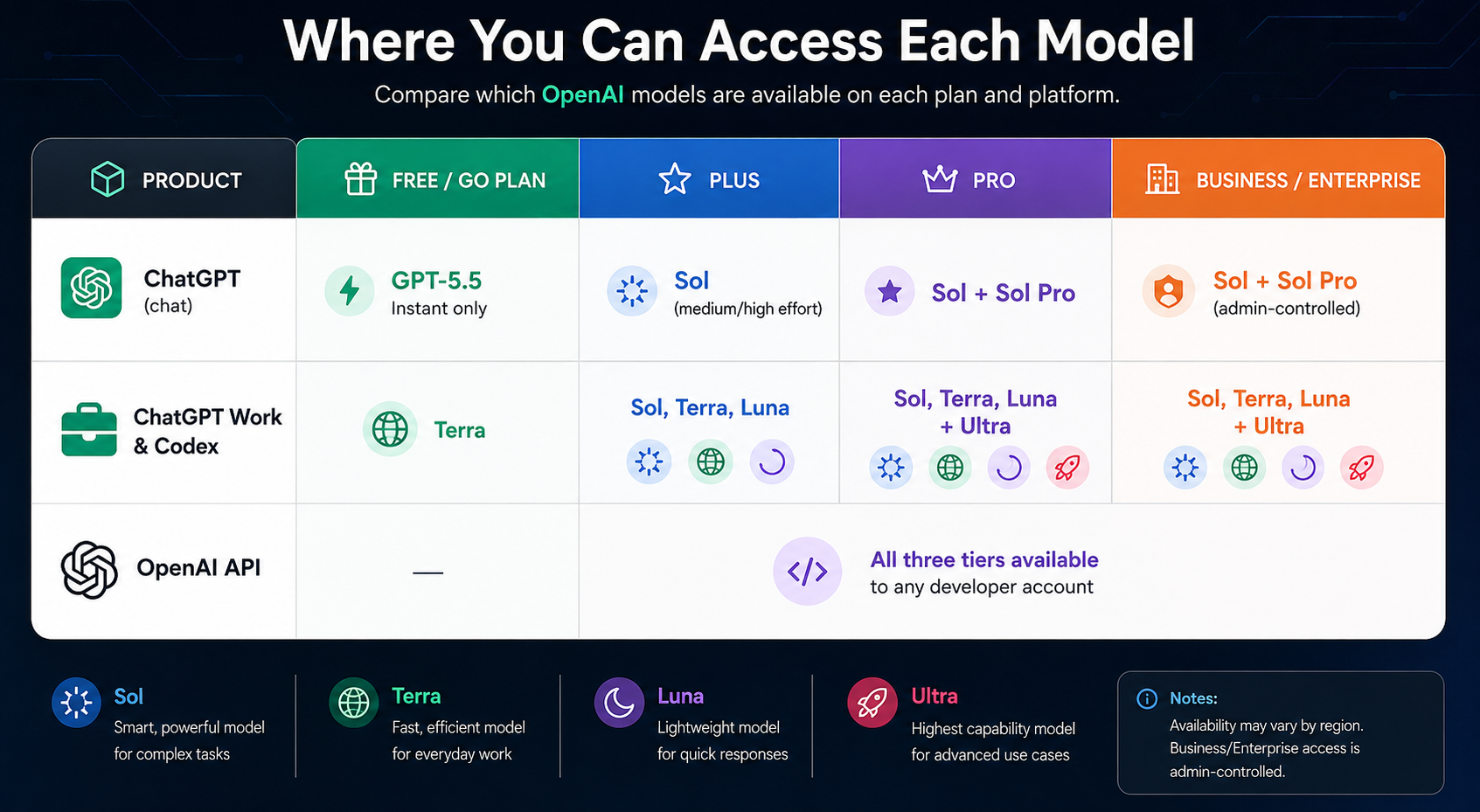
| Product | Free / Go plan | Plus | Pro | Business / Enterprise |
|---|---|---|---|---|
| ChatGPT (chat) | GPT-5.5 Instant only | Sol (medium/high effort) | Sol + Sol Pro | Sol + Sol Pro (admin-controlled) |
| ChatGPT Work & Codex | Terra | Sol, Terra, Luna | Sol, Terra, Luna + Ultra | Sol, Terra, Luna + Ultra |
| OpenAI API | — | All three tiers available to any developer account |
Note: GPT-5.5 Instant remains the ChatGPT default for fast, everyday conversational responses — Sol powers the higher-reasoning options, not the default chat experience.
GPT-5.6 Performance: Coding, Reasoning, and Agentic Benchmarks
Coding Benchmarks
OpenAI is positioning Sol as its strongest coding model to date. On the Artificial Analysis Coding Agent Index, an independent third-party benchmark, Sol (with max reasoning) scored 80.0 — about 2.8 points above Anthropic’s Claude Fable 5 — while using less than half the output tokens, completing tasks in under half the time, and costing roughly a third less.
That efficiency reportedly carries down the lineup too: Terra performs slightly above Fable 5, and Luna outperforms Anthropic’s Opus 4.8, each while using a fraction of the tokens and time of comparable rivals, according to OpenAI’s published benchmarks.
Important context missing from most coverage: these are OpenAI’s own benchmark claims, cross-checked against a third-party index (Artificial Analysis), but independent testers have reported mixed results. Dutch outlet Techzine, for instance, noted that on broader general-intelligence measures, GPT-5.6 Sol still trails Fable 5, and that on SWE-Bench Pro specifically, Sol’s score of 64.6% trails Claude’s newer Mythos 5 model’s 80.3% by roughly 15 points. Treat vendor benchmark comparisons — from any lab — as directional, not definitive, and validate against your own workloads before switching.
General Intelligence
On the Artificial Analysis Intelligence Index — a broader measure spanning agentic work, coding, science, and general reasoning — Sol at max reasoning came within about one point of Fable 5 while completing tasks in 61% less time at roughly half the cost, per OpenAI. At medium reasoning, OpenAI claims Sol still beats Fable 5 by 11.4 points at about a quarter of the cost.
Agentic and Long-Horizon Work
On Agents’ Last Exam, a benchmark for long-running, professional-domain agentic workflows, OpenAI reports Sol reaching a new high score of 53.6. The new “ultra” mode — which runs four agents in parallel by default — reportedly lifted Terminal-Bench 2.1 performance from 88.8% to 91.9%, trading higher token usage for stronger and faster results on demanding tasks.
Quick Benchmark Comparison Table
| Benchmark | GPT-5.6 Sol | Claude Fable 5 | Notes |
|---|---|---|---|
| Artificial Analysis Coding Agent Index | 80.0 | ~77.2 | Sol leads; uses <50% of the tokens/time |
| Artificial Analysis Intelligence Index (max reasoning) | Within ~1 point of Fable 5 | Baseline | Sol trades slightly lower score for 61% less time |
| SWE-Bench Pro | 64.6% | 80.3% (Claude Mythos 5) | Claude’s newer Mythos tier leads here |
| ExploitBench (cyber) | 73.5% | Not publicly compared | Up from GPT-5.5’s 47.9% |
Benchmark figures are self-reported by vendors or drawn from Artificial Analysis’ public leaderboard as of July 2026 and can shift as models are updated. Always re-verify current scores before making procurement decisions.
Cybersecurity: OpenAI’s “Strongest Cyber Model Yet” — With Caveats
OpenAI calls the GPT-5.6 family its most capable cybersecurity models so far. The models are designed to assist defensive security work: source code review, vulnerability identification, patch recommendations, threat modeling, and blue-team simulation exercises. On ExploitGym, a benchmark developed by UC Berkeley researchers in partnership with OpenAI and other frontier labs, GPT-5.6 models show strong gains in cyber capability as reasoning effort increases — Sol scores 73.5% on ExploitBench versus 47.9% for GPT-5.5.
The Safety Detail Most Articles Leave Out
This is the part competitor coverage largely skips: OpenAI’s own safety report classifies all three GPT-5.6 tiers — including the “budget” Luna model — at “High” risk for both cyber misuse and biological/chemical misuse under its Preparedness Framework. That means the cheaper tiers are not watered-down or low-risk versions; they carry the same elevated safeguards category as the flagship.
To manage this, OpenAI says it built its most robust safety stack to date for this release, including:
- Multi-week red-teaming and adversarial pressure-testing before general availability
- Real-time monitoring and rapid-remediation processes layered on top of trained-in protections
- Access controls calibrated to user trust and risk level
- An expanded biology bug bounty program feeding into ongoing safeguard updates
Government review was part of the rollout. As part of engagement with the U.S. government under an executive order establishing voluntary review of the most capable frontier models, OpenAI previewed GPT-5.6’s capabilities to officials before the public launch and initially limited early access to roughly 20 government-vetted partner organizations. A White House official later told CNBC that the administration did not give OpenAI explicit “approval or clearance” to release the models, clarifying that release decisions “rest entirely with the companies” — an important nuance, since some early coverage implied a formal government sign-off.
Why this matters for your team: if your organization plans to use GPT-5.6 for security research, penetration testing, or vulnerability disclosure work, expect usage restrictions and monitoring on sensitive queries, even on Terra or Luna. Build that into your compliance and procurement review, not just your budget review.
ChatGPT Work: OpenAI’s New Enterprise Agent
ChatGPT Work is OpenAI’s new workplace-focused AI agent, blending Codex’s coding capability with ChatGPT to handle longer, multi-step office tasks rather than single-turn Q&A. It’s designed to:
- Pull source material from uploaded documents and connected work apps
- Draft and format documents, spreadsheets, and presentations
- Build interfaces, visual explanations, and frontend prototypes
- Convert raw information into shareable, editable outputs
This pushes ChatGPT further from “chatbot” toward what OpenAI calls a work-execution environment — an agent that goes off, does a multi-step job, and returns a finished artifact rather than a text answer you have to act on yourself.
A useful reality check comes from OpenAI itself. Its own guidance for ChatGPT Work suggests giving it “a task you already know well” as a first test — a candid acknowledgment that outputs still need human review against something you understand, not blind trust. Treat this as an assistant that accelerates first drafts, not a fully autonomous replacement for domain expertise.
Desktop Changes
Codex has also moved out of its standalone tool status and into a unified ChatGPT desktop app for macOS and Windows, sitting alongside Chat and Work in one interface — a signal that OpenAI wants coding, chat, and work-execution to feel like one product rather than three separate tools.
New Technical Capabilities in GPT-5.6
Beyond raw benchmark scores, GPT-5.6 ships several under-the-hood features that materially change how developers build with it:
1. Programmatic Tool Calling
The model can write and execute in-memory JavaScript inside an isolated V8 runtime (no network access) to coordinate multiple tools, run them in parallel, apply loops and conditional logic, and process intermediate results before generating a final answer. This reduces the number of round-trip API calls needed for complex, multi-tool workflows.
2. “Ultra” Multi-Agent Mode
Available on Sol, ultra mode coordinates four agents working in parallel by default on a single hard task, trading higher token consumption for faster completion and stronger results. Developers can replicate similar patterns using the multi-agent beta in the Responses API.
3. Reasoning Effort Controls
Each model tier now offers multiple reasoning/effort levels (roughly four per model, plus the additional “ultra” mode for Sol), letting teams dial cost and latency up or down per request rather than switching models entirely.
4. Predictable Prompt Caching
Explicit cache breakpoints and a guaranteed 30-minute minimum cache life make cost estimation more reliable for high-repetition workloads like customer support bots or document-processing pipelines.
GPT-5.6 vs. the Competition: How It Stacks Up
The launch landed in the middle of what several outlets called an unusually dense “LLM week” — Grok 4.5 (from the rebranded SpaceXAI) and Meta’s Muse Spark 1.1 both shipped within days of GPT-5.6, both with a heavy coding focus.
| Factor | GPT-5.6 Sol | Claude Fable 5 | Grok 4.5 | Meta Muse Spark 1.1 |
|---|---|---|---|---|
| Primary strength | Coding efficiency, agentic speed | General intelligence leader (per Artificial Analysis) | Competitive with Opus 4.8/GPT-5.5 tier | Competitive with Opus 4.8/GPT-5.5 tier |
| Coding Agent Index | 80.0 | ~77.2 | Not directly comparable at publish time | Not directly comparable at publish time |
| Pricing model | Tiered (3 models) | Tiered (Fable / Mythos) | Single flagship | Single flagship |
| Cyber/safety focus | High-risk classification, layered safeguards | Cybersecurity classifier added July 2026 | Not extensively documented publicly | Not extensively documented publicly |
The honest takeaway: no single lab is unambiguously “ahead” across every metric right now. OpenAI leads on coding-agent efficiency and cost-per-task; Anthropic’s Claude Mythos 5 leads on SWE-Bench Pro and, per independent measurement, still tops general intelligence rankings. If your priority is raw coding-agent throughput and cost control, Sol’s numbers are compelling. If your priority is long-horizon software engineering accuracy, it’s worth benchmarking Claude Mythos 5 and Fable 5 against your own repository before committing.
Should You Use Sol, Terra, or Luna? A Decision Checklist
Use this checklist to match a tier to your actual workload instead of defaulting to the most expensive option:
- Choose Sol if: you run complex, multi-step coding or research agents; you need the highest available reasoning quality; token efficiency matters more than raw per-token price; you’re doing security research, threat modeling, or advanced scientific work.
- Choose Terra if: you need strong general-purpose performance for everyday business writing, analysis, and moderate coding tasks, and want roughly half the cost of the previous generation’s comparable tier.
- Choose Luna if: you’re running high-volume, latency-sensitive, or routine tasks (classification, short-form drafting, simple chat support) where cost-per-request is the dominant constraint.
- Use “ultra” mode only when: a task is complex enough to justify 4x the typical token spend for faster, more reliable completion — not as a default setting.
- Budget for cache-write costs: the new 1.25x uncached-rate charge on cache writes can add up on rapidly-changing prompts; static, reusable prompt prefixes benefit most from the 90% cache-read discount.
- Plan your GPT-5.4 migration now: OpenAI has set July 23, 2026, as the retirement date for GPT-5.4. If you’re still on that model, testing GPT-5.6 (or GPT-5.5 as an interim step) is time-sensitive.
GPT-5.6 and the Bigger AI Market Picture
This launch didn’t happen in a vacuum. It lands amid a period of extremely rapid enterprise AI spending growth:
- Global AI spending is projected to exceed $300 billion in 2026, up from roughly $223 billion in 2025, according to IDC’s Worldwide AI Spending Guide.
- Enterprise generative AI spending specifically reached an estimated $37 billion in 2025, more than triple the 2024 figure, per Menlo Ventures’ State of Generative AI in the Enterprise research.
- Coding remains the single largest enterprise generative AI use case, which explains why OpenAI, Anthropic, xAI, and Meta all shipped coding-focused model updates within roughly the same two-week window in July 2026.
- Market-share estimates vary by research firm, but OpenAI has been commonly cited holding the largest single share of the generative AI market (roughly the low-to-mid 20% range in several 2025 estimates), with Anthropic reported to be gaining ground specifically in enterprise deal volume through mid-2026.
Why this matters for your decision: pricing pressure is real and structural, not promotional. Terra’s roughly 50% price cut over GPT-5.5, alongside similar aggressive tiering from competitors, suggests per-token costs across the frontier-model market will likely keep compressing through the rest of 2026 — a relevant factor if you’re negotiating annual API commitments right now.
Frequently Asked Questions
What is GPT-5.6?
GPT-5.6 is OpenAI’s latest AI model generation, released on July 9, 2026, as three separate tiers — Sol (flagship), Terra (balanced/everyday), and Luna (fast and low-cost) — available through ChatGPT, ChatGPT Work, Codex, and the OpenAI API.
What’s the difference between Sol, Terra, and Luna?
Sol is the most capable and most expensive model, built for complex coding, research, and cybersecurity tasks. Terra offers performance competitive with the previous GPT-5.5 generation at roughly half the price, for everyday professional work. Luna is the fastest and cheapest tier, designed for high-volume, routine tasks.
How much does GPT-5.6 cost?
Per 1 million tokens: Sol costs $5 input / $30 output, Terra costs $2.50 input / $15 output, and Luna costs $1 input / $6 output. Cache writes are billed at 1.25x the uncached input rate; cache reads retain a 90% discount.
Is GPT-5.6 better than Claude Fable 5?
It depends on the task. GPT-5.6 Sol leads Claude Fable 5 on the Artificial Analysis Coding Agent Index (80.0 vs. ~77.2) while using fewer tokens and less time. However, independent measurements show Fable 5 still ahead on broader general-intelligence benchmarks, and Claude’s newer Mythos 5 model leads on SWE-Bench Pro by a wide margin. Benchmark your specific use case rather than relying on a single headline score.
Is GPT-5.6 available for free users?
Free and Go-tier users get access to Terra in ChatGPT Work and Codex. Sol is available to Plus, Pro, Business, and Enterprise users in ChatGPT chat at medium and higher reasoning effort; Pro and Enterprise users can also select Sol Pro.
What is ChatGPT Work?
ChatGPT Work is OpenAI’s new enterprise-focused AI agent that combines Codex’s coding capability with ChatGPT to handle multi-step office tasks — such as building documents, spreadsheets, and presentations from source material — rather than answering single questions.
Is GPT-5.6 safe to use for cybersecurity tasks?
GPT-5.6 supports defensive cybersecurity work like code review, vulnerability identification, and patch development, and OpenAI reports strong gains on the ExploitBench benchmark. However, OpenAI’s own safety classification rates all three tiers — including Luna — at “High” risk for cyber and biological/chemical misuse, meaning usage restrictions and monitoring apply even to lower-cost tiers.
When is GPT-5.4 being retired?
OpenAI has set July 23, 2026, as the retirement date for GPT-5.4. Teams still using that model should test GPT-5.6 or GPT-5.5 as a migration path before that date.
Can developers access all three GPT-5.6 models through the API?
Yes. Sol, Terra, and Luna are all available to developers through the OpenAI API, along with new features like Programmatic Tool Calling and the multi-agent Responses API beta.
Final Thoughts: What GPT-5.6 Actually Changes
GPT-5.6 isn’t just a smarter model — it’s OpenAI restructuring how it sells intelligence. The move to three durable, independently-updatable tiers signals that the “one flagship model for everyone” era is ending across the industry, not just at OpenAI. Anthropic already runs a similar tiered structure with Fable and Mythos; expect Google and Meta to lean further into this pattern too.
Actionable next steps:
- Run your own benchmark, not just vendor-published scores, on 2–3 representative tasks from your actual workload before switching models.
- Default to Terra or Luna for routine work and reserve Sol (and especially “ultra” mode) for genuinely complex, high-value tasks — the cost gap between tiers is significant at scale.
- Review your compliance posture if you touch cybersecurity or biosecurity-adjacent use cases, given the “High risk” classification applies across all three tiers.
- Set a migration deadline internally ahead of GPT-5.4’s July 23, 2026 retirement if you haven’t already moved to a current-generation model.
- Re-check pricing quarterly. Given the pace of tiered pricing cuts across OpenAI, Anthropic, and xAI in 2026, locking into long-term contracts without a re-negotiation clause could leave you overpaying within months.