
Best Age Verification Software in 2026: The Complete Buyer’s Guide
Age verification stopped being a “nice to have” checkbox a while ago. In 2026 it’s a legal requirement in dozens of jurisdictions, and getting it wrong can mean seven-figure fines, blocked traffic, or a very uncomfortable call from your legal team.
The problem is that “age verification software” isn’t one thing. Some tools guess your age from a selfie in under a second. Others authenticate a government ID and pull the exact date of birth off it. Some do both, layered together, and quietly escalate a check only when something looks off. Picking the wrong category for your use case is the single biggest mistake businesses make — not picking the wrong vendor.
This guide breaks down how the technology actually works, compares the leading providers on features and pricing, and points you toward the right fit depending on whether you’re running a Shopify store, a content platform, an iGaming brand, or an enterprise compliance program.
Quick answer: For most regulated businesses (iGaming, fintech, adult content, marketplaces), a document-plus-biometric platform like Persona, Sumsub, or Veriff gives you the strongest compliance evidence. For lightweight age gating on retail or media sites, Yoti or VerifyMyAge offer fast, privacy-friendly facial age estimation with minimal friction. If you need one platform that scales from a simple gate to full KYC, Regula, Jumio, or Identomat are worth a serious look. There’s no single “best” tool — only the best fit for your risk profile, budget, and user experience goals.
What Is Age Verification Software?
Age verification software is a category of identity-assurance technology that confirms whether a user meets a minimum age requirement before they can access content, buy a product, or use a service. Instead of trusting a self-reported birthdate typed into a form (which regulators in the UK, EU, and a growing list of US states now explicitly reject as insufficient), these platforms verify age through independent evidence.
That evidence generally falls into three buckets:
1. Document-based verification. The system scans a government-issued ID — a driver’s license, passport, or national ID card — authenticates the document itself (checking for tampering, forged security features, or expired templates), and extracts the date of birth. This is the highest-assurance method because it ties the age claim to an official record, not a guess.
2. Biometric age estimation. An AI model analyzes a live selfie or short video and predicts an age range, usually accurate to within one to three years. No document is collected, so it’s faster and more private, but it produces a probability rather than a confirmed date of birth. It’s typically used where a “likely 18+” signal is enough.
3. Data-source and database matching. The platform cross-references a name, address, or partial identifiers against credit bureau data, government records, or mobile carrier data to infer age without a document scan or selfie. This is common in the US and UK for retail and delivery use cases.
Most serious platforms in 2026 don’t force you to pick just one. They offer a layered or risk-based model: start with a low-friction check (like age estimation), and only step up to a document scan, liveness check, or manual review if the confidence score is borderline or the use case demands stronger evidence.
Also Read :What Is Loop Engineering? The New Meta for AI Coding Agents
Why This Matters More in 2026 Than Ever Before
If you last looked at age verification requirements a couple of years ago, the landscape has moved considerably. A few developments worth knowing before you shop for software:
- The UK’s Online Safety Act is now in active enforcement. Ofcom has explicitly ruled that a simple “I am over 18” checkbox does not meet the “highly effective age assurance” bar, and has already taken enforcement action against platforms relying on self-declaration. Fines can reach £18 million or 10% of global revenue.
- The EU is folding age assurance into the Digital Services Act and building a privacy-preserving “prove you’re over 18 without revealing your birthdate” model tied to the eIDAS 2.0 Digital Identity Wallet, with penalties of up to 6% of global turnover for serious breaches.
- US states continue to pass age verification laws for adult content, social media, and gambling — though several have been challenged or partially blocked on First Amendment grounds, so the legal map shifts by the month. There’s still no single federal standard, which is exactly why flexible, jurisdiction-configurable software matters.
- Australia rolled out Age-Restricted Material Codes in 2026 covering social media, app stores, AI chatbots, and search — with accepted methods including facial age estimation, digital ID wallets, and photo ID checks.
- Brazil, Canada, and South Korea have all introduced or expanded their own age-assurance obligations in the past year, pushing this from a “US/UK problem” to a genuinely global compliance requirement.
The practical takeaway: whatever tool you choose should support multiple verification methods and configurable rules by region, because “compliant in one country” rarely means “compliant everywhere.”
Also Read : Why Social Apps Are Ditching the Feed for Live, Profile-First Communities
Best Age Verification Software: Quick Comparison
| Provider | Primary Method | Best For | Starting Price |
|---|---|---|---|
| Regula | Document + biometric age estimation | Businesses wanting one platform across the full assurance spectrum | Custom quote |
| Sumsub | Document + biometric, multi-jurisdiction | Global platforms in gaming, crypto, fintech | Custom quote |
| Veriff | Video-based ID + facial estimation | High-volume onboarding needing speed and broad document coverage | Custom quote |
| Yoti | Facial age estimation, reusable digital ID | Privacy-first retail, media, and social platforms | Free tier + paid API |
| iDenfy | Document + hybrid AI/human review | Businesses that want an extra layer of manual review | From ~$0.85–$2/check |
| Persona | Configurable, no-code verification blocks | Product and engineering teams building custom flows | Usage-based, from ~$0.85/check |
| Jumio | Document-centric + biometric | Regulated industries needing strong document forensics | Custom quote |
| Identomat | Document + selfie match, modular KYC | Startups and mid-market needing full KYC bundled with age checks | Custom quote (lower entry cost) |
| VerifyMyAge | Passive + document, plugin-ready | Small e-commerce stores (Shopify, WooCommerce) | Low-cost, per-check pricing |
| AgeChecked | UK-government-recognized gateway | UK e-commerce and gambling operators | Custom quote |
| FaceTec | 3D liveness + biometric age estimation | Vendors who want to license biometric tech, not a full platform | Developer licensing |
| Trulioo | Global data + document matching | Enterprises scaling across many countries at once | Custom quote |
| Socure | Predictive risk scoring + document/face | US fintech needing instant 18+ decisions | Custom quote |
| GBG/IDology | Data-source matching | US/UK retail and point-of-sale age checks | Custom quote |
| AU10TIX | Document scan + fraud scoring | Enterprises needing rapid, high-volume ID processing | Custom quote |
Pricing above reflects typical market positioning as of mid-2026. Nearly every vendor in this space uses custom or volume-based pricing, so treat these as directional — always request a live quote before budgeting.
Top Age Verification Software Providers, Reviewed
1. Regula — Best All-in-One Platform for Flexible Assurance
Regula built its reputation in document forensics before expanding into biometrics, and it shows. The platform lets you configure everything from a quick selfie-based age estimate to full document authentication with face matching and liveness detection, all inside one workflow builder.
Features: age estimation, government ID authentication with over 16,000 document templates from 254 countries/territories, biometric face matching, liveness detection, configurable thresholds (13+, 16+, 18+, 21+, 25+, or custom), and deployment options spanning cloud, on-prem, hybrid, and SDK.
Pros: genuinely one of the few vendors that owns both its document and biometric tech stack in-house, so updates and customization aren’t bottlenecked by a third-party partner. Strong performance in independent NIST facial age estimation benchmarks.
Cons: the breadth of configuration options means a real onboarding investment; smaller teams may find the platform more than they need.
Best for: businesses that expect their compliance requirements to get more complex over time and want one vendor that can grow with them.
2. Sumsub — Best for Multi-Country Compliance at Scale
Sumsub is built for companies operating across many regulatory regimes at once — crypto exchanges, global gaming platforms, and fintechs that can’t afford a one-size-fits-all workflow.
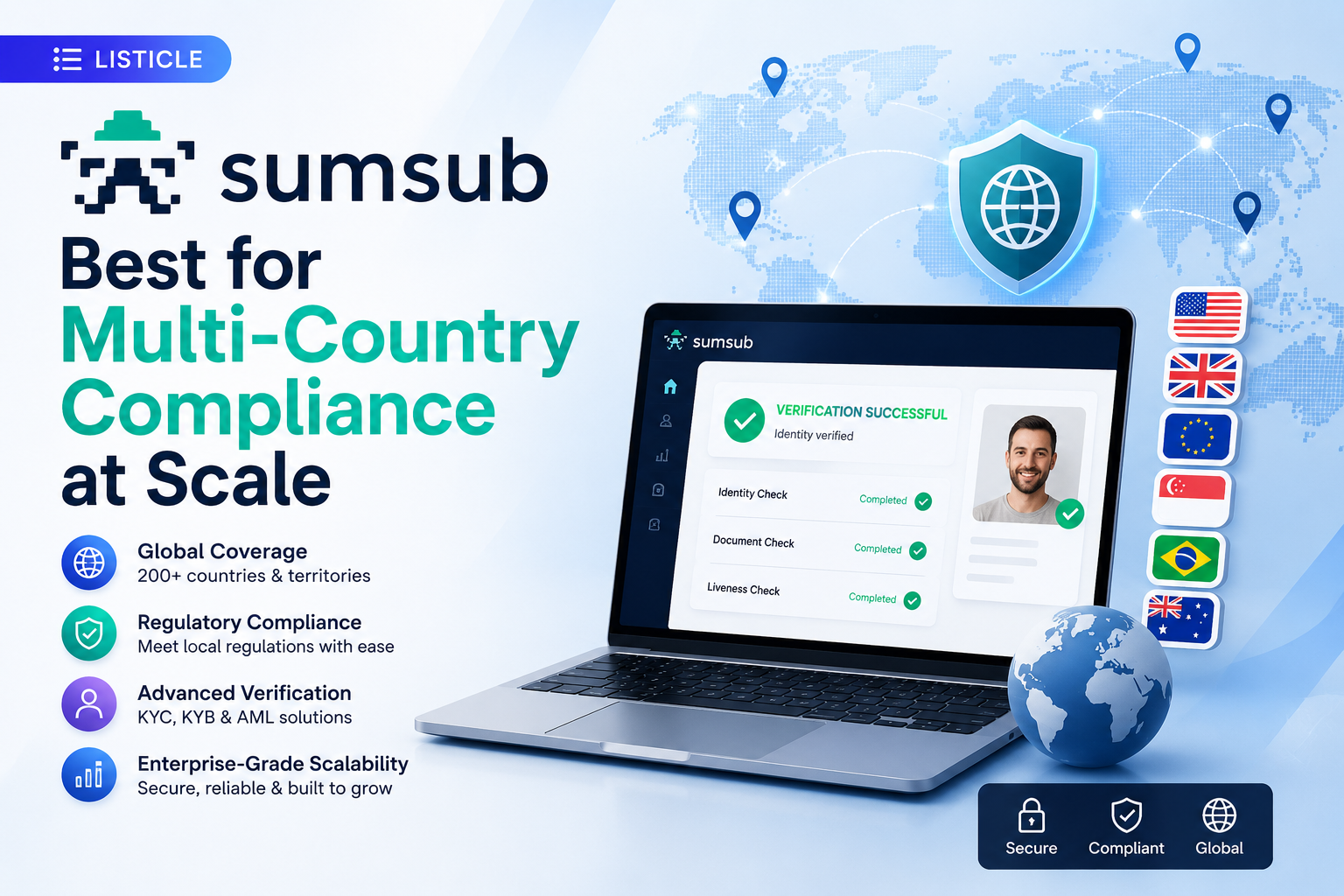
Features: document verification, AI facial recognition, AML and sanctions screening bundled in, and travel-rule support for crypto businesses.
Pros: deep jurisdiction coverage and strong back-end automation for high-volume onboarding.
Cons: processing can slow down at very high transaction volumes, and the configuration options have a learning curve.
Best for: international platforms where age verification is just one piece of a larger KYC/AML obligation.
3. Veriff — Best for Speed and Document Coverage
Veriff leans on video-based verification and claims support for over 10,000 document types worldwide, which matters if your user base is genuinely global.
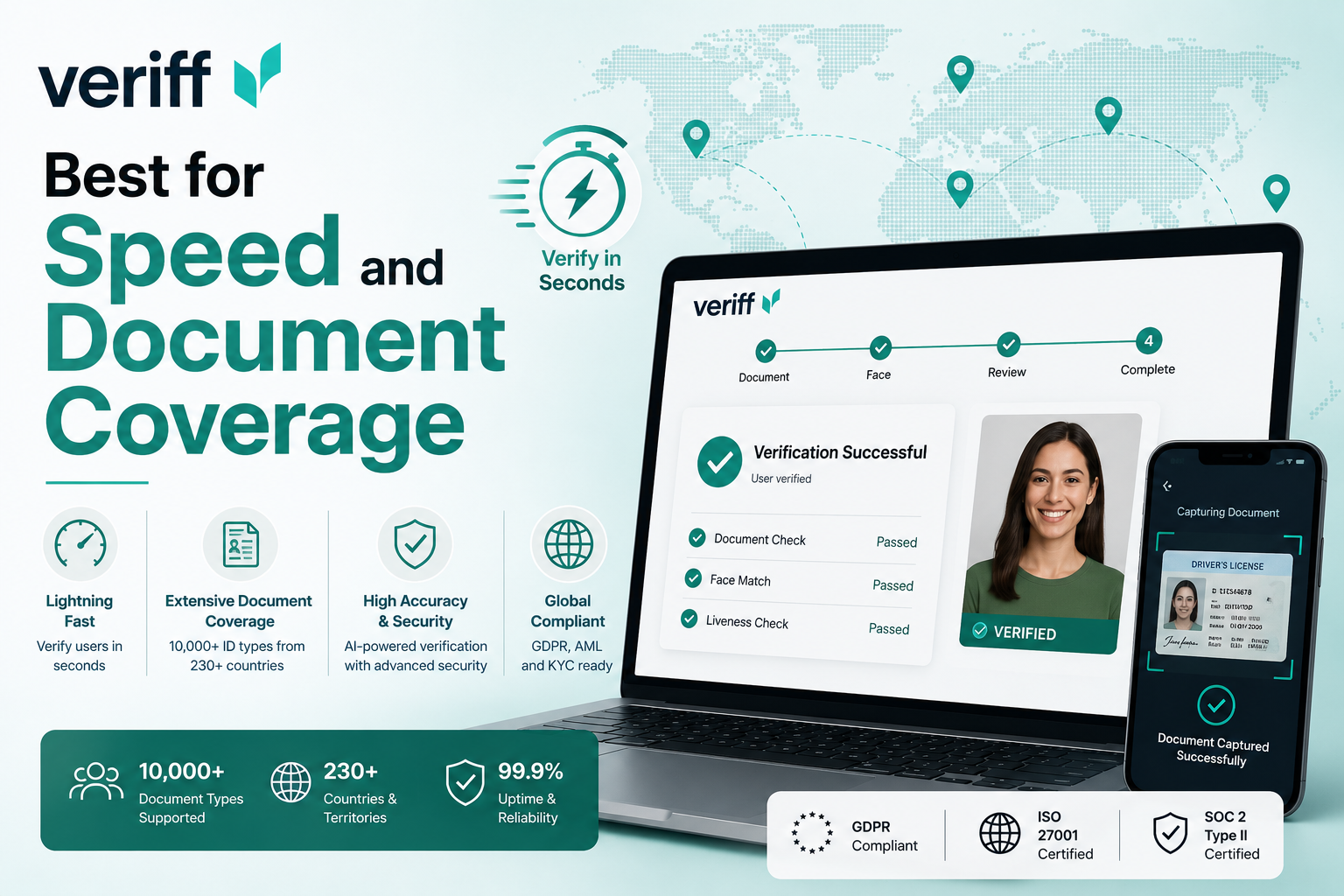
Features: video-based ID verification, an automated decision engine, and facial age estimation as a lighter-weight option.
Pros: fast checks, broad country coverage, and a setup process most teams can complete quickly.
Cons: less backend logic control than some competitors, and costs can climb as volume scales.
Best for: consumer apps that need to onboard users quickly without sacrificing document breadth.
4. Yoti — Best for Privacy-First Age Estimation
Yoti made its name by minimizing the data it collects. Its facial age estimation model can confirm someone is likely over a threshold without ever touching a government ID, which is a meaningfully different privacy posture than document-first vendors.
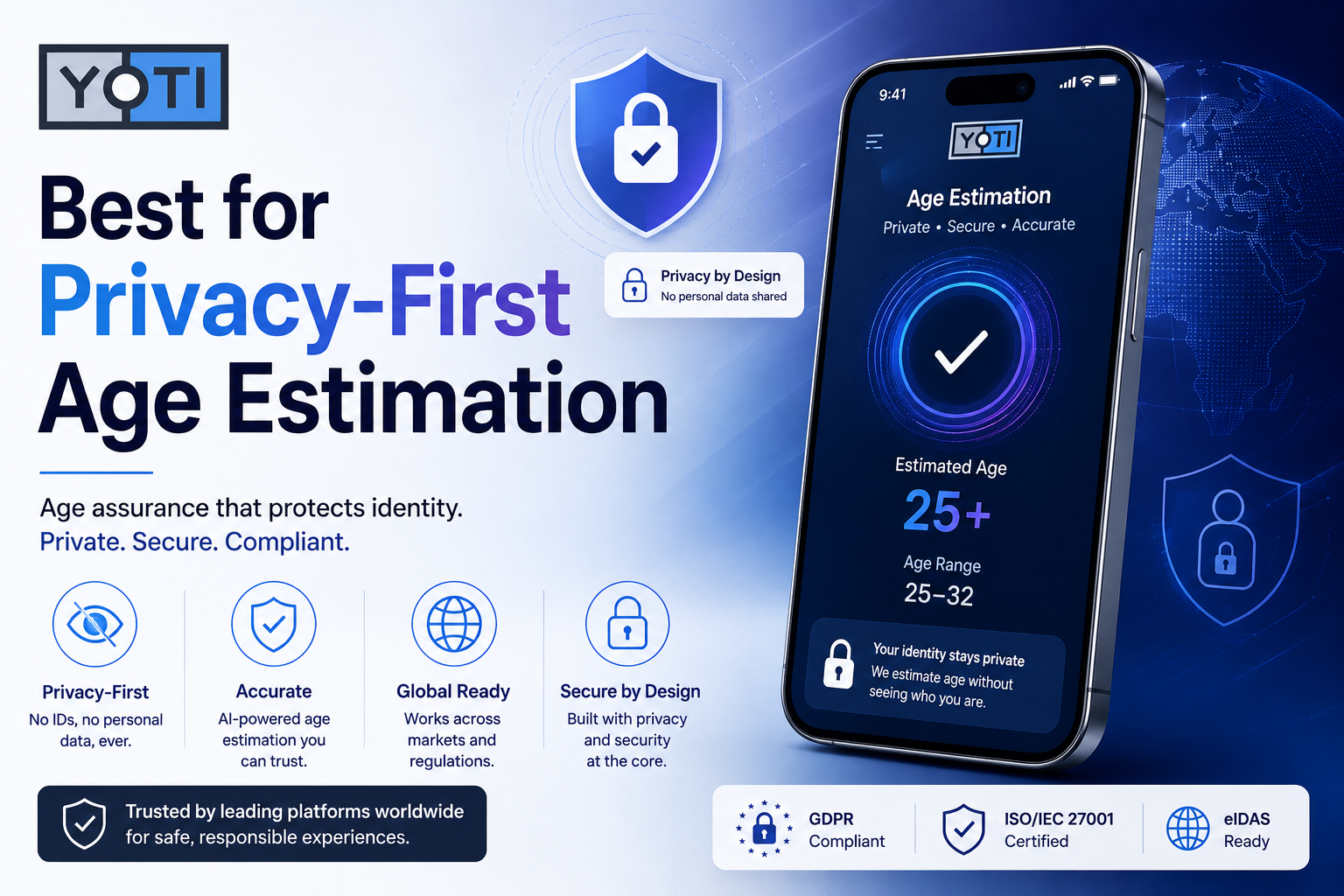
Features: facial age scan, optional ID upload for edge cases, reusable digital identity and proof-of-age credentials, liveness detection.
Pros: very low friction, no long-term storage of personal documents in most flows, and a strong track record with UK media and retail.
Cons: accuracy can be affected by poor lighting or camera quality, and it may not satisfy the highest-assurance requirements in strictly regulated sectors like gambling.
Best for: social platforms, retailers, and content sites where speed and privacy matter more than pinpoint-exact date-of-birth confirmation.
5. iDenfy — Best for Hybrid AI + Human Review
iDenfy pairs automated document and biometric checks with a human review layer, which reduces the odds of a false pass slipping through.
Features: document verification across a wide country list, 3D liveness detection, hybrid AI/human review, KYC/KYB/AML add-ons, and configurable age thresholds via dashboard or API.
Pros: the manual review backstop is genuinely useful for edge cases and higher-fraud sectors like iGaming and cannabis retail.
Cons: pricing is custom-quote only, which makes it harder to comparison-shop upfront.
Best for: regulated verticals — online dating, alcohol, vaping, cannabis — where a false pass carries real regulatory risk.
6. Persona — Best for Custom, Developer-Built Flows
Persona doesn’t sell a fixed age-verification product so much as a toolkit of configurable “blocks” your team assembles into whatever flow fits your product.
Features: no-code verification building blocks, conditional logic and branching, privacy-first data handling, and strong API/webhook support.
Pros: extremely flexible for product teams who want granular control over exactly what triggers a step-up check.
Cons: that flexibility means more setup time than an off-the-shelf tool, and per-check costs can add up at scale.
Best for: engineering-led teams building a custom onboarding or age-gating experience rather than adopting a vendor’s default flow.
7. Jumio — Best for Document-Heavy Regulated Industries
Jumio combines optional facial age estimation with deep document authentication, and supports ongoing re-authentication for returning users against a previously verified record.
Features: document-based age verification across 5,000+ ID types, optional facial estimation as a first screen, face-to-document matching, liveness detection.
Pros: strong document forensics and a mature platform trusted across banking and gaming.
Cons: heavier setup than lightweight, retail-oriented tools; pricing isn’t public.
Best for: regulated financial services and gaming platforms that need document-grade evidence as the default, not the exception.
8. Identomat — Best Value for Startups Needing Full KYC + Age Checks
Identomat bundles age verification into a broader, modular identity platform — ID verification, liveness, sanctions and PEP screening — at a price point generally more accessible than the largest enterprise vendors.
Features: selfie-to-ID matching, active and passive liveness detection, OCR-based document validation, sanctions/watchlist screening, API/SDK integration.
Pros: fast onboarding, a genuinely modular pricing structure so you’re not paying for AML tooling you don’t need, and support across 190+ countries.
Cons: the platform’s full capability set can be more than very small, low-risk businesses actually require.
Best for: startups and mid-market companies in fintech, iGaming, or crypto that need age verification alongside broader compliance tooling without enterprise-level pricing.
9. VerifyMyAge — Best for Small E-Commerce Sellers
If you’re running a Shopify or WooCommerce store and just need a plug-and-play age gate for alcohol, vaping, or knives, VerifyMyAge is built specifically for that use case.
Features: passive and document-based checks, “stealth” background confirmation for repeat customers, e-commerce plugin integrations.
Pros: genuinely fast to install, priced for smaller merchants, minimal engineering lift.
Cons: limited enterprise reporting and workflow customization compared to larger platforms.
Best for: independent online stores that need compliance without hiring a developer.
10. AgeChecked — Best for UK-Regulated E-Commerce and Gambling
AgeChecked is one of the few providers formally recognized under the UK’s age-verification framework, which matters if UK regulatory sign-off is a specific procurement requirement for you.
Features: a central age-verification gateway, browser plugin and API access, combined age estimation and document check.
Pros: UK-government-recognized status, quick setup for UK-focused merchants.
Cons: the product is optimized heavily for the UK market and offers fewer advanced identity features outside it.
Best for: UK online retailers and gambling operators who want a provider built around Ofcom’s specific expectations.
Performance: How Accurate Is Age Verification Software, Really?
Accuracy claims in vendor marketing are notoriously inconsistent, which is why independent benchmarks matter. The US National Institute of Standards and Technology (NIST) runs a Facial Age Estimation (FATE) evaluation that several vendors — including Regula and Incode — participate in and publish results from. A few things worth understanding before you trust a headline accuracy number:
- Age estimation is a range, not a fact. Even top-performing models are typically accurate to within one to three years, which is usually fine for an 18+ gate but risky if your legal threshold sits close to a common age (say, verifying 21+ where most flagged users cluster at 19–20).
- Document verification accuracy depends on document coverage. A platform claiming “99% accuracy” is only as good as its template library for the specific ID types your users actually present — a rural US state license or an older-format passport can trip up thinner document databases.
- False rejection rates matter as much as false acceptance rates. A tool that’s overly conservative will block legitimate adult users, hurting conversion; one that’s too permissive creates compliance exposure. Ask vendors for both numbers, not just overall “accuracy.”
- Speed varies more than you’d expect. Passive facial estimation checks typically complete in under two seconds. Full document-plus-liveness flows generally run five to twenty seconds, and hybrid AI-plus-human-review models (like iDenfy’s) can take minutes to hours depending on queue volume.
If accuracy and audit defensibility are central to your decision — which they should be for iGaming, financial services, and adult content — ask any shortlisted vendor for their most recent third-party benchmark results and their documented false-positive/false-negative rates by demographic group, since accuracy has historically varied by skin tone, gender, and age band across the industry.
Pricing and Credit Systems: What to Actually Expect in 2026
Almost no major provider publishes flat public pricing, which makes budgeting genuinely annoying. Here’s how the market generally structures cost in 2026:
- Per-check / per-credit pricing is the dominant model. You buy a bundle of verification “credits,” and each completed check (or attempted check, depending on the vendor) consumes one. Rates commonly range from roughly $0.30 to $0.50 per check for lightweight facial age estimation, up to $1.50–$3.00+ per check for full document authentication with liveness and face matching, and higher still if AML/sanctions screening is bundled in.
- Tiered monthly plans bundle a set number of credits with support and SLA levels — common for mid-market platforms like iDenfy and Identomat, where entry tiers can start in the low hundreds of dollars per month.
- Custom enterprise pricing is standard for Jumio, Sumsub, Trulioo, Regula, and Socure — expect a sales conversation and volume-based discounts rather than a self-serve checkout.
- Free or freemium tiers exist for a handful of vendors (Yoti offers free consumer-facing tools alongside its paid business API) but are rarely sufficient for production compliance use.
- Watch for hidden costs: charges for manual review escalations, data retention/storage fees, per-country surcharges for less common document types, and minimum monthly commitments that punish low-volume seasonal businesses.
The honest advice here: request a quote based on your actual projected monthly check volume, not a generic “starter plan,” because per-check pricing at low volume can look nothing like the rate you’ll get at scale.
Age Verification by Use Case
For E-Commerce Sellers
If you sell alcohol, vaping products, knives, or CBD, your priority is a lightweight plugin that doesn’t tank checkout conversion. Look at VerifyMyAge, AgeChecked, or Yoti — all designed to slot into Shopify/WooCommerce with minimal engineering, using passive checks for repeat customers and stepping up to document verification only when needed.
For Content Creators and Platforms
If you run a community, forum, or content platform that needs to gate age-restricted material (or simply demonstrate “highly effective age assurance” under laws like the UK’s OSA), facial age estimation from Yoti, FaceTec, or Persona offers a fast, privacy-conscious first layer, with document verification available as a fallback for borderline cases.
For Marketers and Agencies
If you’re advising clients across multiple verticals and countries, you need a partner with configurable, jurisdiction-aware rules rather than a fixed flow — Regula, Sumsub, or Trulioo let you tune verification requirements per client, per region, without rebuilding the integration each time.
For Regulated Businesses (iGaming, Fintech, Alcohol, Cannabis)
Here, document-grade evidence isn’t optional. Jumio, iDenfy, Identomat, or Socure combine ID authentication, liveness, and audit trails suited to regulators who will ask for proof, not just a pass/fail flag.
Alternatives Worth Knowing
Beyond the providers profiled above, a few other names come up often enough to mention: Entrust (identity orchestration for enterprises already using its broader credential-management suite), IDnow (strong in Germany and the EU with video-agent flows), Mitek (mobile-first, popular in banking apps), AU10TIX (fast document scanning at enterprise volume), GBG/IDology (US/UK data-matching for point-of-sale age checks), and LexisNexis Instant Age Verify (non-biometric, data-broker-based confirmation common in US retail and government use). None of these unseat the leaders above for most buyers, but each has a specific niche where it’s the stronger pick.
Watch: Age Verification, Explained
For a broader look at how the age-verification landscape has shifted over the past year and what businesses are learning from early enforcement, these two explainers are worth ten minutes of your time:
📺 Age Verification Is Here — So What Have We Learned? — a look back at the first wave of enforcement across regions and what it means for platforms still catching up.
📺 Age Verification Just Won — a breakdown of how age verification moved from a niche compliance topic to a mainstream internet policy shift.
How to Choose the Right Age Verification Software
Work through these questions before you request a demo:
- What decision do you actually need to make? “Probably over 18” and “confirmed date of birth from a valid ID” are different products with different price points — don’t over-buy assurance you don’t legally need, and don’t under-buy it where you do.
- Which jurisdictions do your users come from? If you serve the UK, EU, and multiple US states simultaneously, you need configurable rules per region, not a single fixed flow.
- How much friction can your conversion funnel tolerate? A 20-second document scan will lose more users at checkout than a 2-second facial estimate — know your tolerance before you commit.
- What’s your fraud risk? Could someone plausibly use a sibling’s or parent’s ID? If so, biometric face-matching against the document isn’t optional.
- Do you need this bundled with broader KYC/AML? If you’re already doing identity verification for fraud or compliance reasons, a modular platform (Identomat, Sumsub, Persona) that bundles age checks in avoids paying for two overlapping systems.
- Can the vendor show you real accuracy data? Ask for NIST FATE results or equivalent third-party benchmarks, plus false-accept and false-reject rates — not just a marketing claim.
Frequently Asked Questions
What is the best age verification software overall? There isn’t a single universal winner — it depends on your risk profile. For flexible, all-in-one coverage, Regula, Sumsub, and Identomat are strong general picks. For lightweight retail gating, Yoti and VerifyMyAge are better fits.
What’s the difference between age verification and age estimation? Age verification confirms an exact date of birth, typically by authenticating a government ID. Age estimation predicts an age range from biometric data, usually a selfie, without confirming identity or an exact birthdate.
Is a simple “I am 18” checkbox still legal? In most regulated contexts as of 2026, no. Regulators including the UK’s Ofcom have explicitly ruled self-declaration insufficient for “highly effective” age assurance under laws like the Online Safety Act, and several US states have similar standards.
How much does age verification software cost? Expect roughly $0.30–$0.50 per check for basic facial age estimation and $1.50–$3.00+ per check for full document verification with liveness detection, though most enterprise vendors quote custom, volume-based pricing.
Does age verification software store my personal data? It depends on the vendor and the method. Facial age estimation tools like Yoti are designed to avoid retaining document data. Document-based platforms typically retain some data for audit purposes, subject to your configured retention policy and applicable privacy law — always check a vendor’s data retention terms directly.
Can age verification software be tricked? No system is perfectly unbeatable, but modern platforms combining document authentication, liveness detection, and biometric face-matching are significantly harder to spoof than a self-declared birthdate, and layered/step-up verification reduces the odds further.
Final Verdict
If you need one honest recommendation: most growing businesses are best served by a layered platform — something that starts with a fast, low-friction check and only escalates to document verification when risk actually warrants it. Among the providers reviewed here, Regula and Sumsub stand out for combining that flexibility with strong compliance depth, while Identomat and iDenfy offer excellent value if you want KYC and age checks bundled without enterprise pricing. If your business is small, low-risk, and mainly needs a fast e-commerce gate, Yoti or VerifyMyAge will get you compliant without slowing down checkout.
Whichever you choose, don’t treat this as a one-time integration. Regulations are still moving — request quarterly updates from your vendor on jurisdiction coverage and don’t assume a setup that passed compliance in 2026 will still pass in 2028 without a review.