
12 Best LLM Tracking Tools to Monitor AI Search in 2026
Google isn’t the only front door to your brand anymore. Every day, millions of people ask ChatGPT, Gemini, Claude, and Perplexity to recommend a product, compare vendors, or explain a topic — and never see a traditional list of blue links. Gartner has projected that traditional search engine volume could drop by roughly a quarter by 2026 as this behavior spreads, and AI Overviews alone now reaches billions of users a month inside Google itself.
That shift creates a blind spot. You might know exactly where you rank on Google, down to the keyword. But do you know what ChatGPT says about you when someone asks for “the best [your category] tool”? Do you know if Perplexity is quietly recommending your closest competitor instead? That’s the gap LLM tracking tools exist to close.
This guide breaks down what LLM tracking tools actually do, the 12 platforms worth your attention in 2026, real pricing (including credit-based models), honest pros and cons, and which tool fits your specific situation — whether you’re an e-commerce seller, a solo content creator, an in-house marketer, or an enterprise brand team.
Quick Answer
LLM tracking tools (also called AI visibility tools, AEO tools, or GEO trackers) are software platforms that repeatedly ask AI chatbots and answer engines — ChatGPT, Gemini, Claude, Perplexity, Copilot, Google AI Overviews and AI Mode — a set of prompts related to your industry, then measure whether, how, and in what context your brand shows up. The strongest options in 2026 are Profound and Semrush AI Toolkit for enterprise-scale coverage, Peec AI and AthenaHQ for mid-market teams that want to act on the data, and Otterly.AI or RankLLM for solo marketers and small businesses on a tight budget. Most tools price by prompt volume and number of AI models tracked, ranging from around $20–$29/month at the entry level to $500+/month for full multi-engine enterprise coverage.
What Is an LLM Tracking Tool?
An LLM tracking tool is a monitoring platform that runs a curated list of prompts — the kinds of questions your real customers ask — against multiple AI models on a recurring schedule (usually daily or weekly). It then parses each response to check for:
- Whether your brand name appears at all
- Whether you’re linked or cited as a source
- How you’re described (sentiment, accuracy, positioning)
- Which competitors show up instead of you, or alongside you
- Which third-party pages, forums, or databases the AI pulled its facts from
Think of it as the AI-era equivalent of a rank tracker. A traditional rank tracker tells you where your page sits in Google’s list of ten blue links. An LLM tracking tool tells you whether your brand made it into the one paragraph an AI model decided to generate instead of showing that list at all.
Why LLM Visibility Tracking Matters Right Now
A few numbers explain why this category went from niche to necessary in under two years:
- Independent research on AI search behavior suggests roughly a third of consumers now begin some purchase research inside an AI assistant rather than a search engine.
- OpenAI has reported ChatGPT crossing 900 million weekly active users, and Google’s own AI Overviews now surface for a large share of everyday searches.
- Citation analysis of hundreds of millions of AI answers shows each platform pulls from different sources — ChatGPT leans heavily on Wikipedia and Reddit, Google AI Overviews draws heavily on Reddit, YouTube, and Quora, and Perplexity favors Reddit and video content. That means “ranking well on Google” and “getting cited by ChatGPT” are no longer the same job.
- LinkedIn moved from outside the top 20 cited domains to the single most-cited source for professional and B2B queries within the last several months, a reminder of how quickly citation patterns can shift.
The practical consequence: your SEO dashboard can look healthy while your AI visibility quietly erodes, because nobody on the team is watching what the AI actually says. This is especially relevant for companies providing AI integration services, where visibility across AI assistants can significantly impact lead generation.
How We Evaluated These Tools
We compared each platform the way a marketing team actually would before signing a contract — not just by reading homepage claims. Our criteria:
- AI platform coverage — how many models (ChatGPT, Gemini, Claude, Perplexity, Copilot, Grok, Google AI Overviews/AI Mode) it tracks, and on which plan tier
- Prompt depth and refresh rate — how many prompts you can track and how often data updates
- Citation and source-level detail — whether it tells you which pages the AI is pulling from, not just that you were mentioned
- Action layer — does it stop at reporting, or does it point you toward specific fixes (schema, content briefs, outreach targets)?
- Pricing transparency and value — published pricing vs. demo-gated “contact us” pages
- Independent user feedback — G2, Trustpilot, Reddit, and community sentiment where available
LLM Tracking Tools Compared at a Glance
| Tool | Best For | AI Models Tracked | Starting Price | Action Layer |
|---|---|---|---|---|
| Profound | Large enterprise GEO programs | Up to 10 (ChatGPT, Gemini, Claude, Perplexity, Copilot, Grok, Meta AI, DeepSeek, AI Overviews, AI Mode) | ~$99–$499/mo self-serve; custom enterprise from ~$2,000/mo | Strong (Agents, Prompt Volumes) |
| Semrush AI Toolkit | Existing Semrush users wanting SEO + AI in one place | ChatGPT, AI Overviews, AI Mode, Gemini, Perplexity | ~$99/mo per domain (add-on) | Moderate |
| Ahrefs Brand Radar | Large-scale competitor and market research | AI Overviews, AI Mode, ChatGPT, Perplexity, Copilot, Gemini, Grok | ~$398–$699/mo | Light |
| Peec AI | Agencies and content-led teams wanting fast action | ChatGPT, Gemini, Perplexity, Claude and more | ~$85–$95/mo | Strong (Pitch Workspaces) |
| AthenaHQ | Mid-market teams wanting monitoring + optimization | ChatGPT, Gemini, Perplexity, Claude | ~$295/mo | Strong |
| Otterly.AI | Freelancers and small teams on a tight budget | ChatGPT, AI Overviews, Perplexity, Copilot (Claude/Gemini as add-ons) | ~$29/mo | Moderate (GEO Audit) |
| SE Ranking AI Tracker | Agencies wanting SEO + GEO in one dashboard | ChatGPT, Perplexity, Gemini, AI Overviews, AI Mode | ~$89–$129/mo | Moderate |
| RankLLM | First-time AI visibility checks, citation building | ChatGPT, Gemini, Perplexity, Claude | ~$20/mo | Strong (Listicle Marketplace) |
| AIClicks | Teams wanting a visibility score plus a to-do list | Up to 11 models depending on plan | ~$39–$59/mo | Strong (AI agents) |
| Scrunch AI | Enterprises wanting to deliver content to AI crawlers, not just monitor | ChatGPT, Gemini, Claude, Perplexity | ~$250–$300/mo | Very strong (AXP) |
| Rankshift.ai | Agencies managing many client brands | ChatGPT, Perplexity, Gemini, Claude, AI Overviews, Meta AI, Mistral | ~€69/mo | Moderate |
| AEO Vision | Marketers wanting a prioritized fix-it plan after every audit | ChatGPT, Gemini, Claude, Perplexity, AI Overviews & AI Mode | From ~$9/mo | Strong (agentic audit) |
Pricing changes frequently in this category — always confirm current rates on the vendor’s pricing page before buying.
Here’s a look at how one creator breaks down the current AI visibility landscape and why the category exploded so fast:
The 12 Best LLM Tracking Tools in 2026
1. Profound — Best for Enterprise GEO Programs
Profound has become the category’s most recognized enterprise name, backed by more than $150M in funding and used by large brands running structured AI-visibility programs across regions and business units.
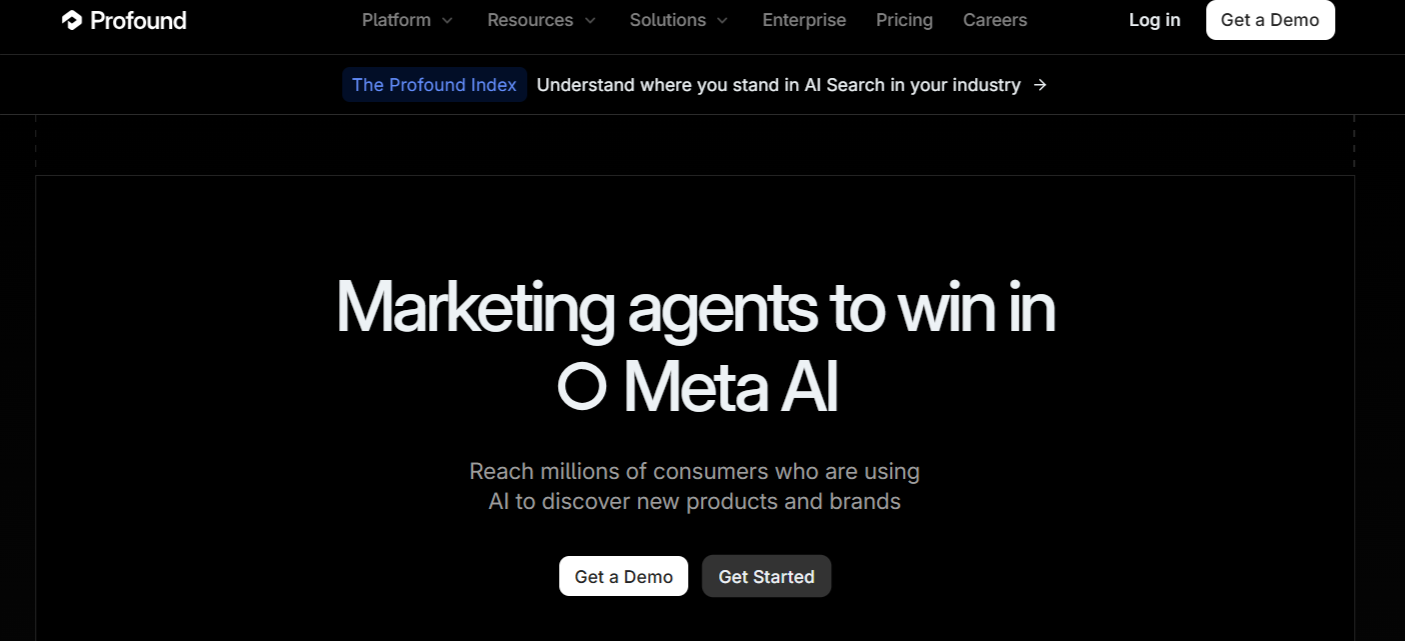
Features: Daily prompt tracking across up to ten AI models, citation and source analysis, sentiment tracking, competitive benchmarking, “Prompt Volumes” (real consumer query data instead of only synthetic prompts), Shopping Insights for ChatGPT commerce, and credit-based “Agents” that can generate AEO content.
Pricing: Entry pricing has shifted between roughly $99 and $499 a month depending on the source and month you check, but full multi-engine access and agency-style multi-brand management typically require a custom enterprise quote — often reported in the $2,000–$5,000+/month range for larger deployments. Agent runs are billed on a separate credit system, with the platform showing an estimated credit cost before each run.
Pros: Deepest platform coverage in the category; strong citation-source intelligence; real (not just simulated) prompt data; built for board-level reporting. Cons: Pricing is not fully transparent past the entry tier; no native multi-client workspace, which frustrates agencies managing several brands; steep learning curve without a dedicated analyst.
2. Semrush AI Toolkit — Best for Existing Semrush Users
If your team already lives inside Semrush for keyword research and backlinks, the AI Toolkit bolts AI visibility tracking onto a platform you already know.
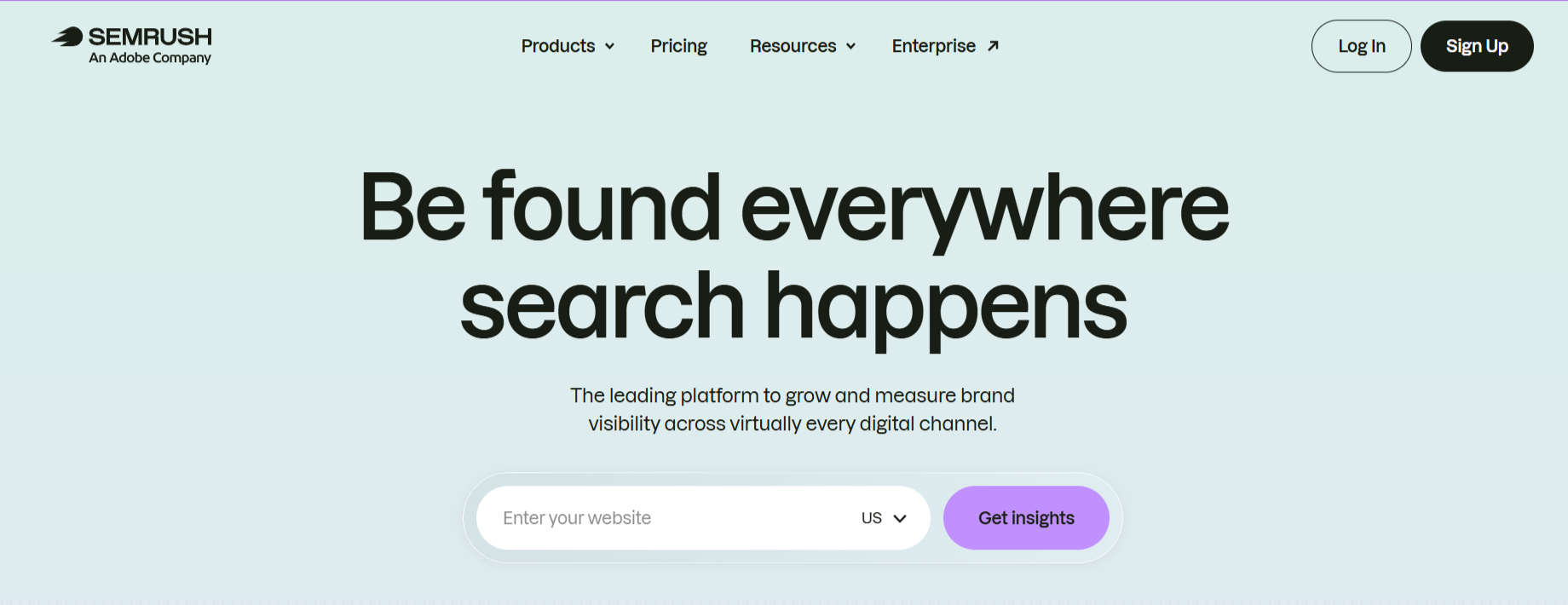
Features: Visibility Overview, Prompt Research, Brand Performance, Competitor Research, and an AI Search Site Audit, all built on a large, frequently refreshed prompt database.
Pricing: Roughly $99/month per domain as an add-on to an existing SEO subscription, or bundled through “Semrush One” starting around $199/month.
Pros: No new login or vendor relationship for teams already invested in Semrush; huge underlying prompt database; familiar workflow. Cons: AI visibility is a secondary module bolted onto a legacy SEO tool, so per-engine depth trails purpose-built AEO platforms; pricing stacks on top of your existing SEO bill.
3. Ahrefs Brand Radar — Best for Large-Scale Market Research
Ahrefs applies its search-backed prompt database to AI visibility, making Brand Radar useful for teams that want to research an entire category rather than track one brand narrowly.
Features: Tracking across seven AI surfaces, hundreds of millions of monthly prompts, AI Share of Voice, cited-domain tracking, and beta visibility data spanning YouTube, TikTok, and Reddit.
Pricing: Around $398/month for individual platform tracking, or roughly $699/month for full access across all supported platforms with several thousand custom checks included.
Pros: Excellent for competitor and market-level research; deep integration with the broader Ahrefs SEO ecosystem. Cons: Pricing is high relative to purpose-built AEO tools; early user feedback on forums suggests smaller or mid-sized brands sometimes get thin data because the underlying prompt volume assumes larger search footprints.
4. Peec AI — Best for Agencies That Want to Act Fast
Peec has grown quickly out of Germany into one of the more action-oriented mid-market platforms, connecting visibility data directly to content recommendations.
Features: Real-time tracking, multi-language support, custom alerts for visibility gains or losses, competitor benchmarking, and “Pitch Workspaces” for turning gaps into content briefs without leaving the platform.
Pricing: Roughly $85–$95/month at the entry tier, scaling with prompt volume and number of models tracked; some sources cite plans up to roughly $500/month for larger teams.
Pros: Genuinely action-oriented rather than dashboard-only; flexible per-model pricing; well-liked by SEO and content teams already comfortable with visibility data. Cons: Lower tiers cap you at only a handful of AI models; per-platform pricing can add up quickly if you want broad coverage.
5. AthenaHQ — Best for Monitoring Plus an Action Center
Backed by Y Combinator, AthenaHQ pairs prompt-based auditing with a built-in action layer designed to close the loop between “here’s your gap” and “here’s what to publish.”
Features: Prompt-based visibility auditing, citation tracking, and an action center that recommends specific content and outreach moves.
Pricing: Self-serve plans start around $295/month; no free trial is currently offered.
Pros: Strong for teams that want a partner in closing visibility gaps, not just a report; solid case studies around citation growth. Cons: No prompt-volume benchmarking (you get a list of prompts but not how often people actually ask them); pricier than budget-tier competitors.
6. Otterly.AI — Best Budget Option for Small Teams
Otterly is consistently the cheapest credible entry point into this category, and it has picked up real third-party recognition (G2 High Performer, a 2025 Gartner Cool Vendor mention) rather than just marketing claims.
Features: Tracks four core AI models by default (ChatGPT, Google AI Overviews, Perplexity, Copilot), with Claude, Gemini, and Google AI Mode available as paid add-ons; a GEO Audit covering more than 25 on-page and technical checkpoints; keyword-to-prompt conversion so you don’t have to write prompts manually.
Pricing: Lite plan starts around $29/month; broader plans run up to roughly $489/month depending on volume and model coverage.
Pros: Best price-to-feature ratio in the category for solo operators and small businesses; simple setup; decent citation analysis for the price. Cons: Claude and Gemini cost extra; refresh cycles are weekly rather than daily on lower tiers; less depth than dedicated mid-market tools if you need granular sentiment analysis.
7. SE Ranking AI Tracker — Best for SEO + GEO in One Dashboard
SE Ranking folds AI visibility tracking into its existing SEO suite, which appeals to agencies that want one login and one client-facing report for both disciplines.
Features: Brand mention and link tracking inside AI answers, competitor visibility, cached copies of AI responses for later review, API and MCP access, and integrations with Looker Studio, AgencyAnalytics, and Whatagraph.
Pricing: The AI Search add-on runs around $89/month on top of an existing SE Ranking plan, or roughly $129/month as a standalone Core plan covering around 100 prompts.
Pros: Genuinely useful for agencies that already report on traditional rankings; API access supports custom dashboards; mature, well-reviewed parent platform. Cons: Can feel like overkill if all you want is a simple AI visibility score; full workflows may require stacking add-ons.
8. RankLLM — Best for a First AI Visibility Check
RankLLM is one of the newer, more affordable tools in this space, and it stands out by connecting tracking directly to citation-building, rather than stopping at “here’s your score.”
Features: Runs a batch of live AI visibility checks using recommendation-style prompts, a free Citation Marketplace for listicle placements, a Listicle Finder and Niche Edit Finder for outreach opportunities, and ready-to-send editor briefs.
Pricing: A free account includes one scan; paid plans start around $20/month for a single brand, scaling to roughly $100/month for agencies tracking up to 50 brands.
Pros: Very low barrier to entry; genuinely useful next step (citation building) after you see a low score; simple dashboard for beginners. Cons: Narrower model coverage than enterprise tools; a newer product with a shorter review track record.
9. AIClicks — Best for a Visibility Score With a Built-In To-Do List
AIClicks positions itself as a command center for LLM visibility rather than a passive dashboard, with strong early G2 and Trustpilot ratings.
Features: Tracks prompts and citations across up to eleven AI surfaces depending on plan, industry benchmarking, real AI-referral-traffic tracking (tying AI mentions back to actual site visits), and AI agents that carry out visibility-improvement tasks.
Pricing: Starter plans have run from roughly $39–$59/month for a limited prompt and model allowance, scaling to around $189–$499/month for broader coverage, with custom enterprise pricing above that.
Pros: Clear recommendations, not just raw numbers; useful source analysis for digital PR; ties AI visibility to real traffic. Cons: Not a substitute for a full SEO suite; lower tiers restrict how many models you can track simultaneously.
10. Scrunch AI — Best for Enterprises That Want to Deliver Content to AI Crawlers
Scrunch leans further into “optimization” than most tools on this list, with an Agent Experience Platform (AXP) that serves an AI-friendly version of your site directly to crawlers.
Features: Multi-brand management, AI crawler and bot-traffic logging, citation tracking, and the AXP layer for actively shaping what LLMs retrieve from your site.
Pricing: Monitoring typically starts around $250–$300/month.
Pros: Strong security posture and multi-brand support for enterprise programs; goes beyond measurement into active content delivery. Cons: Heavier and more technical than teams need if they just want a weekly visibility snapshot; the optimization layer adds cost you may not use right away.
11. Rankshift.ai — Best for Agencies Managing Many Client Brands
Rankshift is built specifically around agency workflows, offering unlimited projects and users on every plan rather than gating seats behind higher tiers.
Features: Captures AI responses directly from the interface (not just via API), visibility score and share-of-voice tracking, sentiment tracking, AI crawler logs, a content brief generator, and integrations with Looker Studio, BigQuery, and Power BI.
Pricing: Starter plans begin around €69/month billed annually, scaling to roughly €359/month for higher prompt volumes.
Pros: Unlimited projects and users make multi-client management practical; strong source analytics for digital PR teams. Cons: Credit-based prompt usage requires planning if you’re tracking a lot of queries; not a full SEO suite on its own.
12. AEO Vision — Best for a Prioritized Fix-It Plan
AEO Vision differentiates itself by pairing daily tracking with an “agentic audit” that turns raw visibility data into a step-by-step improvement checklist, including schema recommendations and crawler-access fixes.
Features: Daily monitoring across ChatGPT, Gemini, Claude, Perplexity, and Google AI Overviews/AI Mode; custom prompt tracking; competitor visibility mapping; Reddit-thread insight tracking to guide off-page strategy.
Pricing: Entry plans start at roughly $9/month, which is unusually low for the category, with higher tiers unlocking deeper audit and reporting features.
Pros: Very low entry price for a tool with real audit depth; execution-focused output (specific fixes, not just scores); useful off-page (Reddit) insight tracking. Cons: Newer entrant with a smaller public review footprint than category leaders like Profound or Semrush.
Performance Analysis: How Accurate Are These Tools, Really?
This is the question most buyers skip — and it matters more here than with traditional SEO software.
AI answers are non-deterministic. The same prompt sent twice, even seconds apart, can return a different answer, a different set of recommended brands, and different citations. A tool that queries a prompt once and reports the result as fact is measuring noise, not a trend. Better tools run each prompt multiple times (or across many prompt variations) and report an aggregate percentage — often called Share of Model or AI Visibility Score — rather than a single yes/no answer.
API-based vs. front-end monitoring. Some platforms query AI models through official APIs, which is fast and cheap but can miss what a real user actually sees on screen, including formatting, follow-up suggestions, and shopping widgets. Others simulate real front-end sessions, which more closely mirrors the user experience but costs more to run at scale. If your buying decision is close, ask each vendor directly which method they use — it’s a fair, and revealing, question.
Refresh rates vary widely. Some tools update daily; others weekly. If your category moves fast (product launches, news-driven topics, seasonal retail), a weekly refresh can leave you reacting to a stale picture for days.
Independent testing found meaningful accuracy gaps between vendors when checked against manual API queries, with match rates in one industry benchmark ranging from roughly 94% to 97% depending on the platform. None of that is disqualifying on its own, but it’s a reminder to treat every score as directionally useful rather than a precise, guaranteed number — and to prioritize trend lines over single snapshots.
Also Read : Best Age Verification Software in 2026: The Complete Buyer’s Guide
Use Cases by Audience
For E-Commerce Sellers
Shopping behavior is moving into AI chat faster than almost any other category. ChatGPT’s shopping features and AI Overviews’ product carousels now directly influence which products get considered before a shopper ever visits a comparison site. If you sell online:
- Prioritize tools with Shopping Insights or product-comparison tracking (Profound is currently the most developed here)
- Track prompts phrased the way real buyers search: “best [product] under $100,” “[Product A] vs [Product B],” “is [brand] worth it”
- Watch for AI models recommending outdated pricing, discontinued products, or the wrong marketplace listing — a wrong price quoted by an AI assistant can quietly cost you sales
For Content Creators and Bloggers
If your revenue depends on traffic and citations rather than direct sales, your priority is citation tracking — knowing which of your articles get pulled into AI answers and which get ignored in favor of a competitor’s roundup post.
- Budget-friendly tools like Otterly.AI, RankLLM, or AEO Vision give solid citation visibility without an enterprise price tag
- Pay attention to which platforms cite you (Reddit and YouTube dominate citations on several AI engines, so a presence there compounds your odds of being cited elsewhere)
- Use listicle- and citation-building features (RankLLM’s marketplace, for example) to actively earn more third-party mentions instead of only monitoring the ones you already have
For Marketers and SEO/Agency Teams
Agencies juggling multiple client brands should weight three things heavily: multi-client workspace support, white-label reporting, and predictable pricing.
- Rankshift.ai and SE Ranking both support multi-brand or agency-style workflows well
- If a tool restricts you to one workspace per account (a documented limitation of some enterprise platforms), factor in the operational cost of managing logins separately for each client
- Pair an AI visibility tool with your existing SEO stack rather than replacing it — the two disciplines overlap but aren’t identical, since AI models cite specific passages, not entire ranked pages
For Businesses and Enterprise Brand Teams
Large organizations should weigh governance and reporting as heavily as raw visibility data:
- Look for SOC 2 Type II compliance, SSO, and role-based access if the data will inform board-level or investor reporting
- Prompt-volume data (real, opted-in consumer queries rather than only synthetic ones) is worth paying a premium for if your category has genuinely high search interest
- Budget realistically: enterprise-grade, multi-engine coverage across a full brand portfolio tends to land in the $2,000–$5,000+/month range once you move past entry-level self-serve tiers
Here’s a regional walkthrough that’s useful even outside its specific market, since it covers the same core evaluation criteria most buyers should apply:
Key Metrics to Understand Before You Buy
- Share of Model / AI Visibility Score: The percentage of tracked prompts where your brand is mentioned or recommended
- Citation Provenance: The specific domains and pages an AI model pulled facts from — critical for directing PR and content efforts
- Sentiment: Whether the tone and framing around your brand name is positive, neutral, or negative
- Competitor Share of Voice: How often competitors appear in the same prompts, and whether they’re winning ground you’re losing
- Query Fan-Out: The secondary, related questions an AI model generates internally to answer a complex query — optimizing for these sub-questions increases your odds of being cited
Also Read : Why Social Apps Are Ditching the Feed for Live, Profile-First Communities
Free and Low-Cost Alternatives Worth Knowing About
Not every team needs a paid subscription on day one. Several vendors listed above (RankLLM, AEO Vision, Semrush) offer a free one-time audit, and Google Search Central’s own guidance confirms that the fundamentals of crawlability, clean site structure, and authoritative content remain the foundation AI systems build on — meaning a manual audit using free tools (checking your robots.txt for AI crawler access, manually running your top 20 customer questions through ChatGPT and Perplexity yourself) is a legitimate starting point before you commit budget to ongoing monitoring.
How to Choose the Right LLM Tracking Tool
- New to AI visibility tracking? Start with RankLLM, Otterly.AI, or AEO Vision’s low-cost entry plans.
- Need SEO and AI visibility in one dashboard? SE Ranking or Semrush AI Toolkit.
- Want a tool that tells you what to fix, not just what’s wrong? Peec AI, AthenaHQ, AIClicks, or AEO Vision.
- Running AI visibility as a billable service for multiple clients? Rankshift.ai or SE Ranking, for the multi-brand and white-label support.
- Doing enterprise-scale competitive research? Ahrefs Brand Radar or Profound.
- Need content actually delivered to AI crawlers, not just measured? Scrunch AI.
- Working with a tight budget under $50/month? Otterly.AI Lite or RankLLM Starter.
Frequently Asked Questions
What is the difference between an LLM tracking tool and a traditional rank tracker? A rank tracker tells you where your page lands among Google’s ten blue links for a keyword. An LLM tracking tool tells you whether your brand gets mentioned, cited, or recommended inside the single synthesized answer an AI model generates instead of a ranked list. The inputs (prompts vs. keywords) and outputs (a sentence vs. a position) are fundamentally different.
Are LLM tracking tools accurate? They’re accurate at spotting trends across many prompts run over time, but no tool can guarantee it shows exactly what a specific user saw in a specific conversation, because AI answers are probabilistic and vary by user, region, and moment. Treat scores as directional signals and prioritize the trend line over any single data point.
Do I still need traditional SEO if I’m tracking AI visibility? Yes. AI models don’t invent information — they retrieve and synthesize it from crawlable, indexed content on the live web. Clean site structure, fast crawlability, and authoritative content remain the foundation that makes you eligible to be cited in the first place.
How much do LLM tracking tools cost in 2026? Entry-level tools start around $9–$29/month for a single brand with limited model coverage. Mid-market platforms with multi-model tracking and action recommendations typically run $85–$300/month. Enterprise deployments with full multi-engine coverage, prompt-volume data, and dedicated support commonly land between $500 and $5,000+/month depending on scope.
Can these tools improve my AI visibility, or do they just measure it? Most are primarily measurement tools. A smaller group — including AEO Vision, Peec AI, AthenaHQ, RankLLM, and Scrunch AI — go further by generating specific recommendations, content briefs, schema fixes, or citation-building opportunities. If action matters as much as measurement to you, weight that feature heavily in your comparison.
Which AI platforms should I prioritize tracking first? Start with ChatGPT and Google AI Overviews, since they currently account for the largest share of AI-driven search volume for most industries. Add Perplexity if your audience skews technical or research-oriented, and add Claude or Gemini if you sell to enterprise or software buyers.
Final Verdict
There’s no single “best” LLM tracking tool — only the best fit for your budget, team size, and how hands-on you want to be with the resulting data.
If you’re a solo creator or small business testing the waters, start with Otterly.AI, RankLLM, or AEO Vision — all offer genuine tracking capability under $30/month without locking you into a long contract. If you’re a marketing agency juggling several client brands, Rankshift.ai and SE Ranking offer the multi-brand workflows and reporting you’ll actually use week to week. If you’re an enterprise brand team with budget to match, Profound remains the deepest, most funded platform in the category, with Ahrefs Brand Radar and Semrush AI Toolkit as strong options if you want AI data sitting inside a suite you already pay for.
Whichever you choose, the real value isn’t the dashboard — it’s what you do with what it shows you. Pick a tool you’ll actually open every week, act on the gaps it finds, and treat the score less like a vanity metric and more like the newest channel your customers are already using to make decisions about you.