
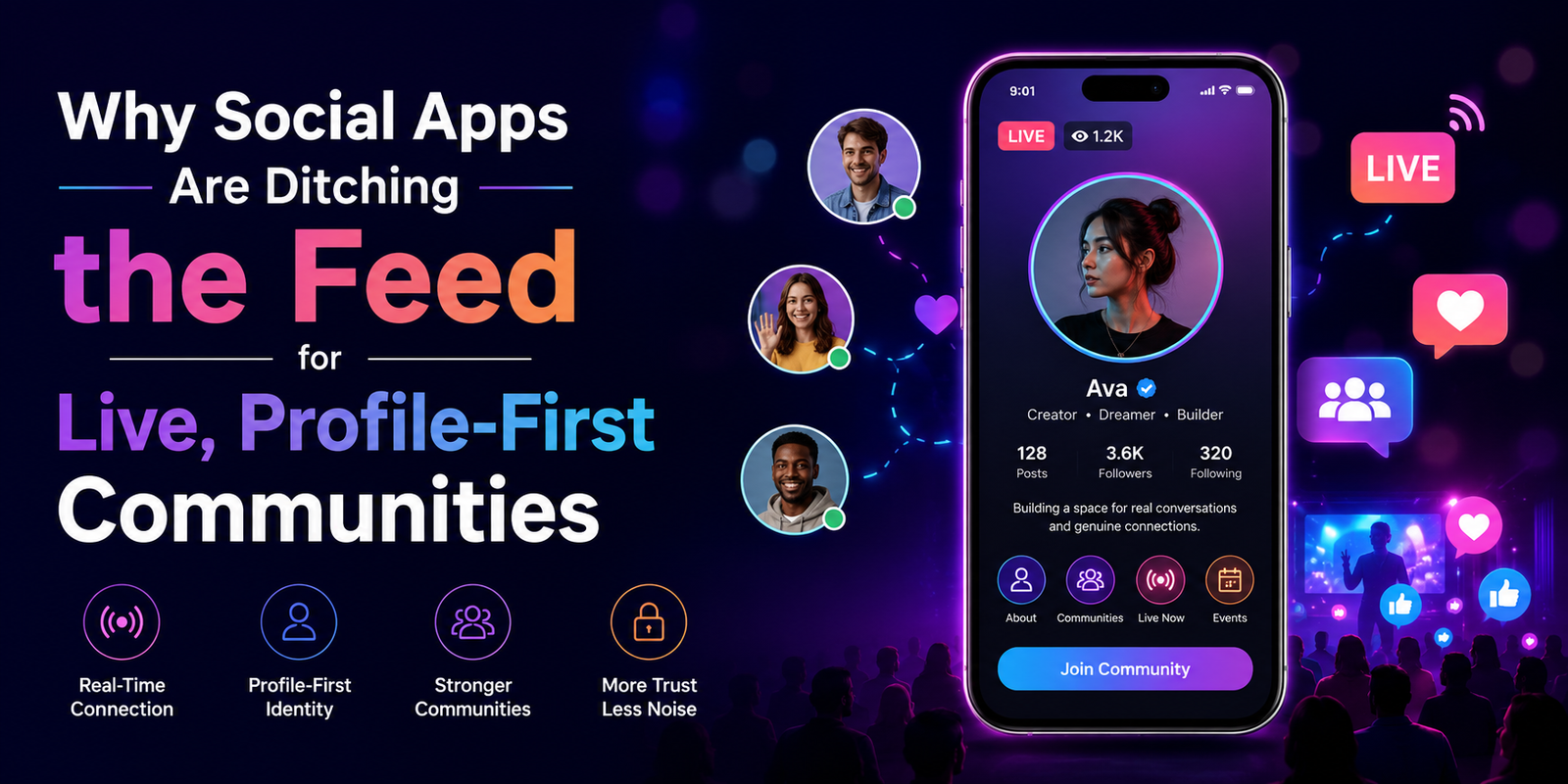
Why Social Apps Are Ditching the Feed for Live, Profile-First Communities
Open any major social app today and you’ll notice something the 2015 version of that same app never had: a live badge on someone’s avatar, a story ring, a level or badge next to a username, a “go live” button sitting right where the compose box used to live alone. This isn’t cosmetic. It’s the clearest signal yet that the feed — the single scrolling list of posts that defined social media for over a decade — is no longer the product. It’s just one feature inside a much bigger one.
This shift is backed by real behavior, not just design trends. Streaming now accounts for over 47% of all US TV viewing, live commerce is on track to become a trillion-dollar-plus global market in 2026, and platforms like Discord, BeReal, and TikTok Live have proven that people don’t just want to watch content anymore — they want to be present for it, with an identity attached. Below, we unpack exactly why this shift is happening, what it looks like in practice, and what it means for anyone building, using, or investing in a social product.
Key Takeaways
- The passive feed model is hitting a ceiling. Algorithmic feeds mixing ads, creator content, and personal updates leave users with high screen time but low feelings of genuine community — a gap multiple 2026 industry reports now describe as “engagement without connection.”
- Live features create something feeds structurally cannot: shared timing. Watching or joining something in the moment, together with others, produces a stronger sense of community than asynchronous content ever will.
- Profiles have evolved from static ID cards into social hubs — showing activity, interests, status, and trust signals that give people a reason to start a conversation.
- The market data backs this up hard: live commerce alone is projected to top $1 trillion globally in 2026, and the broader live e-commerce market is forecast to exceed $1.6 trillion in 2026 growing toward $4.3+ trillion by 2035.
- Apps like Discord, Twitch, TikTok, and newer entrants such as Aveola are converging around the same formula: stories + live streams + messaging + rich profiles + status/rewards systems, all in one connected space.
- Safety infrastructure — moderation, reporting, blocking, age verification — is now a core design requirement, not an afterthought, because real-time and profile-rich features raise the stakes of every interaction.
The Problem With the Passive Feed
For most of the 2010s, the social media formula was simple: open the app, scroll a vertical list of posts, tap a heart, close the app. It worked because it was novel, and because the ratio of friends’ content to everything else was high enough to feel personal.
That ratio has collapsed. A modern feed on most major platforms is now a blend of:
- Personal updates from friends and family
- Paid advertisements
- Algorithmically recommended content from strangers
- Creator and influencer posts
- Short-form video optimized purely for watch time
- News and brand content
The result, according to recent industry surveys, is a generation that spends enormous amounts of time on social platforms — Gen Z averages over 3 hours a day on social media, with roughly half spending 4+ hours daily — while simultaneously reporting rising rates of digital fatigue, “social media detoxes,” and skepticism toward algorithmic curation. One 2026 Gen Z survey found 55% had taken at least one deliberate social media detox in the past year specifically to manage anxiety and fatigue from feed-based platforms.
In short: high time-spent no longer equals high satisfaction. Users can spend hours in an app and still walk away feeling like they weren’t really part of anything. That gap is exactly what’s driving the shift toward live, profile-anchored, multi-feature social products.
What “Live, Profile-Based” Actually Means
This next generation of social products isn’t defined by one single feature — it’s defined by how several features reinforce each other inside one connected space. The pattern shows up across very different platforms, from established giants to newer entrants like Aveola, which combines stories, live streams, messaging, profile tools, gifting, and level systems into a single social environment rather than a single-purpose app.
The Core Components
| Component | What It Does | Why It Matters |
|---|---|---|
| Stories | Lightweight, often ephemeral updates | Lowers the bar for sharing — no pressure of a permanent post |
| Live streams | Real-time video/audio broadcasting | Creates shared attention and presence “in the moment” |
| Messaging (DMs) | Private, one-to-one or group follow-up | Keeps the connection alive after public content disappears |
| Rich profiles | Interests, activity, bio, photos, badges | Gives context before a conversation starts, reducing “cold start” friction |
| Gifts, badges, levels | Visible social signals and status markers | Adds motivation and a sense of progression/reputation |
| Safety tools | Reporting, blocking, moderation, age checks | Makes real-time, identity-rich interaction feel safe enough to use |
None of these are new inventions individually — Snapchat pioneered stories, Twitch pioneered mainstream live streaming, Facebook pioneered the modern profile. What’s new is the convergence: users increasingly expect all of it available without switching apps mid-session.
Featured Snippet Answer
Why are social apps moving toward live, profile-based communities? Social apps are shifting from passive content feeds toward live, profile-based communities because static feeds no longer create a strong sense of belonging. Live features add real-time shared presence, while richer profiles give users context and continuity — together making the app feel like a living community rather than a one-way content channel.
How Profiles Became Social Hubs, Not Just ID Cards
In the early social web, a profile was largely decorative: a photo, a name, maybe a short bio, and a wall of past posts. It was something you filled out once and mostly ignored.
That’s changed for three concrete reasons:
1. People decide whether to engage based on small signals. A profile showing shared interests, recent activity, or mutual context gives a stranger a reason to start a conversation instead of scrolling past. This “reduces the cold feeling” that has historically made online-first interactions feel awkward or risky.
2. Profiles provide continuity that ephemeral content can’t. A live stream ends. A story disappears after 24 hours. The profile is what remains — a place people can return to, learn more, and pick the thread back up.
3. Status and trust signals now live on the profile itself. Badges, levels, verification marks, and gift/reward history function as a lightweight reputation system, helping users quickly gauge who they’re interacting with — particularly important in spaces where live video and real-time chat raise the emotional and safety stakes of every interaction.
Why Live Features Change Community Behavior
Feeds are asynchronous by design — you can view a post posted three hours or three days ago and the experience is identical. Live features break that pattern entirely by introducing shared timing: the sense that other real people are experiencing this exact moment alongside you.
This isn’t a minor UX detail — it’s arguably the single biggest behavioral shift in social product design over the past five years. Consider the scale this has already reached:
- Streaming made up 47.5% of all US TV viewing in December 2025, the highest share Nielsen has ever recorded, crossing 50% on individual days for the first time.
- 82% of consumers say they trust a brand more after watching a live video, and 33% purchase within 24 hours of watching a livestream that interests them.
- Live commerce conversion rates run 9–34%, compared to roughly 2–3% for standard e-commerce — largely because live interaction resolves hesitation (about fit, quality, authenticity) in real time instead of leaving it unresolved.
- The global live commerce market is projected to be worth over $1 trillion in 2026 by some estimates, with the live e-commerce category broadly forecast to exceed $1.67 trillion in 2026, en route to over $4.3 trillion by 2035.
- On platforms like Whatnot, livestreamers collectively broadcast more than 175,000 hours per week — roughly 800 times the weekly airtime of a traditional shopping channel like QVC.
Live Design Requires Careful Guardrails
The same qualities that make live features powerful — immediacy, presence, unfiltered interaction — also make them riskier if left unmanaged. Real-time video and chat feel more personal and more exposed than a scheduled post, which is why platforms investing seriously in live features are pairing them with:
- Reporting and moderation tools active during live sessions, not just on static posts
- Age verification for content and interaction eligibility
- Blocking and muting controls accessible mid-stream
- Clear community guidelines specific to real-time behavior, not just posted content
Without this layer, live features tend to produce the opposite of community — stress, harassment, and churn — rather than the connection they’re designed to build.
The Multi-Feature Social Space: A New Product Category
The practical consequence of all this is that “social app” is becoming a broader category than it used to be. Modern users increasingly expect one app to cover the full loop: post → watch → react → message → build profile → repeat.
Comparison: Old Social Model vs. New Social Model
| Dimension | Feed-First (2010s Model) | Live, Profile-First (2026 Model) |
|---|---|---|
| Core loop | Scroll → like → scroll | Watch/join → react → message → return to profile |
| Primary content type | Static posts, photos | Stories, live streams, short video, DMs |
| Profile role | Decorative identity card | Active social hub with signals and history |
| Time orientation | Asynchronous | Real-time / synchronous, blended with async |
| Monetization signal | Ad impressions | Live commerce, gifting, subscriptions, status purchases |
| Trust mechanism | Follower count | Badges, levels, verified activity, mutual context |
| Safety design | Post-hoc reporting | Real-time moderation built into the interaction layer |
This convergence is also visible in the broader “super app” trend, where messaging, payments, commerce, and social features increasingly live under one roof. The global super app market is projected to reach roughly $155 billion in 2026, growing at a 27% CAGR toward 2033 — driven largely by the same logic: users don’t want to context-switch between five different single-purpose apps to socialize, transact, and consume content.
Who’s Actually Doing This Well
A few patterns worth noting from platforms already built around this model:
- Discord has grown well beyond gaming into general-purpose community hosting, with over 40 million weekly US users, built entirely around persistent servers, live voice/video channels, and rich member profiles/roles.
- Twitch sustains roughly 35 million daily active users and 2.5–3 million average concurrent viewers, proving that live-first, community-driven platforms can retain massive daily engagement without a traditional feed as the primary surface.
- TikTok and Instagram have both layered live shopping, stories, and enriched profile/status features on top of their original feed products — a retrofit that underscores how strong the pull toward this model has become even for feed-native incumbents.
- Newer entrants like Aveola are building profile-and-live-first from the ground up rather than retrofitting a feed-based app, combining stories, live streams, messaging, profile tools, gifts, and levels as one integrated space from day one.
What This Means for Builders, Marketers, and Users
If You’re Building a Social Product
Treat the feed as one module, not the whole architecture. Budget real engineering and design time for real-time infrastructure (low-latency streaming, live chat), profile depth (activity history, interests, trust signals), and — critically — safety tooling proportional to how “live” and identity-rich your product is. Skipping the safety layer to ship live features faster is one of the most common and costly mistakes in this space.
If You’re a Brand or Marketer
Live formats convert dramatically better than static content — the data above (9–34% live commerce conversion vs. 2–3% standard e-commerce) isn’t a marginal difference, it’s an order of magnitude. But authenticity matters more here than in traditional ad formats: audiences are increasingly cautious of overly polished or clearly AI-generated content, and reward natural, imperfect, real-time interaction instead.
If You’re a User
The apps worth your time in 2026 are increasingly the ones that let you do something with your presence — join a live moment, build a profile people can actually learn something from, message someone directly — rather than the ones that just ask you to keep scrolling.
Frequently Asked Questions
Why are social media apps adding live streaming features?
Live streaming creates “shared timing” — the sense that other real users are present in the same moment — which builds a stronger sense of community than asynchronous posts. It also converts significantly better commercially: live commerce conversion rates (9–34%) run far above standard e-commerce (2–3%), giving platforms and brands strong business incentives alongside the community benefits.
What is a profile-based social community?
A profile-based social community is a social platform where user profiles function as active hubs — showing activity, interests, status, and trust signals — rather than static identity cards. This gives users context before interacting and a place to return to after ephemeral content (like stories or live streams) disappears.
Is live commerce actually growing, or is it hype?
It’s growing substantially, backed by consistent data across multiple research firms. Global live commerce is projected to be worth over $1 trillion in 2026 by some estimates, with related “live e-commerce” market sizing (a broader category) forecast above $1.6 trillion in 2026 and rising toward $4+ trillion by the mid-2030s. China remains the most mature market, while North America and Europe are earlier in adoption but growing faster percentage-wise.
What’s the difference between a feed-based app and a multi-feature social space?
A feed-based app centers almost entirely on a scrolling list of posts as the primary interaction surface. A multi-feature social space integrates stories, live streams, messaging, rich profiles, and status/reward systems into one connected experience, letting users move between watching, posting, joining, and messaging without switching apps.
Are live, profile-rich social apps safe?
Safety depends entirely on the platform’s design choices, not the feature set itself. Because real-time interaction and detailed profiles raise the personal stakes of every interaction, platforms serious about this model invest in real-time moderation, reporting tools accessible during live sessions, blocking controls, and age verification — not just post-hoc content review.
Which platforms exemplify the shift toward live, profile-based social apps?
Discord (community servers with live voice/video and rich profiles), Twitch (live-first video community), and newer purpose-built platforms such as Aveola (stories, live streams, messaging, profiles, and gifting combined from launch) are commonly cited examples. Established feed-first platforms like TikTok and Instagram have also retrofitted live shopping and enriched profile features to follow the same trend.
Conclusion: The Feed Isn’t Dead — It’s Just Not Enough Anymore
The passive feed hasn’t disappeared, and it’s not going to. But it’s been demoted from “the whole product” to “one layer of a bigger system.” The data across live streaming, live commerce, and community platforms all point the same direction: users want more than a stream of content to react to — they want presence, context, and continuity.
Three things to take away from this shift:
- If you’re building or evaluating a social platform, ask what it offers beyond the feed. Live presence, profile depth, and direct messaging are no longer nice-to-haves; they’re the features driving retention and monetization in 2026.
- Safety infrastructure has to scale with intimacy. The more real-time and identity-rich a platform gets, the more essential moderation, reporting, and age-verification tools become — build them in from the start, not after a crisis.
- Watch where the money is actually flowing. Live commerce conversion rates and the trillion-dollar-plus trajectory of live shopping aren’t a side trend — they’re a leading indicator of where user attention and platform investment are headed next.
The apps that win the next phase of social media won’t be the ones with the best algorithm. They’ll be the ones that make people feel like they actually showed up somewhere.