
Jilo Viral Exposed: Free Streaming Sensation, Hidden Risk, or Both?
If you’ve typed “Jilo Viral” into Google in the last few months, you’ve probably landed in a maze of contradictory answers. Some pages call it a free movie goldmine. Others call it a phishing trap. A few even confuse it with a TikTok dance challenge. This guide clears up the confusion with a single, structured, no-fluff breakdown of what Jilo Viral actually is, how it works, what it costs you (yes, “free” has a price), and what you should use instead.
Quick Answer: Jilo Viral is the name attached to a rotating network of unlicensed movie and TV streaming websites that offer free playback without sign-up. It is not a legally licensed streaming service, it has no verified owner or company behind it, and security researchers consistently link similar sites to intrusive ads, redirect scams, and malware exposure. There is no subscription or credit system — it’s free to access, but the real cost shows up later, in the form of privacy risk, device security issues, or legal exposure depending on your country.
What Exactly Is Jilo Viral?
Here’s where most articles trip people up: “Jilo Viral” isn’t one single thing.
There are actually two unrelated trends sharing the same name:
- Jilo Viral the streaming site — a free, no-registration website (and its many domain copies, like jiloviral.net, jiloviral.world, jiloviralz.com, and others) that lets visitors stream movies and TV shows without payment.
- Jilo Viral the social trend — a short-form dance/audio trend that occasionally circulates on TikTok and Instagram Reels, completely separate from the streaming controversy.
This article focuses on the streaming version, since that’s the one carrying real safety and legal implications, and the one most people searching “Jilo Viral” in 2026 actually mean.
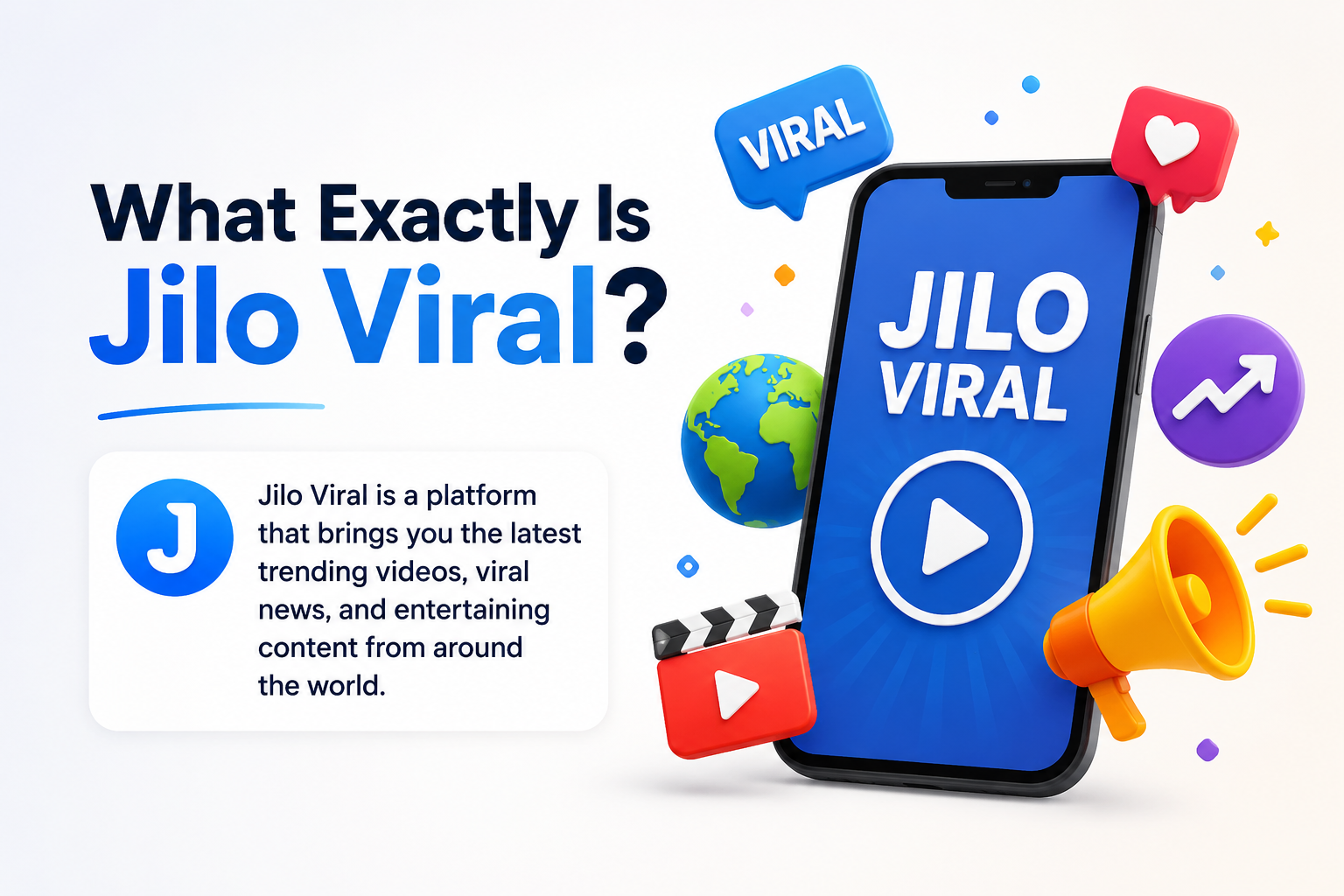
Functionally, the streaming version of Jilo Viral works as a content aggregator, not a host. It doesn’t necessarily store every movie file on its own servers — instead, it indexes and embeds video links pulled from third-party mirrors scattered across the web. That’s an important distinction: it’s why the site can keep operating even when individual links go dead, and why quality and safety vary wildly from one title to the next.
There’s no single “official” Jilo Viral. The name has been recycled across dozens of domains since it first started gaining traction, each with a near-identical layout: a homepage grid of movie posters, a search bar, genre filters, and a “Play” button that takes you straight into a video window — no email, no password, no payment screen.
Why Is “Jilo Viral” Suddenly Everywhere in 2026?
Jilo Viral doesn’t build an audience the way Netflix or Disney+ does — through marketing budgets, app store rankings, or press coverage. It spreads almost entirely through search behavior and social comment loops, and the pattern repeats every time a blockbuster drops:
- A major movie or season premiere goes live on a paid platform.
- TikTok, Reddit, and YouTube comment sections fill with people asking for a “free link.”
- Someone replies with a Jilo Viral-style domain.
- Search interest spikes for a few days or weeks, then fades — until the next big release.
This cycle is sometimes called keyword hijacking: rather than building a trustworthy brand, the site rides the search demand created by genuinely popular, legitimately licensed content. It’s also why you’ll see wildly different domain extensions (.com, .net, .world, .xyz, .cc) all using the same “Jilo Viral” branding — when one gets blocked, blacklisted, or taken down, another pops up using the recognizable name to keep traffic flowing.
Independent traffic-estimation tools have shown the pattern clearly: visits spike sharply around major releases, then drop off just as fast. That volatility is a signature of unlicensed streaming operations generally, not a sign of a stable, growing platform.
Also Read : Best Social Media Advertising Services in 2026
Jilo Viral Features: What the Site Actually Offers
Putting aside the legal and safety questions for a moment, here’s what users typically encounter on a Jilo Viral-branded site:
- No account creation — you land on the homepage and start browsing immediately.
- Genre and category browsing — action, romance, anime, horror, documentaries, and “trending now” sections.
- Search function — type a title and (sometimes) find it instantly.
- Multiple “servers” per title — if one video link is broken or slow, you can usually try an alternate source for the same movie.
- No official app — everything runs through a mobile or desktop browser; any app claiming to be the “official Jilo Viral app” is not legitimate and should be treated as a red flag.
- Responsive layout — most versions are usable on phones and tablets, though playback stability varies a lot by device and browser.
On the surface, this checklist looks like a stripped-down version of a real streaming service. The difference shows up the moment you actually try to watch something.
Jilo Viral Pricing & the “No Credit System” Reality
This is the section most reviews skip past, but it matters: Jilo Viral has no subscription tiers, no credit system, and no paywall. There’s nothing to buy, no premium plan, and no in-platform currency. Every title is technically available to anyone who lands on the site.
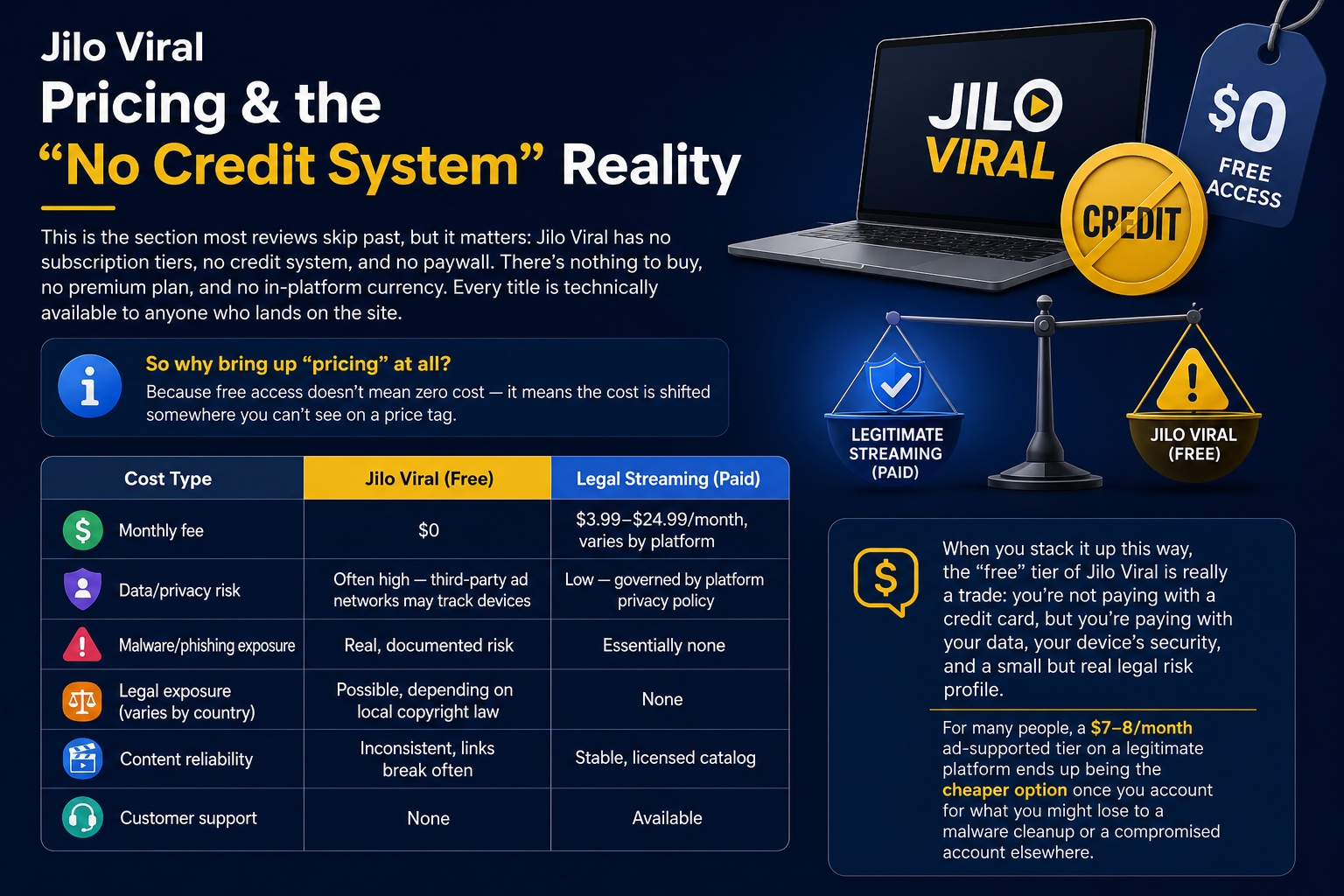
So why bring up “pricing” at all? Because free access doesn’t mean zero cost — it means the cost is shifted somewhere you can’t see on a price tag:
| Cost Type | Jilo Viral (Free) | Legal Streaming (Paid) |
|---|---|---|
| Monthly fee | $0 | $3.99–$24.99/month, varies by platform |
| Data/privacy risk | Often high — third-party ad networks may track devices | Low — governed by platform privacy policy |
| Malware/phishing exposure | Real, documented risk | Essentially none |
| Legal exposure (varies by country) | Possible, depending on local copyright law | None |
| Content reliability | Inconsistent, links break often | Stable, licensed catalog |
| Customer support | None | Available |
When you stack it up this way, the “free” tier of Jilo Viral is really a trade: you’re not paying with a credit card, but you’re paying with your data, your device’s security, and a small but real legal risk profile. For many people, a $7–8/month ad-supported tier on a legitimate platform ends up being the cheaper option once you account for what you might lose to a malware cleanup or a compromised account elsewhere.
Performance Analysis: Speed, Quality, and Ads
Performance on Jilo Viral-type sites is best described as inconsistent by design. Because the platform pulls content from scattered third-party mirrors rather than a centralized, paid content-delivery network, the experience can change dramatically from one title to the next, or even one day to the next on the same title.
What users commonly report:
- Initial load speed is often fast — the homepage and browsing experience feel snappy.
- Playback quality ranges from grainy standard-definition to passable HD, with no consistency guarantee.
- Buffering is common, especially during peak evening hours or right after a big release (when servers are overloaded with first-day traffic).
- Subtitles are frequently missing, mistimed, or attached to the wrong release.
- Ad load is the biggest complaint by far. Multiple pop-ups, redirect tabs, and fake “Play” or “Download HD” buttons routinely appear before the real video starts.
That last point deserves emphasis: on a legitimate ad-supported platform, ads appear in defined breaks controlled by the platform itself. On Jilo Viral-style sites, ad behavior is controlled by whichever third-party network is currently plugged in — which means there’s no consistency, no quality control, and no way to “opt out” beyond using browser-level ad blockers.
Pros and Cons of Jilo Viral
| Pros | Cons |
|---|---|
| No cost to access | Not licensed — legally a grey or outright illegal zone depending on your country |
| No sign-up or personal details required upfront | No verified owner, company, or support contact |
| Large, varied content catalog | Frequent ads, pop-ups, and deceptive buttons |
| Fast initial page load | Unstable streaming quality and broken links |
| Works across most browsers/devices | No accountability if something goes wrong (malware, scam redirect) |
| Genre filters make browsing easy | Domain constantly changes, making it hard to know which version is “real” |
Is Jilo Viral Legal? The Honest Answer
In most countries, streaming copyrighted movies and TV shows from a source that doesn’t hold distribution rights is against the law — and Jilo Viral, by every available indicator, falls into that category. There’s no visible licensing agreement, no studio partnership disclosure, and no copyright acknowledgment anywhere on the site.
A useful way to think about it: hosting pirated content is unambiguously illegal almost everywhere. Accessing or streaming it as a viewer carries lower but non-zero risk, and that risk varies sharply by jurisdiction. Some countries actively monitor and warn repeat visitors of known piracy domains through ISP notices; others rarely pursue individual viewers at all. Either way, “low enforcement” isn’t the same as “no risk,” and the legal grey area is exactly the kind of thing platforms like this are designed to exploit.
History also isn’t on Jilo Viral’s side here. Similarly structured platforms — 123Movies, Soap2Day, FMovies, and others — followed an almost identical lifecycle: rapid traffic growth, media attention, legal pressure, and eventual shutdown or forced domain migration. There’s no indication Jilo Viral-branded sites will play out any differently.
Security Risks: What Can Actually Go Wrong
This is the part that should matter most to anyone considering using the site, regardless of how they feel about the legal question.
Because Jilo Viral relies on unregulated, third-party ad networks rather than vetted advertising platforms, it inherits all the risk that comes with that model:
- Fake “HD Player” or codec downloads — prompts asking you to install a special plugin to “unlock” playback. These are a classic malware delivery method; legitimate streaming never requires a downloaded player.
- Drive-by ad redirects — clicking anywhere near the video window can trigger a new tab, sometimes several in a row, often leading to scam pages, fake prize notifications, or adult content.
- Browser notification hijacking — sites that ask you to “allow notifications” and then flood your browser with intrusive alert-style ads, even after you leave the page.
- Device and IP fingerprinting — many ad networks used on unlicensed sites track device identifiers and browsing patterns far more aggressively than mainstream ad platforms are permitted to.
- Credential-harvesting clones — particularly around major movie releases, copycat domains have appeared mimicking the same branding to capture login or payment details from users who assume “Jilo Viral” is a single trustworthy source.
The unsettling part is that none of this requires you to do anything “wrong.” Simply landing on the wrong mirror or clicking the wrong ad is often enough.
Jilo Viral vs. Legal Streaming Platforms
| Platform | Legal Status | Monthly Cost | Safety | Reliability | Official App |
|---|---|---|---|---|---|
| Jilo Viral | Unlicensed / illegal in most regions | $0 | Unsafe | Unstable | No (claims of one are malware) |
| Netflix | Fully licensed | ~$7.99–$24.99 | Safe | High | Yes |
| Amazon Prime Video | Fully licensed | ~$8.99/mo or bundled | Safe | High | Yes |
| Disney+ | Fully licensed | ~$7.99–$15.99 | Safe | High | Yes |
| Tubi | Fully licensed, ad-supported | Free | Safe | High | Yes |
| Pluto TV | Fully licensed, ad-supported | Free | Safe | High | Yes |
| YouTube (official channels) | Fully licensed | Free/ad-supported | Safe | High | Yes |
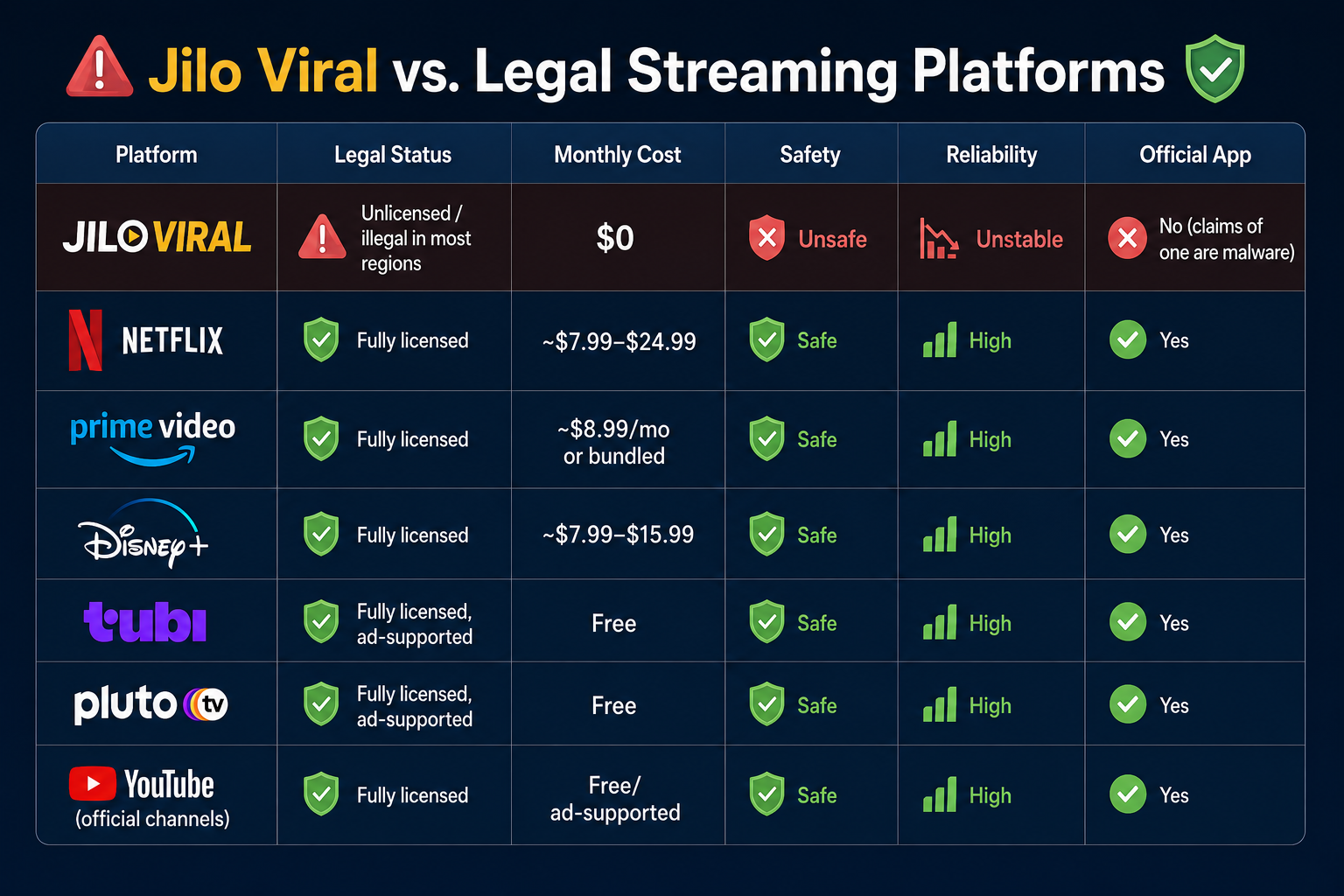
The takeaway is simple: every legal alternative on this list matches or beats Jilo Viral on safety and reliability, and several of them match it on price.
What Real Users Are Saying
Patterns across forums, social comment sections, and review sites tend to split into two camps:
Positive feedback generally centers on convenience: people appreciate not needing to sign up, and many report being able to find a wide range of titles, including recent releases, without paying anything.
Negative feedback is more consistent and more serious: complaints about excessive, aggressive advertising are nearly universal. A meaningful share of users also describe broken links, sudden domain changes that left them confused about which site was “real,” and — in a smaller but notable number of cases — needing to run a malware scan or reset their browser after a visit.
The general sentiment, when you read enough of it, isn’t “this is a great service.” It’s closer to “it works until it doesn’t, and when it doesn’t, it can get messy.”
Who Is Actually Using Sites Like Jilo Viral?
Based on the traffic and behavior patterns reported around similar platforms, the typical visitor profile looks like this:
- People searching for a specific, very recent release that isn’t yet available on their existing subscriptions.
- Viewers in regions where multiple paid subscriptions are expensive relative to local income.
- Casual, one-off visitors who saw a link mentioned on social media and clicked out of curiosity.
- Younger users following TikTok or Reddit recommendations without independently checking the source.
Notably, there’s little evidence of long-term loyalty. Most visits look disposable — useful for a single watch, then forgotten until the next viral mention resurfaces the name.
Jilo Viral for eCommerce Sellers
If you sell physical or digital products and you’re seeing “Jilo Viral” show up in your traffic referrers, ad placements, or affiliate network reports, treat it as a warning sign rather than an opportunity. Unlicensed streaming domains are frequently blocklisted by ad exchanges, payment processors, and brand-safety tools — and association with them, even indirectly through a low-quality ad network, can hurt your store’s standing with platforms like Google Ads or Meta. If you run retargeting or display campaigns through broad ad networks, it’s worth auditing your placement exclusions to make sure your ads aren’t appearing on piracy-adjacent domains like this one.
Jilo Viral for Content Creators
There’s a genuine content opportunity here — “Jilo Viral” is a high-search-volume term, and plenty of viewers are actively looking for clarity on whether it’s safe. Creators (bloggers, YouTubers, TikTok creators) can responsibly cover the topic by:
- Publishing fact-based explainer content (like this article) rather than tutorials on how to access the site.
- Avoiding direct links to piracy domains in videos or descriptions, which can trigger demonetization, platform strikes, or removal under copyright-adjacent content policies.
- Pivoting the content toward legal alternatives, which keeps the piece monetizable and brand-safe while still satisfying search intent.
- Using the keyword in titles and headers (as done throughout this guide) to capture search traffic without promoting the underlying site.
Jilo Viral for Marketers and Brands
From a marketing standpoint, “Jilo Viral” is a textbook example of newsjacking risk versus reward. The search volume is real and recurring, which makes it tempting to publish content around it for traffic. The smart approach is to participate in the conversation (informational content, safety guides, “alternatives” round-ups) while avoiding anything that could be read as an endorsement or a how-to. Brands should also double-check affiliate and programmatic ad partners, since some lower-tier ad networks place banners on piracy sites without a brand’s direct knowledge — a fast way to end up unintentionally associated with a platform like this.
Jilo Viral for Businesses and IT Teams
For companies managing shared networks, school computers, or employee devices, sites like Jilo Viral are a recurring headache for IT and security teams. Because the ad networks behind these sites are unregulated, a single employee or student visiting during a break can introduce malware risk to an entire network. Practical steps worth taking:
- Add known Jilo Viral-style domains to DNS-level blocklists (tools like Quad9 or CleanBrowsing can help automate this).
- Maintain updated endpoint antivirus/antimalware coverage across all devices with network access.
- Educate staff or students on recognizing fake “player download” prompts, since social engineering — not just malicious code — is the primary attack vector here.
- Review browser extension permissions periodically, since adware often arrives disguised as a helpful plugin.
Best Legal Alternatives to Jilo Viral
If the appeal of Jilo Viral is simply “free, no-hassle entertainment,” there are several legitimate platforms that deliver the same convenience without the risk:
- Tubi — large free, ad-supported library covering movies and TV across most genres.
- Pluto TV — free live “channel” style streaming plus on-demand titles, no account required for casual browsing.
- The Roku Channel — free ad-supported catalog, available even without owning Roku hardware.
- YouTube (official studio and network channels) — many studios upload full, legally licensed films and older TV seasons for free, ad-supported viewing.
- Crackle — long-running free, ad-supported library with a decent rotating catalog.
- Library streaming apps (Kanopy, Hoopla) — completely free with a public library card, often including newer independent and documentary titles.
- Paid tiers (Netflix, Prime Video, Disney+, Max) — the obvious trade-off of a monthly fee for guaranteed reliability, security, and the newest releases.
How to Spot a Risky Clone Site
Whether it’s Jilo Viral or the next site that takes its place, the warning signs tend to repeat:
- The domain has changed recently, or you found the link through a comment section rather than a direct search result.
- There’s no company name, address, or “About Us” page with verifiable information.
- The site asks you to download a player, codec, or extension before playback starts.
- Ads appear before, during, and immediately after you click “Play” — especially multiple pop-up tabs at once.
- There’s no HTTPS padlock in the browser address bar.
- Urgent language (“Watch now before it’s removed!”) is used to rush you past normal caution.
If two or more of these apply, treat the site as high-risk.
Watch: Understanding the Risk (Video)
Video explainers can make the risks here much easier to visualize than text alone. We recommend embedding two short videos in the published version of this article:
- A general explainer on how free/pirate streaming sites monetize through unregulated ad networks (search “how do free movie streaming sites make money” on YouTube for current, reputable cybersecurity-channel options).
- A walkthrough on spotting phishing and fake “player download” prompts, aimed at non-technical viewers.
FAQs About Jilo Viral
Is Jilo Viral safe to use? No. Independent reviews and security write-ups consistently flag risks including intrusive ads, redirect scams, and potential malware exposure through third-party ad networks.
Is Jilo Viral actually free, or are there hidden costs? There’s no subscription fee or credit system, but “free” comes with trade-offs: data tracking, ad-driven security risk, and possible legal exposure depending on where you live.
Why does Jilo Viral keep changing its domain name? Domain rotation (.com, .net, .world, .xyz, and others) is a common tactic used to dodge blocks, takedown notices, and search suppression once a particular URL gets flagged.
Does Jilo Viral have an official app? No. There’s no verified official app. Anything claiming to be a “Jilo Viral app” in an app store or via a download link should be treated as a likely security threat.
Can I get in legal trouble for streaming from Jilo Viral? It depends heavily on your country’s copyright enforcement practices. In some regions, ISPs send warning notices for known piracy traffic; in others, individual viewers are rarely pursued. The legal risk is real but inconsistent — and entirely avoidable by using a licensed platform.
What’s the safest free alternative to Jilo Viral? Tubi, Pluto TV, and The Roku Channel are widely considered the safest fully-free, fully-legal options, since they’re ad-supported but properly licensed.
Is “Jilo Viral” the same as the TikTok dance trend with the same name? No. The dance/audio trend and the streaming site are unrelated, despite sharing the same name — a frequent source of search confusion.
Final Verdict
Jilo Viral solves a real problem — subscription fatigue and the frustration of not finding a specific title — but it solves it by creating a different, less visible problem. There’s no pricing plan to evaluate because there’s nothing to buy, but the absence of a price tag doesn’t mean the cost is zero. Between inconsistent streaming quality, aggressive and unregulated advertising, no verifiable ownership or support, and a legal status that ranges from grey to clearly illegal depending on where you live, the math doesn’t favor regular use.
If your goal is genuinely free, no-fuss streaming, platforms like Tubi, Pluto TV, and YouTube’s official studio channels deliver the same “no subscription required” experience without asking you to gamble your device security or legal standing to get it. Jilo Viral isn’t a long-term streaming solution — it’s a short-term workaround with a long list of trade-offs that rarely show up until after you’ve clicked play.