
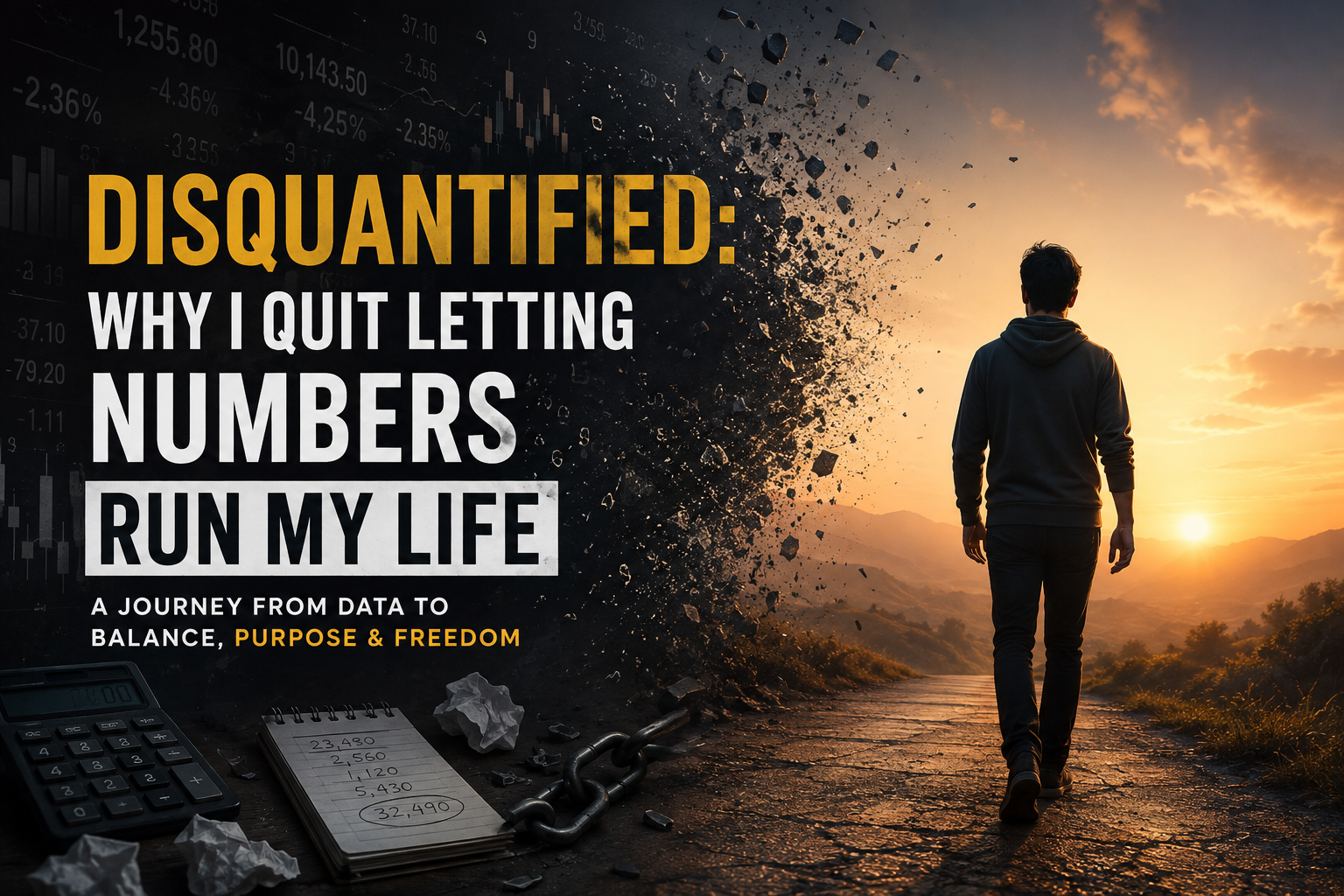
Disquantified: Why I Quit Letting Numbers Run My Life
I used to wake up and check three things before I even sat up in bed. Step count from yesterday. Sleep score. Weight from the smart scale sitting smugly in the corner of my room. Some mornings the numbers were “good” and I’d feel a small, cheap hit of relief. Other mornings they weren’t, and I’d carry a low-grade sense of failure into the shower with me — over a night’s sleep I hadn’t even consciously experienced.
It took me embarrassingly long to notice how strange this was. I wasn’t sick. I wasn’t training for anything. I was just… measuring, because the tools existed and because everyone around me seemed to be doing it too. That’s roughly where the idea behind Disquantified.org comes from — the growing sense that we’ve quietly outsourced our self-understanding to dashboards, and that maybe it’s time to take some of it back.
This isn’t an anti-technology rant. I still wear a fitness tracker some days. I still check my bank balance more than I probably need to. But there’s a difference between using numbers as tools and living inside them, and I think a lot of us have drifted into the second category without really deciding to.
The Quiet Rise of a Numbered Life
Go back twenty years and the average person tracked maybe a handful of things: their weight on a bathroom scale once a week, their bank balance at the ATM, their grades on a report card a few times a year. Numbers existed, but they were occasional visitors, not roommates.

Now? Your phone knows your screen time down to the minute. Your watch counts your steps, your heart rate, your “readiness score,” whatever that means on any given day. Your bank app pings you with spending summaries. Your streaming apps tell you how many hours of TV you watched this week, which is a statistic nobody actually asked for but somehow everyone now knows about themselves.
There’s genuinely useful stuff buried in all this data. A friend of mine caught an irregular heartbeat because her watch flagged it — that’s not nothing, and I’d never tell someone to rip their smartwatch off out of principle. But there’s a growing conversation happening online, one that Disquantified.org taps into, about what happens when tracking stops being occasional and becomes the default lens through which we see ourselves. It’s worth reading a bit about the quantified self movement criticism that’s been building for a few years now, because it puts words to a feeling a lot of people have but rarely articulate.
When Measurement Starts Measuring You Back
Here’s the thing nobody warns you about: once you start tracking something, you start optimizing for the tracker instead of the thing itself.
I noticed this with my sleep app. I’d wake up feeling genuinely fine — rested, clear-headed, ready for coffee and my day — and then check the app and see a “72/100” sleep score, and suddenly I’d feel tired. Not because my body was tired. Because a number told me I should be. My subjective experience got overwritten by a badge on a screen designed by a company that, let’s be honest, wants me checking that app every single day.
This is a documented pattern, not just my own neurosis. Researchers looking into the mental health effects of constant tracking have found that people who obsessively monitor metrics like steps, calories, or sleep scores often report higher anxiety and lower body satisfaction than people who don’t track at all — even when their actual health outcomes are identical. The number becomes the reality. The body becomes an afterthought.
And it’s not just health data. Think about how many people check their follower count multiple times a day, or refresh a stock ticker during a slightly volatile week, or obsessively watch a “streak” counter on a language app until missing one day feels like a small personal tragedy. We’ve built an entire ecosystem of apps whose core function is turning ordinary human experience into a scoreboard.
The Disquantified Idea, in Plain Terms
So what does “disquantified” actually mean, beyond the clever domain name?
It’s not about abandoning data entirely — that would be a bit dramatic, and honestly kind of impractical in 2026. It’s more of a mindset shift: treating numbers as one input among many, rather than the final word. It means asking, before you check a metric, “do I actually need this information right now, or am I just anxious and looking for reassurance from an app?”
I started experimenting with this myself about eight months ago. Small stuff, nothing heroic. I moved my scale into a closet so I’d have to make a deliberate choice to weigh myself instead of doing it on autopilot. I turned off the sleep score notification on my watch — I still collect the data, I just don’t let it greet me first thing in the morning. I deleted the app that showed my daily screen time because, ironically, checking it was becoming its own screen-time habit.
None of this made me a monk. I still glance at numbers plenty. But there’s a real difference between glancing and being governed, and closing that gap has honestly done more for my mood than most of the “wellness” advice I’ve tried over the years.
If you’re curious about actually trying this, there’s a decent amount of practical writing out there now on doing a proper digital detox from self-tracking apps, and most of it agrees on one thing: the goal isn’t zero data, it’s intentional data.
Why This Resonates With So Many People Right Now
I think part of why the disquantified conversation is gaining traction is timing. We’re a few years into peak wearable-tech adoption, long enough for the novelty to wear off and for people to start noticing the side effects. The initial thrill of “wow, I can see my heart rate variability!” has settled into something closer to low-level obligation for a lot of users.
There’s also a broader cultural fatigue with optimization culture in general. Productivity apps that gamify your to-do list. Finance apps that turn your spending into a “score.” Even dating apps quietly running the numbers on your matches and message rates behind the scenes. At some point, a critical mass of people started asking: when did just living become a performance review?
A close friend of mine, a nurse who works genuinely brutal twelve-hour shifts, told me she deleted her step tracker not because she didn’t care about her health, but because seeing “6,342 steps — goal not met” after a shift where she’d been on her feet nonstop, lifting patients and running between rooms, made her feel like a failure for no good reason. The number couldn’t capture what her day had actually been. That’s the disconnect a lot of us are starting to name out loud.
There’s genuine value in learning how to stop obsessing over numbers, and it’s not just a self-help platitude — it changes how you relate to ordinary days that don’t fit neatly into a metric.
Practical Ways to Start Disquantifying
I’m not going to give you a ten-step program, because frankly the whole point is to move away from rigid systems. But a few things have genuinely helped me, and might be worth trying:
Pick one metric to let go of first. Don’t try to quit everything at once — that usually backfires and you end up re-downloading the app within a week out of anxiety. I started with the sleep score because it felt the most useless to me personally.
Notice the checking impulse, not just the number. Half the problem isn’t the data itself, it’s the compulsive glance. Try leaving your phone in another room for the first hour of your day and see what happens to your mood before you’ve seen a single stat.
Ask what the number is actually for. Sometimes tracking genuinely serves a purpose — training for a marathon, managing a medical condition, budgeting toward a real goal. Keep those. The stuff that’s tracking for tracking’s sake is usually what needs trimming.
Talk to people instead of dashboards. If you want to know how you’re really doing, a conversation with someone who knows you will usually tell you more than a graph will. This sounds obvious written down, but it’s surprising how often we reach for the app before the person.
If you want a broader philosophical frame for all this, there’s a growing body of writing around living without metrics and data that goes deeper into the psychology of why we started measuring everything in the first place, and what we might be trying to control by doing it.
The Anxiety Underneath the Apps
If I’m being honest with myself, a lot of my old tracking habits weren’t really about health or productivity. They were about control. Life is unpredictable and a little scary, and a number on a screen feels solid in a way that “I think I slept okay” doesn’t. There’s comfort in a precise figure, even when that precision is mostly fake — most consumer trackers are far less accurate than people assume, but we treat the output like gospel anyway.
This is where I think a lot of writing on the topic of escaping number anxiety in daily life gets something right: the anxiety usually isn’t really about the metric. It’s about needing external proof that you’re okay, doing well, on track. And no app, however sophisticated, can actually give you that. Only you can, eventually, by learning to trust your own read on things again.
That’s a slower, less satisfying answer than “just delete the app,” I know. But it’s the honest one.
So, Is Disquantified.org Anti-Data?
Not really, and I don’t think that’s the goal of the broader movement either. Data has genuine uses. If you’re diabetic, tracking your blood sugar isn’t optional anxiety-fuel, it’s medical necessity. If you’re an athlete, your coach probably needs your training metrics to build a smart program. Nobody’s arguing for throwing every number out the window.
The argument is narrower and, I think, more reasonable: most of us are tracking things that don’t need tracking, for reasons that have more to do with app design than actual self-improvement. And somewhere in that excess, we’ve lost a bit of our ability to just feel how we feel without a device confirming it first.
I still own a smartwatch. I still glance at my step count sometimes, mostly out of curiosity, not obligation. The difference is small on paper but it’s felt enormous in practice — that shift from data as verdict to data as, at most, a mildly interesting footnote.
Where to Go From Here
If any of this sounds familiar — the morning phone-check ritual, the vague dread before opening a health app, the way a “bad” number can ruin an otherwise fine day — you’re not imagining it, and you’re definitely not alone. It’s a pretty widely shared experience right now, which is exactly why sites like Disquantified.org exist in the first place: to give language to something a lot of people are quietly feeling but haven’t quite named yet.
You don’t need to throw your devices in a drawer tomorrow. Start smaller. Notice one number you check out of habit rather than need, and just… don’t, for a few days. See what happens. You might be surprised how much mental space opens up when you’re not constantly grading yourself against a screen.
If you want to go deeper into this way of thinking and pick up some practical tools for building a healthier relationship with the data in your life, explore more disquantified living resources here and see where it takes you.