

iGaming Marketing in 2026: The Complete Guide to Strategy, Tools, and Player Retention
iGaming marketing covers every tactic, channel, and system an online gambling brand uses to attract, convert, and retain players. This includes everything from SEO and paid search campaigns to CRM automation, affiliate management, bonus engineering, and responsible gambling compliance.
The term “iGaming” spans online casinos, sports betting platforms, poker rooms, fantasy sports, and skill-based games. Each vertical comes with its own regulatory constraints, audience psychology, and competitive dynamics — which is exactly why iGaming marketing demands a purpose-built approach rather than a repackaged e-commerce playbook.
In 2026, the global online gambling market is projected to surpass $130 billion in gross gaming revenue. Marketing spend is accelerating accordingly, but so is regulatory pressure. The brands growing profitably are the ones treating marketing as an integrated system — not a collection of disconnected channels.
Why iGaming Marketing Is Different from Other Industries
Most marketing principles apply across industries, but iGaming creates unique challenges that demand specialist knowledge:
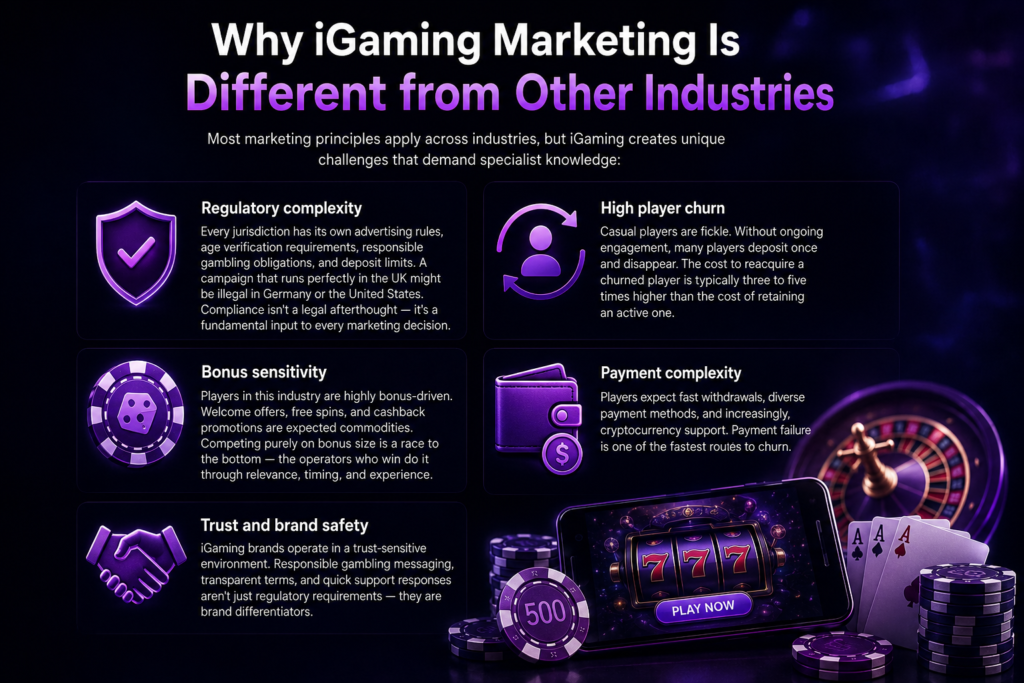
Regulatory complexity. Every jurisdiction has its own advertising rules, age verification requirements, responsible gambling obligations, and deposit limits. A campaign that runs perfectly in the UK might be illegal in Germany or the United States. Compliance isn’t a legal afterthought — it’s a fundamental input to every marketing decision.
High player churn. Casual players are fickle. Without ongoing engagement, many players deposit once and disappear. The cost to reacquire a churned player is typically three to five times higher than the cost of retaining an active one.
Bonus sensitivity. Players in this industry are highly bonus-driven. Welcome offers, free spins, and cashback promotions are expected commodities. Competing purely on bonus size is a race to the bottom — the operators who win do it through relevance, timing, and experience.
Payment complexity. Players expect fast withdrawals, diverse payment methods, and increasingly, cryptocurrency support. Payment failure is one of the fastest routes to churn.
Trust and brand safety. iGaming brands operate in a trust-sensitive environment. Responsible gambling messaging, transparent terms, and quick support responses aren’t just regulatory requirements — they are brand differentiators.
The 5 Core Pillars of iGaming Marketing in 2026
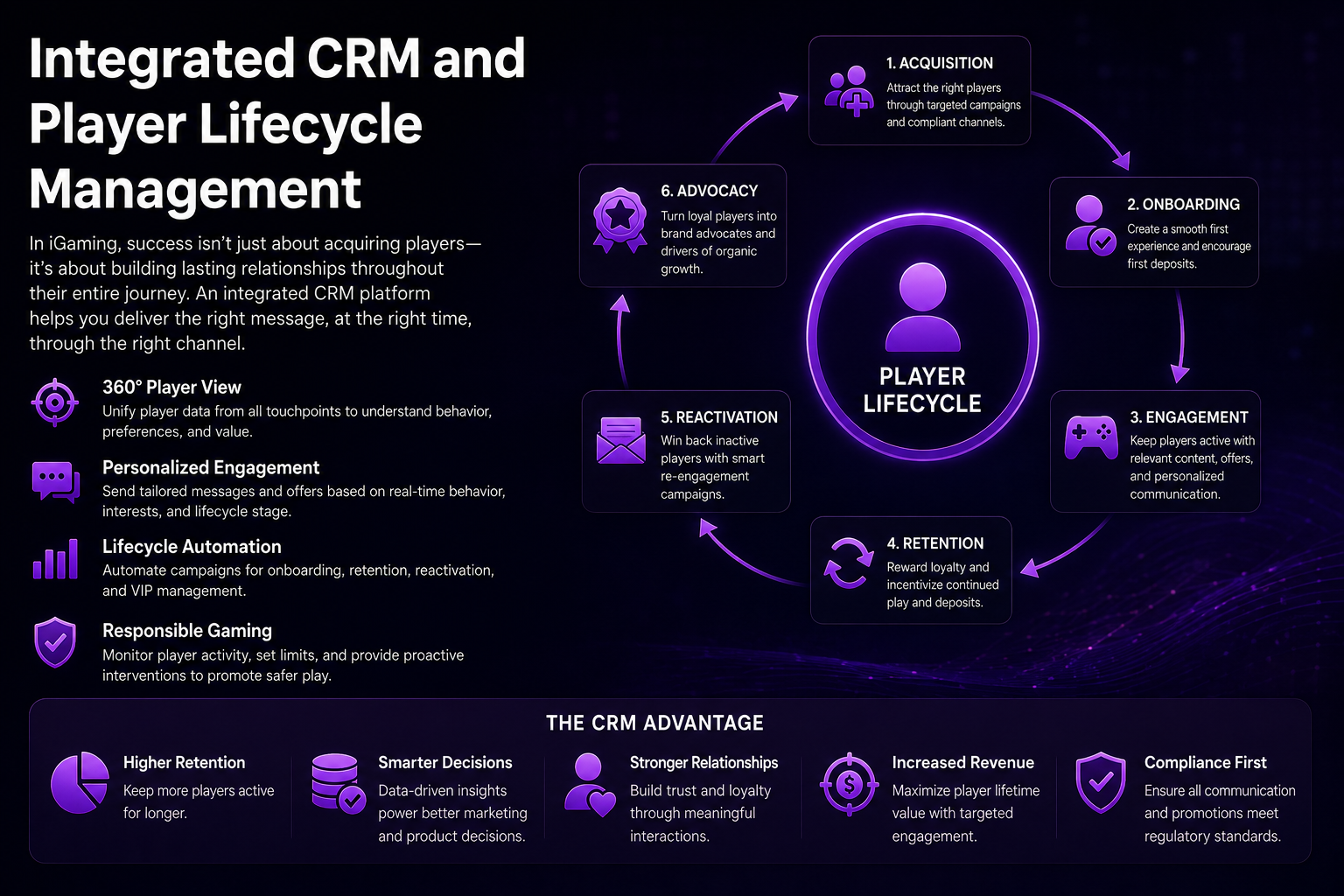
1. Integrated CRM and Player Lifecycle Management
Your CRM is the engine of your entire marketing operation. It needs to track player behaviour in real time — deposits, session length, game preferences, withdrawal patterns — and trigger relevant responses automatically. A CRM built for retail e-commerce retrofitted with gambling features will fail at this. Player lifecycle management requires purpose-built tooling.
2. Unified Analytics and Reporting
One of the most common operational failures in iGaming is teams debating which dashboard shows the “real” numbers. When your analytics layer is fragmented across five different tools, your reports conflict and decisions slow down. A unified analytics layer gives marketing, product, and finance teams a shared source of truth — covering web traffic, campaign ROI, player LTV, churn rates, and revenue signals in one place.
3. Multi-Channel Campaign Automation
Players in 2026 exist across email, SMS, push notifications, on-site banners, live chat, and social channels. Effective iGaming marketing doesn’t mean being everywhere — it means being in the right place at the right moment. Automation platforms that orchestrate personalised journeys across channels, while respecting consent settings and regional communication rules, consistently outperform brands that manage channels separately.
4. Compliance and Consent by Design
Brands that treat compliance as a bolt-on build their stack twice. Jurisdiction-specific communication restrictions, self-exclusion flags, responsible gambling limits, and AML requirements all need to be wired directly into marketing workflows — not checked manually. When compliance is embedded from day one, scaling into new markets becomes a configuration change, not a crisis.
5. Region-Specific and Audience-Specific Campaigns
A generic global campaign is not marketing — it’s broadcasting. iGaming audiences differ dramatically by region: payment preferences, promotional expectations, cultural nuances, and language all affect conversion rates. Similarly, a slots player and a sports bettor have completely different engagement patterns, risk profiles, and receptivity windows. Effective iGaming marketing campaigns are built around both who the player is and where they are.
Building Your iGaming Marketing Tech Stack
In 2024 and 2025, many iGaming teams fell into the trap of solving each new problem with a new tool. The result was martech sprawl — a dozen platforms that don’t talk to each other, conflicting data, and slower execution than before. The principle that has emerged from this era: fewer tools that integrate deeply outperform many tools that coexist loosely.
Here is what a lean, high-performance iGaming marketing stack looks like in 2026:
Layer 1 — Data Foundation A centralised player data platform or CRM that stores unified profiles across game activity, payment history, support interactions, and campaign engagement. This is the layer everything else depends on.
Layer 2 — Automation and Campaign Engine A multi-channel automation platform that sends the right message at the right moment based on defined triggers. Modern platforms include AI-assisted segmentation, A/B testing, and rule-based conditional logic (if/then workflows).
Layer 3 — Analytics and Reporting A reporting layer that surfaces player LTV, campaign ROI, channel attribution, churn prediction, and regulatory reporting in one view. When marketing and finance read the same numbers, decision velocity increases.
Layer 4 — Affiliate and Partner Management Multi-level affiliate tracking that gives visibility into sub-affiliate performance, attribution accuracy, and fraud indicators across the entire partner network.
Layer 5 — Compliance and Risk Integration Responsible gambling tools, KYC status tracking, and AML signals that feed directly back into campaign eligibility logic — so a bonus never lands with someone who flagged a self-exclusion request 24 hours earlier.
Acquisition vs. Retention: Where the Real Money Is {#acquisition-vs-retention}
Player acquisition has become genuinely expensive. In regulated markets, top iGaming keywords now attract CPC bids above $300–$400, and affiliate CPA deals for quality players regularly exceed $200. New player acquisition costs have climbed significantly year-over-year.
Meanwhile, a returning player costs a fraction of that to reactivate — and their LTV is already known.
The operators scaling profitably in 2026 have tilted investment toward retention infrastructure. They focus on:
- Churn prediction: Using behavioural signals — drop in login frequency, shorter sessions, reduced deposit velocity — to identify at-risk players before they go silent, then triggering personalised reactivation flows proactively.
- VIP-style treatment at scale: AI-powered segmentation has made personalised experiences achievable for your entire player base, not just your top tier.
- LTV-based campaign optimisation: Measuring marketing effectiveness by lifetime value impact, not just cost-per-acquisition.
This shift doesn’t mean abandoning acquisition — it means funding retention properly alongside it. An operator that acquires well but retains poorly is just a very expensive revolving door.
iGaming Marketing Channels Compared {#channels-compared}
| Channel | Best For | Avg. CPA Range | Compliance Complexity | Long-term Scalability |
|---|---|---|---|---|
| SEO / Content | Organic acquisition, brand authority | Low ($5–$50 per lead) | Low | High |
| Paid Search (PPC) | High-intent acquisition | High ($150–$400+) | Medium | Medium |
| Affiliate Marketing | Volume acquisition | Medium ($100–$300) | Medium | High |
| Email Marketing | Retention and reactivation | Very Low | Low | High |
| Push Notifications | Time-sensitive promotions | Very Low | Low | Medium |
| Social Media | Brand awareness, community | Medium | High (ad restrictions) | Medium |
| Influencer / Streaming | New market penetration | Variable | High | Low–Medium |
| SMS | Urgent offers, VIP comms | Low | Medium | Medium |
Note: CPA ranges are estimates and vary significantly by market, product type, and player quality. Always measure by LTV, not just CPA.
Personalisation, AI, and Behavioural Marketing {#personalisation-and-ai}
The most overused phrase in iGaming marketing is also the most underpractised discipline: personalisation.
True personalisation in iGaming doesn’t mean putting a player’s name in an email subject line. It means:
- A player who deposits every Friday evening receives a tailored offer timed for Friday afternoon — not a generic Monday morning push.
- A casual slots player doesn’t receive sportsbook reload promotions.
- A high-value player showing early disengagement signals receives a proactive retention flow before they’ve fully churned, not a win-back campaign three weeks later.
AI and behavioural automation have collapsed the operational cost of doing this at scale. What previously required a dedicated team of analysts to build and manage for VIP players can now run automatically for your entire active player base.
The most consequential shift in iGaming CRM over the past 18 months is from reactive to predictive. The operators pulling ahead use behavioural signals as leading indicators of churn and intervene at the right moment — not after the player has gone silent.
Compliance as a Marketing Advantage {#compliance}
In most industries, compliance is a cost centre. In iGaming, brands that genuinely embed compliance into their marketing operations gain something their competitors don’t: trust, speed, and operational stability.
Here’s what compliance-first iGaming marketing looks like in practice:
- Age verification and self-exclusion checks run automatically before every promotional communication. A flagged player never receives a bonus offer — reducing regulatory risk and protecting the brand.
- Responsible gambling messaging is integrated into player-facing communications, not just buried in terms and conditions.
- Jurisdiction-specific communication rules (blackout periods, message frequency caps, prohibited content) are configured at the platform level, not checked manually by a compliance officer reviewing campaigns after the fact.
- AML signals feed back into CRM logic, so unusual deposit patterns can trigger a review before becoming a regulatory problem.
Operators who build this way scale into new markets faster. Adding a jurisdiction becomes a configuration change — not a legal and operational fire drill.
iGaming Marketing for Different Business Types {#business-types}
For Casino Operators
Your primary marketing levers are SEO, affiliate partnerships, and retention CRM. Focus on game variety coverage in content, bonus engine flexibility, and payment method diversity. Your biggest risk is bonus abuse and affiliate fraud — build detection into your stack from day one.
For Sportsbook Operators
Live betting creates real-time marketing opportunities. Event-triggered campaigns — offers that deploy during a key match moment — drive high engagement. Attribution is complex when players bet on multiple devices; invest in unified identity resolution early.
For B2B iGaming Providers (Software, Platform, Studio)
Your buyers are operators, not players. The marketing playbook looks different: account-based marketing (ABM), trade events (ICE, SiGMA, SBC Summit), LinkedIn content, and technical thought leadership. Sales cycles are long; CRM discipline and lead nurturing matter more than volume acquisition.
For Affiliate Marketers and Content Creators
iGaming affiliate marketing remains one of the highest-paying affiliate verticals in the world. Revenue share models (typically 25–45% of net gaming revenue) can generate compounding income from evergreen content. Focus on long-tail SEO, review content, and comparison pages. Build trust signals — age verification disclaimers, responsible gambling links, clear operator disclosures — as both a compliance and conversion tool.
For Marketing Technology Vendors
Prove integration depth, not feature breadth. iGaming buyers have been burned by platforms that claim to do everything and do nothing well. Offer clear APIs, documented compliance features, and case studies from live operators.
Top iGaming Marketing Tools: Comparison Table {#tools-comparison}
| Tool Category | Leading Options | Key Features | Best For | Pricing Model |
|---|---|---|---|---|
| iGaming CRM / Platform | Fortuna (Gaming Entertainment), Optimove, FastTrack | Player segmentation, bonus engine, lifecycle automation | Mid-to-large operators | Custom / enterprise |
| General CRM | HubSpot, Salesforce, Pipedrive | Pipeline management, email sequences, reporting | B2B providers | From $45/month |
| Email Automation | Klaviyo, Customer.io, ActiveCampaign | Behavioural triggers, A/B testing, segmentation | Retention teams | From $20/month |
| Affiliate Platform | Income Access, Affilka, MyAffiliates | Multi-tier tracking, fraud detection, reporting | Acquisition teams | Custom |
| Analytics | Tableau, Looker, GA4 + BigQuery | Unified dashboards, custom reporting | All operator sizes | From free (GA4) |
| SEO / Content | Ahrefs, SEMrush, Surfer SEO | Keyword research, competitor analysis, content optimisation | SEO and content teams | From $99/month |
| Push / SMS | OneSignal, Twilio, Braze | Omnichannel messaging, segmentation | Retention teams | Usage-based |
| Responsible Gambling | GamCare tools, Continent 8 compliance suite | Self-exclusion, limit management, alerts | All operators | Custom |
Pricing note: Enterprise iGaming platform pricing is almost always custom-quoted based on player volume, markets, and required modules. The figures above reflect indicative entry-level pricing for non-enterprise tiers.
Performance Metrics You Must Track {#kpis}
The gap between iGaming operators who scale and those who plateau is often a data problem — not a traffic problem. If you’re tracking these metrics monthly, you’re too slow.
Track these weekly:
- Customer Acquisition Cost (CAC): Total marketing spend divided by new depositing players.
- Lifetime Value (LTV): Average gross gaming revenue per player over their active period.
- LTV:CAC Ratio: Should generally exceed 3:1 for sustainable growth.
- 30-Day Retention Rate: What percentage of new depositors make a second deposit within 30 days?
- Churn Rate by Cohort: Track churn by acquisition channel, month, and player segment separately.
- Average Revenue Per User (ARPU): Monthly or weekly ARPU segmented by player tier.
- Bonus Cost as % of GGR: Keep this controlled — runaway bonus costs destroy margins.
- Payment Success Rate: A low payment success rate is a silent retention killer.
- Affiliate Fraud Rate: Monitor for suspicious traffic patterns, especially on CPA deals.
- First-Time Depositor (FTD) Conversion Rate: What percentage of registrations convert to first deposit?
Common iGaming Marketing Mistakes (And How to Fix Them)
Mistake 1: Broadcasting the same bonus to every player Generic promotional blasts train players to ignore your messaging and erode bonus budget with no differentiation. Fix: implement RFM segmentation (recency, frequency, monetary value) combined with game preference to build distinct player cohorts. Each cohort gets a different offer.
Mistake 2: Building your stack tool by tool instead of system by system Adding a new tool for each new problem is how you end up with eight platforms that don’t share data, conflicting reports, and slow execution. Fix: choose fewer, more integrated platforms and eliminate redundant tools. A connected stack outperforms a crowded one.
Mistake 3: Treating compliance as a legal department issue Compliance that isn’t built into marketing workflows creates operational risk and slows down campaign launches. Fix: integrate KYC status, self-exclusion flags, and jurisdictional rules directly into your campaign eligibility logic.
Mistake 4: Measuring success by acquisition volume, not LTV High FTD counts look impressive in monthly reports but mask high churn and poor player quality. Fix: restructure KPIs around LTV and 30-day / 90-day retention rates. Align affiliate commissions to quality signals, not raw volume.
Mistake 5: Reacting to churn instead of predicting it By the time a player stops logging in, you’ve often already lost them. Fix: configure behavioural triggers for early disengagement signals — declining session frequency, shorter play time, slowing deposit cadence — and launch retention flows while the player is still active.
Mistake 6: Neglecting localisation A campaign that converts in the UK often fails in Brazil or Japan because payment methods, cultural references, promotional formats, and communication timing differ significantly. Fix: build region-specific variations of core campaigns rather than translating a global template.
FAQs
What is iGaming marketing and how does it differ from regular digital marketing? iGaming marketing uses the same digital channels as other industries — SEO, paid media, email, affiliates — but operates under strict regulatory requirements, serves an audience with unique psychology (bonus sensitivity, game preference, payment expectations), and runs in a highly competitive environment. Purpose-built tools and compliance expertise are not optional; they’re baseline requirements.
How much does iGaming marketing cost? It varies enormously by channel and market. Organic acquisition through SEO is cost-efficient over time but slow. Paid search in competitive markets can cost $300–$500+ per depositing player. Affiliate marketing typically ranges from $100–$300 CPA in established markets. Retention marketing — email, push, CRM automation — is the cheapest and highest-ROI channel for existing players.
Which is more important: acquisition or retention? Both matter, but most operators underinvest in retention relative to acquisition. A player retained for 12 months at average ARPU delivers far more value than the acquisition cost justifies if — and only if — you have the retention infrastructure to keep them engaged. The most profitable iGaming operations optimise both sides of the equation.
What compliance requirements should my iGaming marketing account for? This depends entirely on jurisdiction. Common requirements include: no marketing to minors, prominent responsible gambling messaging, clear bonus terms, self-exclusion list checking, communication frequency limits, and prohibited bonus types (e.g., some jurisdictions ban wagering requirements). Always consult a licensed legal or compliance specialist for your specific markets.
How do I reduce player churn in iGaming? Churn reduction starts with data. Map your player lifecycle and identify where and when players typically disengage. Build automated intervention flows that trigger at early disengagement signals — before players go silent. Personalise bonus and communication timing to individual player behaviour. Improve payment success rates (failed withdrawals are a major churn driver). And invest in customer support quality — players who feel heard are significantly less likely to churn.
What are the best affiliate marketing strategies for iGaming? For operators: prioritise quality over volume by shifting from flat CPA to hybrid or revenue share models. Implement real-time fraud detection to identify suspicious traffic. For affiliate marketers: build content around long-tail informational keywords, develop in-depth operator reviews, and create comparison tools. Responsible gambling disclosure and transparent editorial standards improve both trust and conversion.
Is AI useful in iGaming marketing? Genuinely, yes — particularly in three areas: predictive churn modelling (identifying at-risk players before they disengage), dynamic segmentation (grouping players by real-time behavioural signals rather than static demographics), and content personalisation (serving different offers to different player segments automatically). The key is connecting AI tools to your data layer so they act on real player signals.
How do I scale iGaming marketing into new markets? Design for scalability from the start. Use a centralised CRM and automation platform with region-specific configuration layers — separate compliance rules, communication preferences, payment methods, and language settings per jurisdiction. Scaling is a configuration challenge when your stack is built correctly; it’s an operational crisis when it isn’t.
Final Verdict
iGaming marketing in 2026 is a discipline that rewards integration, data fluency, and regulatory intelligence. The operators, affiliates, and vendors who are growing profitably share a common approach: they’ve stopped treating marketing as a collection of disconnected channels and started building it as a unified system.
For casino and sportsbook operators: the most valuable investments you can make right now are retention infrastructure and unified analytics. Acquisition will always matter, but it’s retention where margin is built. If your CRM can’t predict churn, personalise offers in real time, and respect compliance flags without manual intervention, that’s the gap to close.
For B2B providers and affiliates: the iGaming marketing ecosystem is more competitive than it’s ever been, and it’s more regulated than it’s ever been. The market rewards specialists who understand the compliance environment and can demonstrate real performance data — not just impressive dashboards.
For new entrants: start with a lean stack, choose integrated platforms over point solutions, and build compliance into your foundation rather than layering it on top. It’s significantly cheaper to architect correctly the first time than to rebuild under regulatory pressure.
The iGaming market is large enough for many different strategies to work. But the ceiling for operators and brands who treat marketing as a disconnected set of tactics is getting lower every year. The ones building intelligence-first, integrated marketing systems are the ones who will still be here in five years — and growing.