

AI Avatar Videos for Businesses in 2027: Use Cases, ROI, Risks & Best Tools
Quick answer: AI avatar videos let businesses produce presenter-led videos from a script, without cameras, studios or actors. In 2027 they matter most for multilingual training, personalized sales outreach, product marketing, and increasingly, real-time conversational agents. Start with one high-value video, measure business outcomes, disclose AI use, and pick a platform based on your use case, not on hype.
What Are AI Avatar Videos?
An AI avatar video features a computer-generated presenter that speaks your script. The presenter can be a licensed stock character, a digital version of you or an employee, or a character built from a written prompt. You write the script, choose the presenter, and the software handles voice, lip sync and rendering.
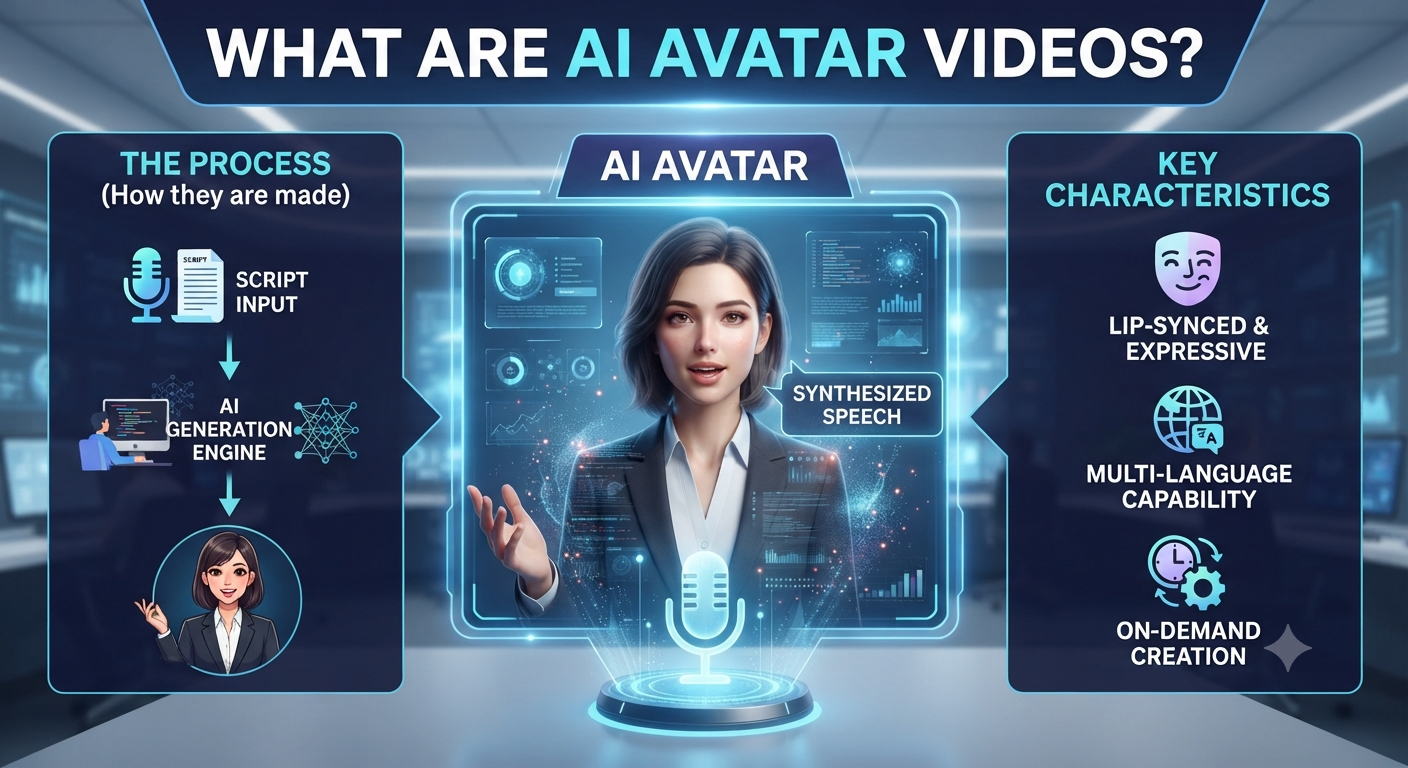
There are two broad types:
- Pre-rendered (asynchronous) avatars: scripted videos for training, marketing and internal comms.
- Interactive (real-time) avatars: avatars that hold live conversations, usually powered by a language model.
Why 2027 Is the Turning Point
The market is growing fast. Estimates vary because analysts define the category differently, but they agree on direction. One forecast puts the AI avatar market at $12.90 billion in 2026, growing at roughly 30% a year through 2035. Another says interactive avatars already held the largest share, 68.4%, in 2025.
Avatars are becoming infrastructure. Industry commentary expects that going into 2027, real-time avatars will function as an interface layer inside enterprise applications and AI agents, and that platforms will be judged on more than realism, including how easily they plug into existing systems.
Cost pressure keeps rising. One statistics roundup reports that avatar video cuts production costs by 65-80% and shortens production cycles by up to 90%. Treat vendor-adjacent figures as directional and test them against your own numbers.
Top Business Use Cases
1. Training and L&D. This is the most mature use case. Synthesia says its videos can be embedded in a Learning Management System, so updating a course means editing a script rather than reshooting. Well-designed training is also a core part of building a productive team, because employees who feel supported and skilled are more engaged.
2. Sales and personalized outreach. Vidyard reports that personalized video messages drove an 8x improvement in click-through rates and a 4x improvement in reply rates. That is a vendor case study, so run your own A/B test.
3. Marketing and ads. Tools such as Creatify generate ad variations from a product URL, which suits performance marketers who need many creative versions.
4. Internal communications. Custom avatars of executives can deliver company news, product updates and training in a fraction of the time that recording each video would take. Avatars work best when they sit on top of effective team communication, so define your goals and message flow before you produce anything.
5. Localization. A single video can be published in many languages without re-recording. Language counts differ by vendor (Synthesia advertises 160+, HeyGen 175+ languages and dialects), so always test lip sync in the specific language you need.
6. Small business websites. A single explainer on a page where visitors decide to call or book is often enough. Start with one useful video on such a page.
How to Choose a Platform
No single tool wins everywhere. Reviewers who tested them side by side agree on the broad split.
| Need | Strong options | Why |
|---|---|---|
| Enterprise training, compliance | Synthesia | 160+ languages with SOC 2 compliance |
| Realism and marketing speed | HeyGen | One review calls it the top choice for business videos, balancing realism, speed and business features |
| E-learning with quizzes | Colossyan | Branching scenarios and built-in quizzes |
| UGC-style ads | Creatify | Ad variations from a product URL |
| Teams already on Google Workspace | Google Vids | Built-in avatars inside Vids |
| Sales video and hosting | Vidyard | Personalized sales workflows |
| Mass personalization | SundaySky | Thousands of variations so each viewer gets a tailored message |
Pricing snapshot (mid-2026, verify before buying): one review lists HeyGen paid plans from $24/month, with business plans from $149/month plus $20 per seat. Another lists Synthesia’s Starter at roughly $18/month on annual billing. Vendors change pricing and credit systems often.
Selection checklist:
- Lip-sync quality in your target languages
- Custom avatar and voice-cloning consent process
- Security (SSO, SOC 2) and LMS/SCORM export
- Brand kit and template control
- API and integrations
- Price per finished minute, not per month
If you are also evaluating the language models that power conversational avatars and AI agents, our AI tools comparison shows how the leading options differ on pricing, features and data residency.
What Does It Really Cost, and How Do You Measure ROI?
Don’t judge success by views. Track the outcome tied to the use case:
| Use case | Metric to track |
|---|---|
| Training | Completion rate, time to update a course, cost per finished minute |
| Sales | Reply rate, meetings booked |
| Website | Calls, form completions, bookings |
| Support | Repeat questions reduced |
| Localization | Cost and time per additional language |
Simple ROI formula:
(Old cost per video - New cost per video) x videos per year - platform cost = annual saving
Add the value of speed too. Updating a script in an hour instead of reshooting for a week is a real benefit that pure cost comparisons miss.
Risks and Compliance
- Disclosure: Label the presenter as AI-generated and check the legal requirements in every market you operate in. Rules on synthetic media are evolving, and market analysts describe the regulatory landscape as uncertain and fragmented. Confirm current rules with your legal team.
- Consent: Custom avatars require the person’s live consent recording. Also agree internally what happens to an employee’s avatar if they leave.
- Realism limits: Most avatar videos can still be identified as synthetic on close inspection, with occasional lip-sync and blink mismatches. Don’t use avatars for sensitive or emotional messages where a real person is expected.
- Content policy: Platforms restrict content. Synthesia, for example, disallows political, sexual, personal, criminal and discriminatory scripts.
- Data security: Check where scripts and likeness data are stored, and who owns the avatar.
A 30-Day Rollout Plan
Week 1: Pick one use case with a clear metric. Shortlist 2-3 platforms and test the same 60-second script on each. Assign an owner and deadline for each step using AI-powered task management so the pilot doesn’t stall.
Week 2: Choose a platform. Get consent and legal sign-off for any custom avatar. Set up brand kit and disclosure wording.
Week 3: Publish one pilot video. Load it carefully on web pages: use a poster image and avoid autoplay with sound.
Week 4: Measure against your baseline. Decide whether to expand, add languages, or stop.
2027 Predictions
- Real-time avatars move into customer service, sales and onboarding, wrapped around AI agents rather than sold as standalone videos.
- Compliance becomes a buying criterion, alongside realism.
- Avatars become a feature of existing tools (Google Vids is an early example) instead of a separate product category.
- Localization becomes the default, not an add-on. In one 2026 L&D report, 54% of respondents expected global localization to be where AI delivers the most value.
- Trust becomes the differentiator. Brands that disclose clearly and use avatars for the right jobs will outperform those that use them everywhere. As AI-generated content grows, it also pays to monitor your AI search visibility, since answer engines increasingly decide which brands get seen.
FAQ
What is the best AI avatar video tool for business in 2027?
It depends on the job. Synthesia is commonly chosen for training and compliance, HeyGen for realism and marketing speed, and Google Vids if your team already lives in Workspace. Test the same script on two or three tools.
Are AI avatar videos worth it for small businesses?
Often yes, if you start with a single high-intent page such as a service or booking page and measure calls or bookings.
Do I have to disclose that a video uses an AI avatar?
You should, and in some jurisdictions you may be legally required to. Check the rules where your audience is.
Can avatars speak multiple languages with accurate lip sync?
Yes, but quality varies by language and platform. Review the output with a native speaker before publishing.
What is the difference between pre-rendered and real-time avatars?
Pre-rendered avatars produce a finished video from a script. Real-time avatars converse live, powered by a language model.
Conclusion
AI avatar videos have moved from novelty to a practical business tool. The winners in 2027 will pick one measurable use case, choose the platform that fits it, disclose AI use openly, and expand only after the numbers justify it.