
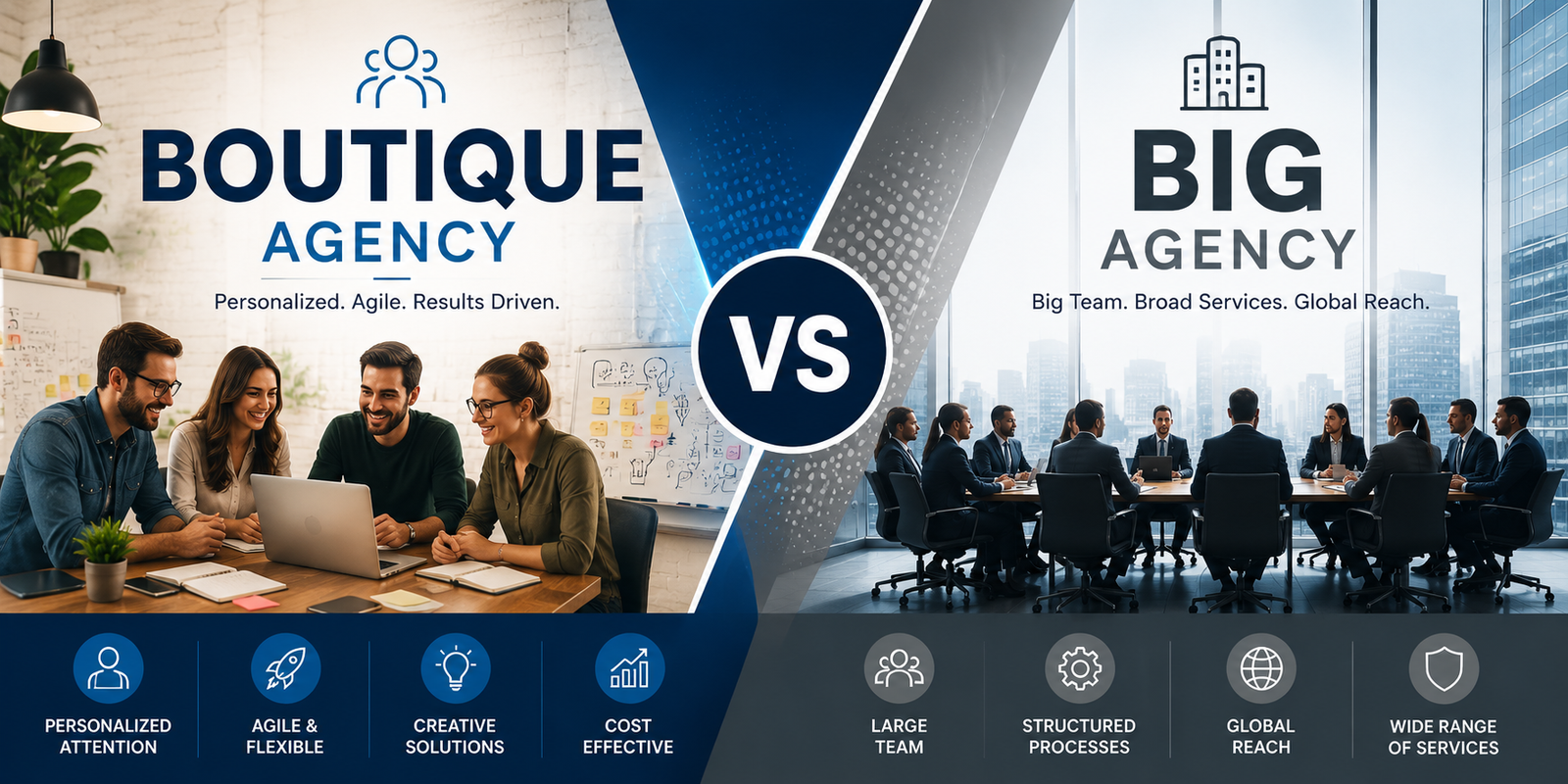
Boutique Agency vs Big Agency: Which One Actually Wins in 2026?
Quick Answer A boutique agency is a small, specialized firm — usually under 20 people — that focuses on one niche, channel, or industry instead of trying to do everything. In 2026, boutique agencies typically charge $1,000–$10,000+ per month depending on scope, give clients direct access to senior strategists instead of junior account managers, and tend to move faster and report more transparently than large, multi-department agencies. They’re a strong fit for premium DTC brands, eCommerce sellers, content creators, and growth-stage companies that want senior attention without enterprise-size budgets — but they’re not always the right call for global, multi-market enterprise campaigns.
If you’ve spent any time researching marketing partners this year, you’ve probably noticed the word “boutique” showing up everywhere. It’s not just a buzzword. As budgets tighten and AI reshapes how people discover brands, more companies are quietly walking away from big-name agencies and signing with smaller, specialized teams instead.
This guide breaks down exactly what a boutique agency is, what it costs in 2026, how it stacks up against a full-service or holding-company agency, and how to figure out — honestly, without the sales pitch — whether one is right for your business.
What Is a Boutique Agency?
A boutique agency is a small, independently run firm that deliberately limits its client roster and narrows its focus to a specific skill, channel, or industry vertical. Instead of offering every marketing service under one roof, a boutique shop typically picks a lane — paid social for DTC brands, SEO for SaaS companies, branding for hospitality groups — and goes deep rather than wide.

Most boutique agencies run with somewhere between 6 and 20 team members, though some solo consultancies and two-person studios also call themselves boutique. What actually defines the category isn’t headcount on its own — it’s the operating model:
- Senior-led work. The person who pitched you is usually the person doing (or directly overseeing) the work.
- A capped client list. Boutiques intentionally avoid overloading their roster so each account gets real attention.
- Niche depth over generalist breadth. A boutique agency would rather be the best at one thing than mediocre at twenty.
- Flat structure. Fewer approval layers between strategy and execution means decisions happen in days, not in committee meetings.
This is different from a “small agency” that simply hasn’t grown yet. A true boutique chooses to stay focused, even as it could expand — the constraint is the strategy.
Also Read : DeepSeek AI Alternatives: 10 Best Tools to Use
Boutique Agency vs. Big Agency: Side-by-Side Comparison
Here’s how the two models actually compare across the factors that matter most when you’re making a hiring decision.
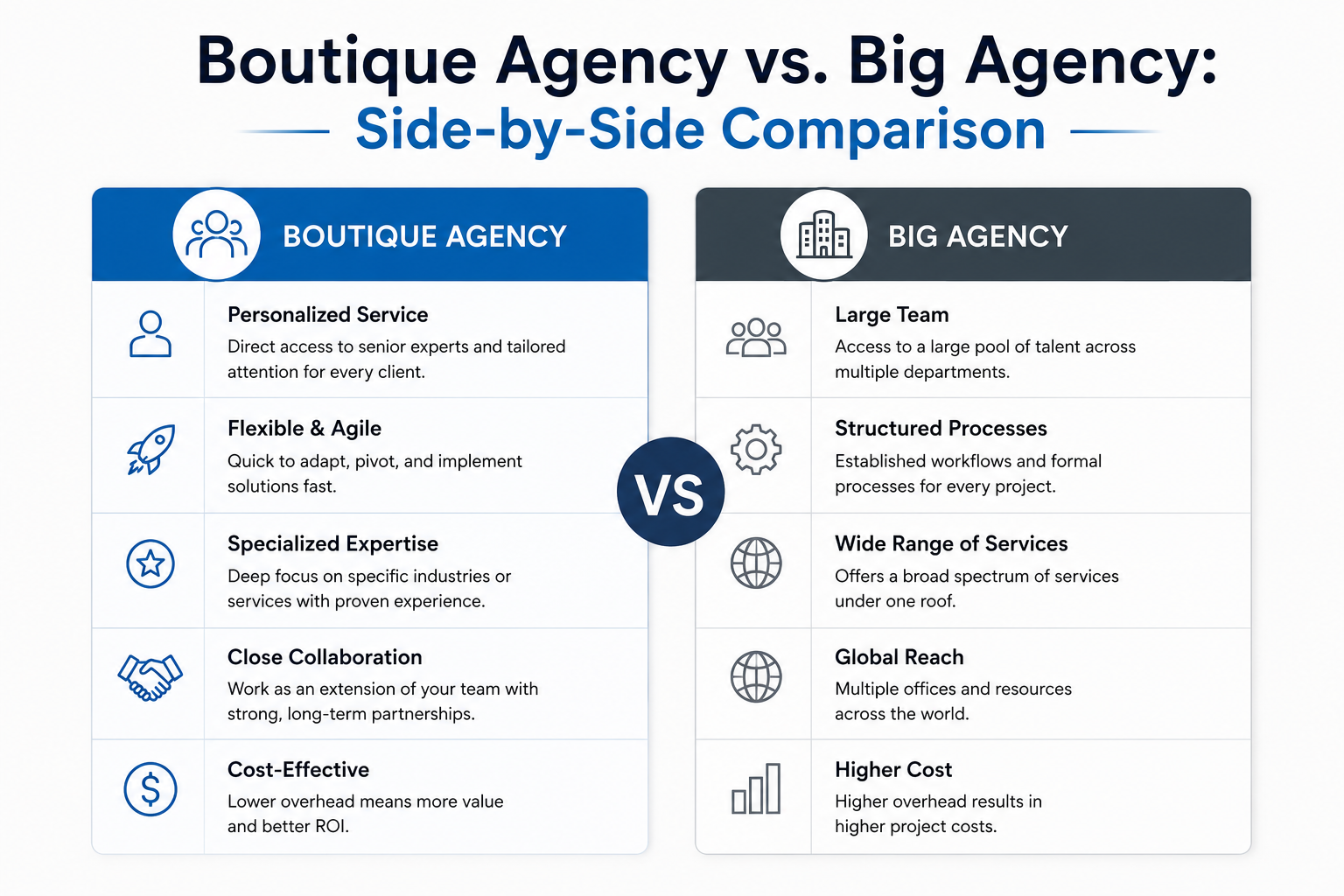
| Factor | Boutique Agency | Large / Holding-Company Agency |
|---|---|---|
| Team size | Typically 6–20 specialists | Hundreds to thousands of employees |
| Who does the work | Senior strategists, often the founders | Junior staff after senior team wins the pitch |
| Decision speed | Days — flat structure, few approvals | Weeks — layered sign-offs and departments |
| Communication | Direct line to the people doing the work | Routed through account managers |
| Specialization | Deep expertise in a narrow niche | Broad, generalist service menu |
| Client load per strategist | Small, intentionally capped roster | Often 5–10+ accounts per manager |
| Customization | Built around your specific business model | Standardized frameworks and templates |
| Pricing transparency | Usually clear, itemized retainers | Can include layered markups and hidden fees |
| Best for | Growth-stage brands, niche industries, fast-moving categories | Global, multi-market enterprise campaigns |
| Typical weak point | Limited bandwidth for sudden scale-ups | Slower pivots, diluted strategic ownership |
Neither model is universally “better.” A 40-country product launch with massive offline media buying genuinely needs the infrastructure of a large network. But for the vast majority of growth-focused businesses — DTC brands, SaaS startups, regional service companies, eCommerce sellers — the boutique model tends to deliver more attention per dollar.
Key Features of a Boutique Agency
Across industries, most boutique agencies share a consistent set of features:
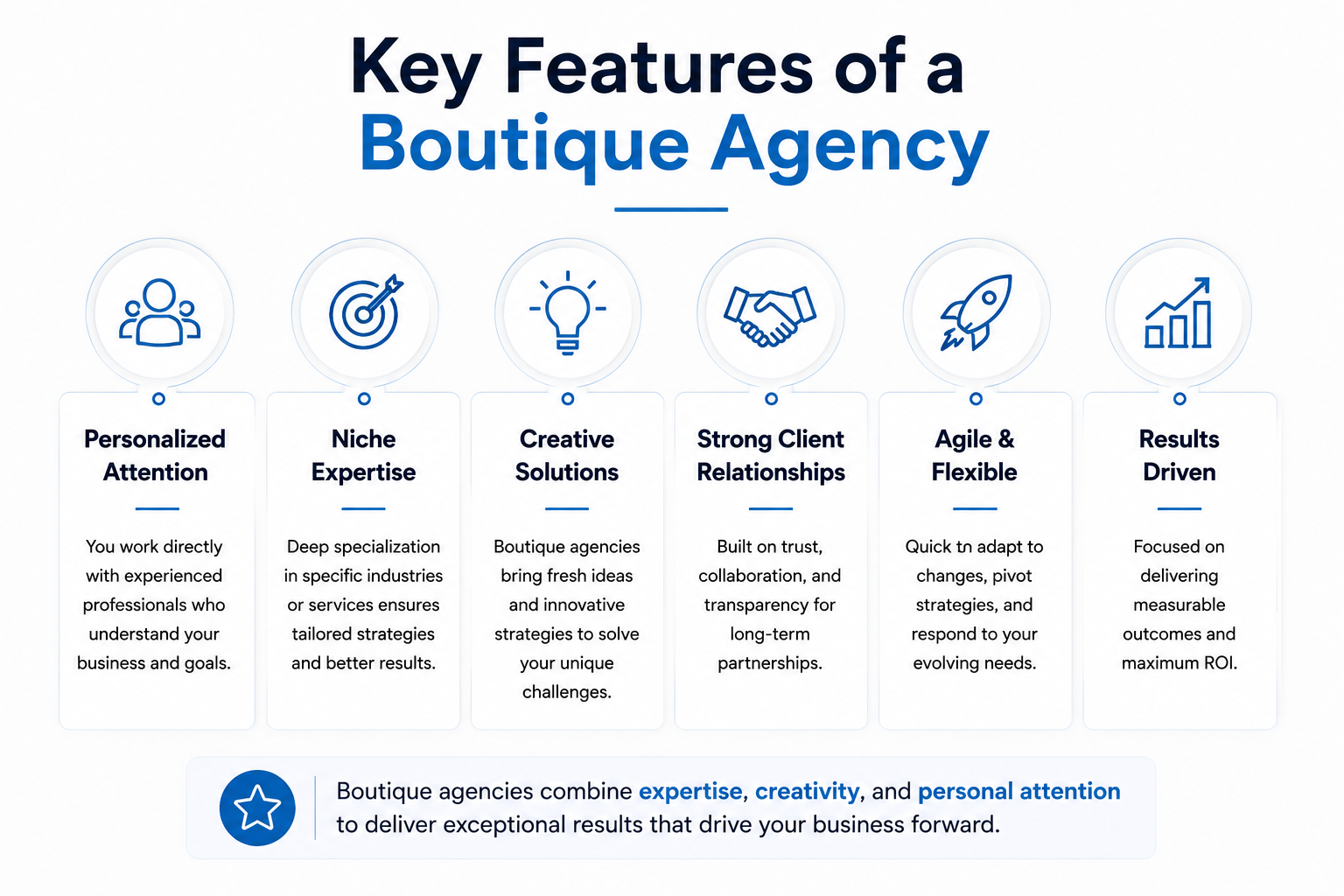
- Direct access to senior talent. No layers between you and the strategist actually running your campaigns.
- A narrow, well-defined service menu. Most boutiques specialize in one or two disciplines — paid media, SEO, branding, PR, or social — rather than offering every service imaginable.
- Customized strategy and reporting. Dashboards and KPIs are typically built around your actual revenue goals, not a templated scorecard.
- Faster iteration cycles. Creative testing, messaging pivots, and campaign adjustments happen in days rather than quarters.
- Vertical or platform fluency. Many boutiques go deep on a single category (wellness, femtech, SaaS, hospitality) or platform (Shopify, Meta Ads, TikTok) so they understand the nuances generalist agencies miss.
- Lean overhead. Fewer management layers means more of your budget goes toward actual strategy and execution.
- Long-term, relationship-driven retention. Because growth depends on reputation rather than a sales floor, boutique agencies tend to fight harder to keep clients happy.
Boutique Agency Pricing in 2026 (Updated)
Pricing is where boutique agencies vary the most, because “boutique” describes an operating model, not a fixed price tag. Based on current 2026 industry benchmarks across marketing, PR, and consulting categories, here’s what you can realistically expect to pay.
| Engagement Type | Typical 2026 Monthly Range | Best Suited For |
|---|---|---|
| Solo / micro-boutique retainer | $1,000 – $3,000 | Local businesses, single-channel management |
| Boutique full-service retainer | $3,500 – $10,000 | Growing brands needing multi-channel coordination |
| Paid media (PPC/social) management | $1,500 – $5,000 flat, or 10–20% of ad spend | eCommerce and DTC brands running active ad budgets |
| Boutique PR retainer | $1,500 – $5,000 (startups: $3,500–$10,000) | Brand launches, press visibility, reputation building |
| Boutique strategy/consulting retainer | $2,000 – $8,000 | Founders needing senior-level strategic guidance |
| Project-based engagement | $2,500 – $25,000 per project | Rebrands, website launches, one-off campaigns |
| Hourly or credit-block billing | $75 – $250/hour | On-demand strategy sessions or overflow work |
A few things worth knowing about how this pricing actually works in practice:
The “hours behind the number” matter more than the number itself. A fully-loaded marketing specialist costs roughly $75–$150 per hour once you account for salary, overhead, and margin. That means a $2,000 retainer buys around 20 hours of monthly work — fine for light monitoring, but not for deep strategic involvement. A $5,000–$8,000 retainer typically buys 50–80 hours, which is where most boutique agencies position their core offer: enough time for genuine strategic ownership without enterprise pricing.
Credit-based and block-hour billing is growing. Instead of a flat monthly retainer, some boutique agencies now sell prepaid hour “credits” or blocks (similar to a consulting retainer) that clients draw down as needed — useful if your workload is seasonal or project-driven rather than constant.
Watch for the percentage-of-spend model. If an agency charges 10–20% of your ad spend for paid media management, that’s standard. Anything above 20–25% without a clear performance justification is worth questioning.
Contract terms shifted in 2026. The current market standard has moved toward a 90-day initial commitment followed by 30-day cancellation terms, replacing the old 12-month lock-in that used to be common with larger agencies.
Pros and Cons of Hiring a Boutique Agency
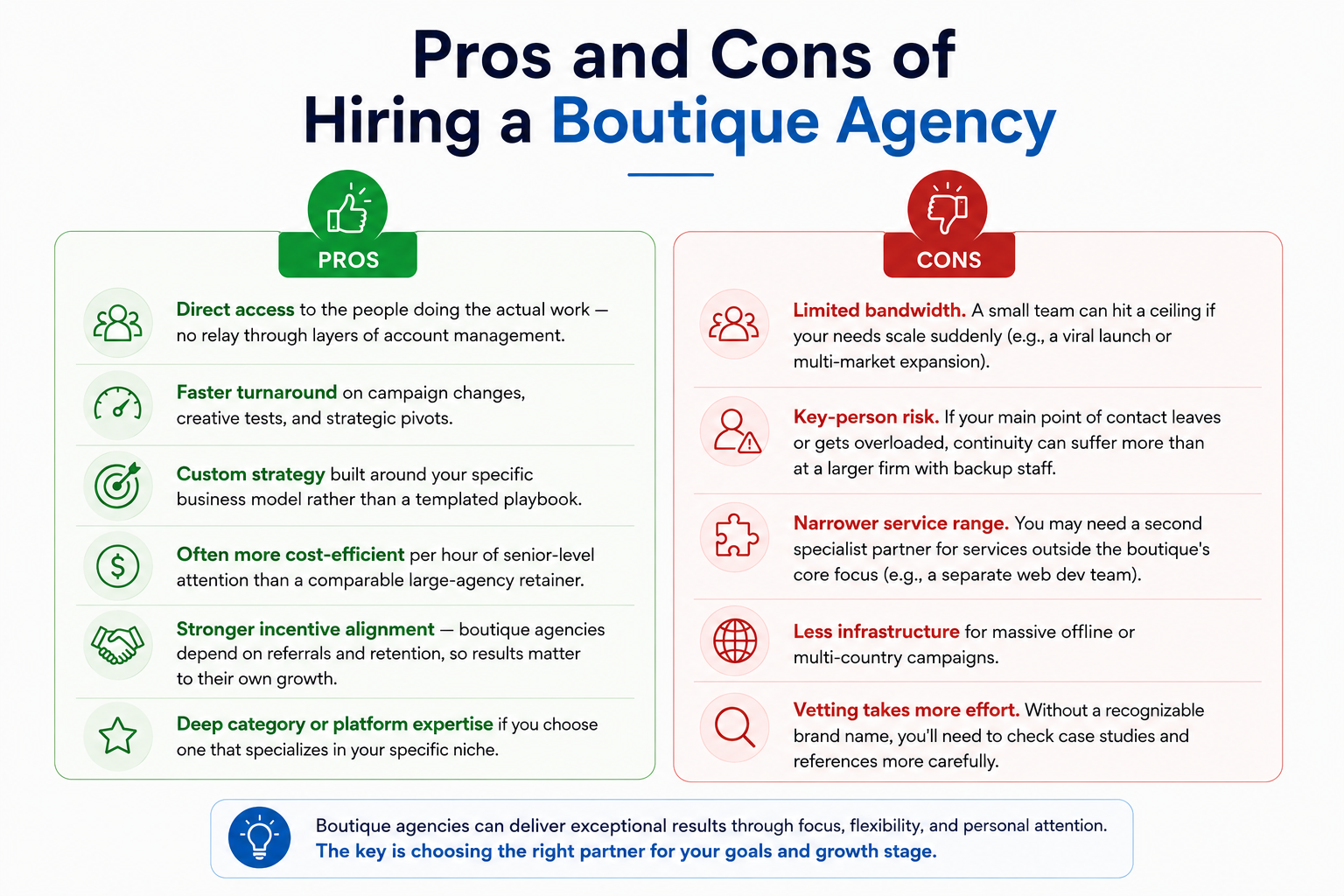
Pros
- Direct access to the people doing the actual work — no relay through layers of account management.
- Faster turnaround on campaign changes, creative tests, and strategic pivots.
- Custom strategy built around your specific business model rather than a templated playbook.
- Often more cost-efficient per hour of senior-level attention than a comparable large-agency retainer.
- Stronger incentive alignment — boutique agencies depend on referrals and retention, so results matter to their own growth.
- Deep category or platform expertise if you choose one that specializes in your specific niche.
Cons
- Limited bandwidth. A small team can hit a ceiling if your needs scale suddenly (e.g., a viral launch or multi-market expansion).
- Key-person risk. If your main point of contact leaves or gets overloaded, continuity can suffer more than at a larger firm with backup staff.
- Narrower service range. You may need a second specialist partner for services outside the boutique’s core focus (e.g., a separate web dev team).
- Less infrastructure for massive offline or multi-country campaigns.
- Vetting takes more effort. Without a recognizable brand name, you’ll need to check case studies and references more carefully.
Performance Analysis: Do Boutique Agencies Actually Deliver Better Results?
“Better” depends on what you’re measuring, but the data trends point in a consistent direction for growth-stage and mid-market brands.
Speed and accountability compound. Because boutique teams operate with fewer approval layers, campaign adjustments — bid changes, creative swaps, messaging pivots — happen in days rather than the multi-week review cycles common at larger firms. In fast-moving, algorithm-driven channels like paid social and search, that speed advantage adds up over a quarter.
Senior involvement correlates with strategic quality. When the same senior strategist who pitched your account is the one optimizing it, there’s less information loss between strategy and execution — a known failure point at larger agencies where the pitch team and the delivery team are often different people entirely.
2026 added a new performance variable: AI search visibility. Google’s May 2026 core update arrived alongside the news that AI Overviews now reach roughly 2.5 billion users, and research tracking dozens of B2B keywords found click-through rates on top-ranking pages dropping 18–34% once an AI-generated answer appeared above them — even when rankings stayed the same. Separately, research into citation patterns found that pages already ranking in the top 10 accounted for roughly three-quarters of AI Overview citations. In practice, that means performance in 2026 isn’t just about ranking — it’s about whether your brand gets cited inside AI-generated answers at all. Boutique agencies that have rebuilt their methodology around structured, machine-readable content tend to outperform larger agencies still running 2022-era SEO playbooks, simply because they’ve had to move faster to stay relevant.
Where the data is less flattering for boutiques: large-scale media buying efficiency. Agencies managing very high ad spend volumes can sometimes negotiate better platform rates and access beta ad features earlier — an advantage tied purely to scale, not skill.
Who Should Hire a Boutique Agency? (Use Cases by Audience)
For eCommerce Sellers
eCommerce brands live and die by ROAS, creative testing speed, and how quickly an agency can react to a sudden CPM spike or a platform algorithm change. A boutique agency that specializes in Shopify, Meta Ads, or DTC growth typically iterates on creative and targeting far faster than a generalist firm juggling 40 unrelated accounts. Look specifically for boutiques with documented case studies in your product category and AOV range — a boutique that’s scaled wellness or fashion brands may not be the right fit for a B2B hardware seller.
For Content Creators
Creators and personal brands usually don’t need (or want) a 12-person account team. What they need is a small, senior partner who understands platform-specific growth mechanics — YouTube packaging and retention, TikTok algorithmic discovery, or newsletter monetization — and can move at the same pace as the creator’s content calendar. A boutique creator-economy agency or a fractional specialist is almost always a better cost-to-attention ratio here than a traditional ad agency.
For Marketers and In-House Teams
If you already have an in-house marketing function, a boutique agency works best as an embedded extension rather than a full outsourced department. Use boutiques to fill specific capability gaps — a dedicated SEO/AEO specialist, a paid social pod, a PR boutique for a launch — while your in-house team keeps strategic ownership. This hybrid model is increasingly common in 2026 as brands try to stay lean without losing specialized expertise.
For Businesses and Premium Brands
Founders, CMOs, and brand directors at premium or challenger brands are often the ones driving the shift away from big agencies, largely because category-specific judgment and senior attention matter more than network size at this stage. If your brand competes on positioning, taste, or community rather than sheer media spend, a boutique’s tighter feedback loop between creative and performance data is usually a meaningful edge.
Boutique Agencies and the 2026 AI Search Shift
This is the trend reshaping the entire “boutique vs. big agency” conversation this year. As AI Overviews, ChatGPT Search, Perplexity, and Gemini increasingly answer queries directly — without a click — visibility now depends on whether a brand gets cited inside those AI-generated answers, not just whether it ranks on page one.
This favors boutique agencies in an unexpected way: agencies that specialize narrowly in “Generative Engine Optimization” (structuring content so AI systems can reliably parse, attribute, and cite it) are, almost by definition, boutique operations. Industry analysts have pointed out that most large agencies are still applying AI as a production tool to speed up old-school SEO workflows, rather than rebuilding their methodology around how generative engines actually select and cite sources. If you’re evaluating a boutique agency in 2026, it’s worth asking directly: do they track AI citation share as a KPI, or only traditional rankings and traffic?
Watch: Boutique Agencies Explained
For a quick visual breakdown of how boutique agencies operate day-to-day compared with larger firms, these two explainer videos are a useful starting point:
- 3 Reasons to Hire a Boutique Marketing Agency Over Freelancers or Big Agencies — breaks down the practical trade-offs between freelancers, boutiques, and large agencies.
- Boutique Agency vs. Full-Service Agency for Your Marketing — a side-by-side look at how boutique and full-service models differ in scope and structure.
(To embed either video directly on your site, drop the URL into your CMS’s video block, or use a standard responsive iframe embed with the video ID from the URL.)
Alternatives to a Boutique Agency
A boutique agency isn’t the only option on the table. Depending on your stage and needs, consider:
- Freelancers / fractional specialists. Lower cost than an agency, but you take on more project-management responsibility yourself. Best for narrowly scoped, ongoing work like a fractional CMO or a dedicated paid-media freelancer.
- Full-service / holding-company agencies. Better suited to enterprise budgets, multi-market campaigns, and businesses that want one vendor handling everything end-to-end.
- In-house team. Highest long-term control and brand context, but slower to build and more expensive to staff for specialized skills (a senior hire can cost $150,000–$250,000+ annually once benefits and overhead are included).
- Hybrid model (in-house + boutique pods). Increasingly common in 2026 — a lean internal team handles strategy and brand, while boutique specialists are brought in for specific channels or campaigns.
- AI-assisted marketing platforms. For very early-stage businesses, software-driven marketing tools can handle basic execution before a human agency relationship makes financial sense — though they can’t replace strategic judgment.
How to Choose the Right Boutique Agency: A Practical Checklist
Before signing anything, run any boutique agency you’re evaluating through these questions:
- Who will actually manage my account day-to-day — the person in the pitch, or someone you haven’t met yet?
- Can they show 2–3 case studies in my specific industry, revenue range, and channel mix?
- What does their pricing actually include — hours, deliverables, reporting frequency — and is it written down?
- What’s the contract term and exit clause? A 90-day initial period with 30-day cancellation terms is the current market standard.
- Do they track AI/GEO visibility as a metric, or only traditional rankings and traffic?
- How many other clients does my main point of contact manage? If it’s more than 4–5, expect divided attention.
- What happens if my needs suddenly scale up? Do they have a documented plan for bandwidth, or will my account get deprioritized?
FAQs
What exactly makes an agency “boutique” instead of just small? Size alone doesn’t make an agency boutique — the deciding factor is intentional focus. A boutique agency deliberately narrows its client list and specializes in a specific niche or channel, with senior staff staying directly involved in execution rather than handing work off to junior teams.
Are boutique agencies cheaper than big agencies? Usually yes, on a pure retainer basis — boutique retainers commonly start around $1,000–$3,500/month versus $5,000–$15,000+ for full-service holding-company agencies. But the more useful comparison is value per hour of senior attention, not the sticker price alone.
Is a boutique agency right for a large enterprise? It can be, especially for a specific project or channel, but most large enterprises with global, multi-market needs still pair a boutique specialist with a larger network agency for scale-heavy work like offline media buying.
How long should a boutique agency contract be? The current 2026 market standard is a 90-day initial commitment followed by 30-day cancellation terms — long enough to see real results, short enough to avoid getting locked into a poor fit.
Do boutique agencies handle AI search optimization (GEO/AEO)? Many do, and it’s increasingly a core differentiator in 2026, since AI Overviews and chat-based search tools now intercept a large share of discovery queries. Ask specifically whether the agency tracks AI citation share as a KPI — not every agency that claims AI expertise actually measures it.
What’s the biggest risk of working with a boutique agency? Limited bandwidth. A small team can struggle to absorb a sudden spike in workload, so it’s worth asking upfront how they handle scale-ups before you need the answer in an emergency.
Final Verdict
There’s no universal “best” choice between a boutique and a big agency — it depends on what you’re actually optimizing for. If your priority is senior-level attention, fast iteration, and a partner that treats your account like it matters, a boutique agency is very likely the stronger fit, especially heading into a year where AI-driven search is rewarding agility over headcount. If you need true global scale, massive offline media infrastructure, or single-vendor coverage across dozens of services, a larger network agency still has a legitimate place.
For most growth-stage brands, eCommerce sellers, content creators, and marketers filling a specific capability gap, the math in 2026 increasingly favors going boutique — provided you vet the agency properly, lock in clear pricing and contract terms, and confirm they’re actually built for how search and discovery work today, not how they worked five years ago.