
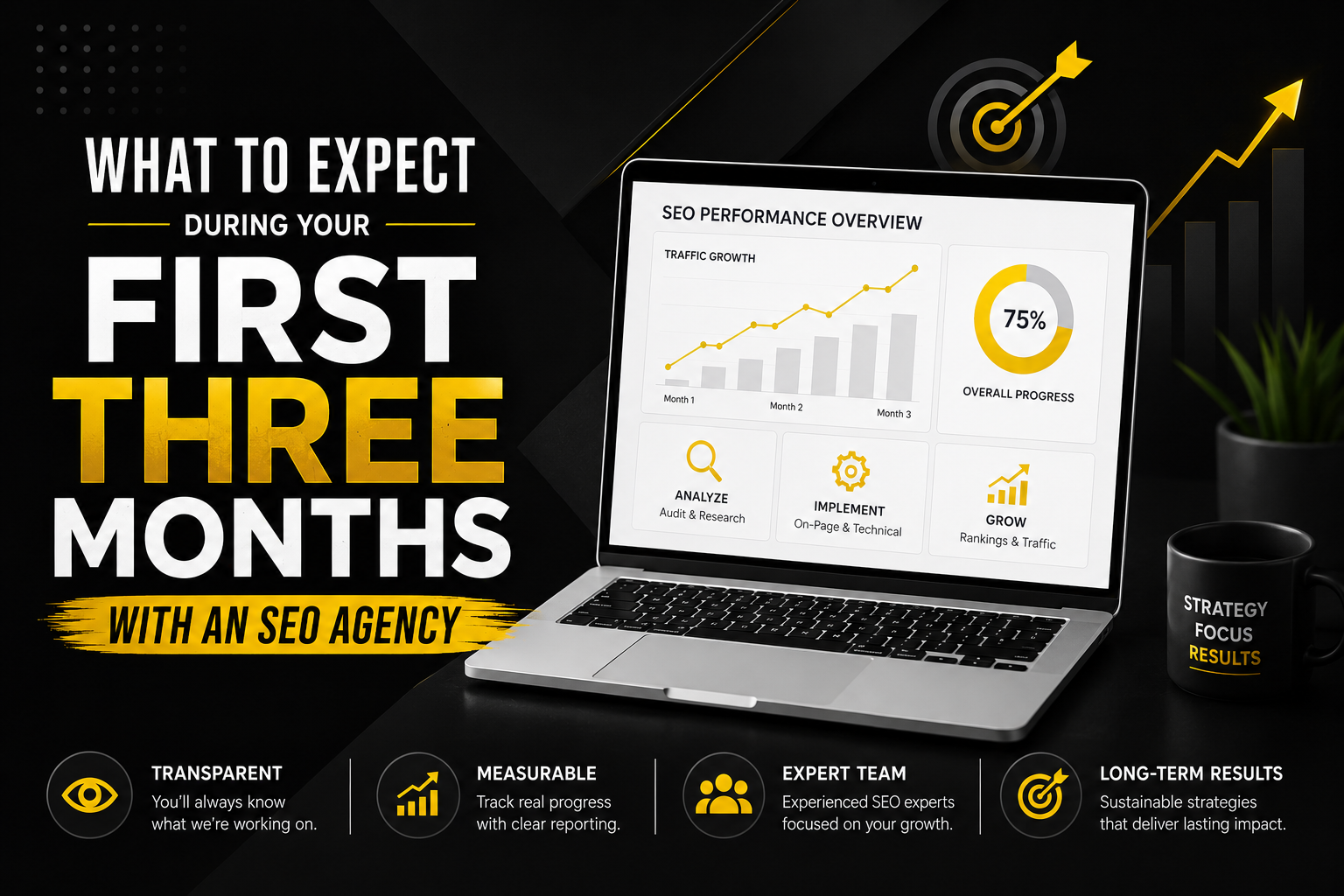
What to Expect During Your First Three Months With an SEO Agency
Hiring an SEO agency is a major step for any business that wants to increase its online visibility, attract more qualified visitors, and generate consistent organic traffic. However, SEO is not an overnight marketing strategy. It requires research, planning, technical improvements, quality content, and ongoing optimization.
The first three months are especially important because they establish the foundation for future growth. While you may not reach the top of Google immediately, you should expect meaningful improvements in your website, search visibility, and overall SEO strategy.
Here is what you can realistically expect during your first three months.
1. Month One: Research, Auditing, and Strategy
The first month is usually focused on understanding your website and developing a clear SEO strategy. Before making significant changes, the agency needs to identify what is working, what is holding your website back, and where the biggest opportunities exist.
What happens during the first month?
An SEO team will typically perform:
- Technical SEO audits: Checking website speed, mobile responsiveness, indexing, crawlability, broken links, redirects, and other technical issues.
- Keyword research: Identifying relevant keywords that potential customers use when searching for your products or services.
- Competitor analysis: Reviewing competitors’ rankings, content, backlinks, and overall SEO strategies.
- Content evaluation: Identifying outdated, thin, duplicated, or poorly optimized content.
- Backlink analysis: Reviewing existing links to determine whether they are relevant, useful, and trustworthy.
- Google Search Console analysis: Examining impressions, clicks, rankings, indexing, and search performance.
- Website structure review: Looking at navigation, internal linking, URLs, headings, and page organization.
After completing this research, the agency should create a roadmap that explains what needs to be improved and which activities should be prioritized.
This stage may not produce dramatic traffic increases, but it is extremely important. Without proper research, SEO work can become a collection of random changes rather than a focused strategy.
2. Month Two: Website Optimization and Content
Once the initial audit and strategy are complete, the second month is generally when implementation becomes more visible.
The agency begins fixing the issues discovered during the first month while also improving important pages across the website.
Common activities during month two include:
- On-page optimization
Existing pages may be optimized with better titles, headings, descriptions, keyword targeting, internal links, and improved content. - Technical improvements
Developers or SEO specialists may fix indexing problems, broken links, slow-loading pages, duplicate URLs, and other technical issues. - Content creation
New blog posts, guides, service pages, FAQs, and other useful resources may be created around relevant search queries. - Internal linking
Important pages can be connected through strategic internal links, helping both users and search engines understand the website’s structure. - User experience improvements
The agency may recommend changes that make pages easier to navigate, read, and use on both desktop and mobile devices.
The goal during this stage is not simply to publish hundreds of words or insert keywords repeatedly. Good SEO content should provide genuine value and satisfy the reason behind a user’s search.
For example, if someone searches for a particular service, the page should clearly explain what the service offers, who it is for, its benefits, and how the visitor can take the next step.
3. Month Three: Tracking, Link Building, and Refinement
By the third month, your SEO campaign should have generated enough data to identify early trends.
The agency can compare current performance with the baseline established during the first month. This helps determine which strategies are producing results and which areas need further attention.
Important metrics to monitor include:
- Organic website traffic
- Keyword rankings
- Search impressions
- Click-through rates
- Indexed pages
- Organic conversions
- Leads and enquiries
- Engagement metrics
- Backlink growth
- Revenue from organic search
Keyword rankings are useful, but they should not be the only measurement of success. Ranking first for a keyword that generates no customers is less valuable than ranking well for a highly relevant term that consistently brings qualified visitors.
Link building may also become a bigger priority
A strong backlink profile can help improve a website’s authority and credibility. However, successful link building is about quality rather than quantity.
A professional SEO strategy may focus on earning links through:
- Relevant guest posts
- Digital PR
- Industry publications
- Useful research and statistics
- Expert contributions
- High-quality informational content
- Business and industry resources
The focus should always be on obtaining relevant and trustworthy links rather than collecting hundreds of low-quality backlinks.
4. What Results Should You Expect After Three Months?
This is one of the most important questions to ask before starting an SEO campaign.
You should not expect every website to reach the first page of Google within 90 days. SEO results depend on several factors, including:
- The age and authority of your website
- Your industry and level of competition
- Your existing backlink profile
- The quality of your content
- Your technical SEO condition
- The keywords you are targeting
- Your previous SEO history
- The consistency of optimization efforts
Instead of expecting instant results, look for positive signals.
Early signs of progress can include:
- More keywords appearing in search results
- Higher search impressions
- Increased organic traffic
- Better rankings for targeted keywords
- More pages being indexed
- Improved website performance
- More organic enquiries or leads
- Growth in relevant backlinks
These improvements can indicate that your website is moving in the right direction.
5. How to Work Effectively With Your SEO Agency
The relationship between a business and its SEO agency can have a significant impact on campaign success.
You can help your agency by providing accurate information about your business, customers, products, services, and competitors.
It is particularly useful to share:
- Your main business goals
- Your target audience
- Your most profitable products or services
- Important geographic markets
- Previous marketing campaigns
- Seasonal trends
- Competitors you consider important
- Any previous SEO work
Communication is also essential. Ask your agency for regular reports and make sure you understand what the numbers actually mean.
A good report should explain:
- What was completed
- What changed
- Which activities performed well
- What needs improvement
- What the agency plans to do next
You should never feel like you are simply receiving a spreadsheet full of numbers without any explanation.
6. Choosing the Right SEO Agency
The first three months can also help you determine whether you have chosen the right SEO partner.
A professional agency should be transparent about its work and realistic about potential results. Be cautious of companies that promise guaranteed number-one rankings or claim they can deliver massive traffic increases within a few weeks.
When evaluating an agency, look for:
- Clear communication
- Transparent reporting
- Realistic expectations
- A customized SEO strategy
- Strong technical knowledge
- Quality content practices
- Ethical link-building methods
- A focus on long-term growth
If you need professional assistance improving your website’s visibility, working with an experienced seo agency can provide the expertise and structured strategy needed to compete effectively in search results.
7. The Bigger Picture: SEO Is a Long-Term Investment
The first three months should be viewed as the beginning of the SEO journey rather than the finish line.
During this period, the agency is building the foundation needed for future growth. Technical issues are addressed, content is improved, keyword opportunities are identified, and authority-building activities begin.
As the campaign continues, successful strategies can be expanded while weaker approaches can be adjusted.
The biggest advantage of SEO is that the work you complete today can continue generating value months or even years later. A high-quality article, well-optimized service page, or authoritative backlink can continue attracting visitors long after it was created.
Final Thoughts
Your first three months with an SEO agency should be focused on building a strong foundation, improving visibility, and creating a clear path toward sustainable growth.
In simple terms:
- Month 1: Research, auditing, competitor analysis, and strategy.
- Month 2: Technical improvements, on-page optimization, and content creation.
- Month 3: Performance analysis, link building, and strategy refinement.
Don’t judge an SEO campaign solely by whether one keyword reaches position one. Instead, look at the complete picture: Are rankings improving? Is organic traffic growing? Are more relevant users finding your website? Are those visitors turning into leads or customers?
SEO takes time, but when it is approached strategically and consistently, the first three months can establish a solid foundation for long-term organic growth.