
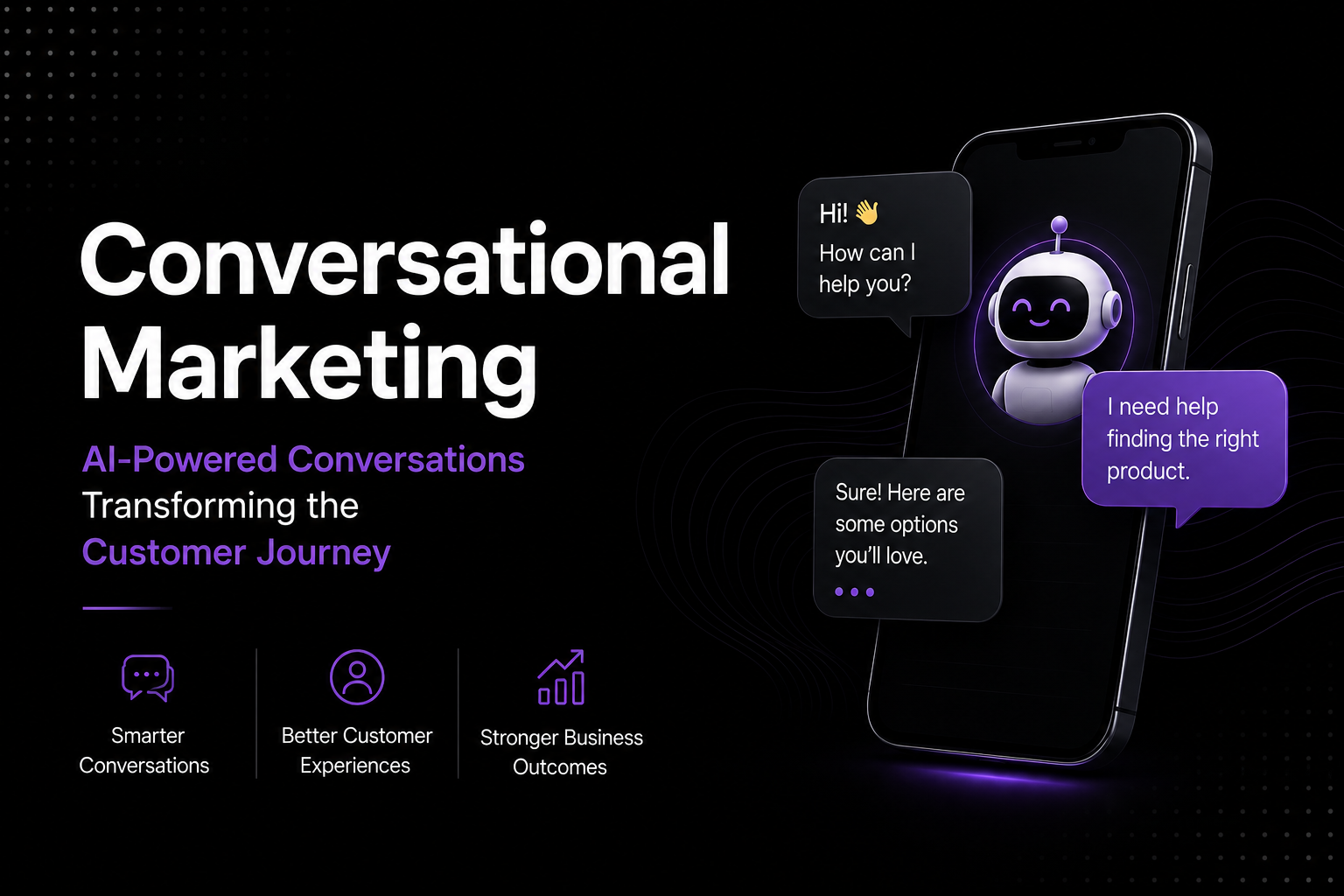
Conversational Marketing in 2026: AI-Powered Customer Journeys
I still see marketing decks with the funnel drawn on them. Awareness at the top, decision at the bottom, a nice clean triangle in between. It’s a comforting picture — it made the customer feel predictable. But if you’ve bought anything online lately, you know that’s not how it actually happens anymore. You ask a chatbot a question, it remembers what you bought last month, it checks stock for you, and somewhere in that exchange you’ve already decided. There was no “stage.” There was just a conversation.
That’s the real story of marketing in 2026. Not that AI got smarter (though it did), but that the whole shape of the customer journey stopped being a line and became something closer to a back-and-forth. And a lot of marketing teams are still building for the line, running the same conversational marketing strategy 2026 that gets talked about everywhere but rarely actually implemented.
The funnel assumed you were patient. You’re not.
The old model worked because information was scarce and marketers controlled the sequence. You saw the ad, then the landing page, then the retargeting email, then maybe you bought. Each piece existed to nudge you to the next one.
Nobody wants to be nudged anymore. If someone wants to know whether a jacket ships to their country, they want the answer in the next ten seconds — not a “stage” of content designed to build consideration. When they can get that answer instantly from a competitor’s chat window, waiting isn’t really an option. Speed has quietly become the whole game.
What’s genuinely different this time around
Chatbots aren’t new — we’ve had clunky versions of them for a decade. What changed is what’s happening underneath.
Context actually follows the customer now. Someone messages a brand on Instagram, picks the conversation back up on WhatsApp two days later, and finishes the purchase on the website — and the system treats that as one person, not three strangers who happen to share a credit card number.
The conversations start themselves, too. Instead of sitting there waiting for someone to type “help,” AI agents notice when a shopper lingers too long on a pricing page or leaves items sitting in a cart, and they open with something specific — not a generic “Need help?” popup, but a line that actually reflects what the system just watched happen.
And maybe the biggest change: these agents can do things, not just talk about them. Check inventory, apply a discount code, reschedule a delivery, close the sale — all inside the same chat window. This is what people mean when they talk about AI chatbot customer journey mapping — the conversation isn’t a detour on the way to a transaction anymore. It basically is the transaction.
Voice is part of this too. As more people talk to assistants instead of typing to them, brands are having to write scripts that sound like something a person would actually say out loud — shorter, plainer, a lot less “unlock your journey today.”
Why static content keeps losing
Here’s the uncomfortable part for a lot of marketing teams: the assets they’ve spent years building are becoming friction rather than help.
A gorgeous mid-funnel landing page means nothing to someone who just wants a yes-or-no answer about shipping. If that answer isn’t available in the conversation, they’re gone — probably to whichever competitor answered them first.
Segmenting people by funnel stage is getting harder to justify, too. When a single chat can take someone from “just curious” to “just bought it” in under five minutes, the whole top-of-funnel/bottom-of-funnel language starts to feel like it’s describing a world that doesn’t exist anymore — which is basically the whole chatbot vs traditional marketing funnel debate in one sentence.
And attribution — ironically — gets messier, not cleaner, the more conversational things get. A customer who starts on Instagram, continues over WhatsApp, and finishes with a voice purchase doesn’t fit neatly into a last-click spreadsheet. Marketing teams are having to rethink what “credit” even means.
What this looks like inside real marketing teams
None of this is theoretical anymore — it’s showing up in job titles and org charts.
“Conversation design” has become its own discipline, the way UX writing did a decade ago. It’s part copywriting, part customer service instinct, part knowing how a language model tends to misread an ambiguous question.
Marketing and customer service are bleeding into each other, because the same AI agent handling a pre-sale question is often the one handling a return three weeks later. Drawing a hard line between “acquisition” and “support” doesn’t make much organizational sense when it’s the same conversation thread.
First-party data for conversational AI has become the thing everyone’s fighting over internally, because a conversational agent is only as good as the context it’s given — purchase history, stated preferences, even how a customer talks. Brands that have their data structured well are noticeably better at this than the ones still working off spreadsheets.
And keeping a brand’s voice intact across thousands of automated conversations turns out to be genuinely hard. It’s easy for an AI system to default into generic helpfulness — polite, competent, and completely forgettable. The brands that stand out are the ones putting real effort into tone guidelines and actually reading transcripts, not just trusting the model to “get it.”
Trust is the part nobody can shortcut
People are more willing to talk to a bot than they used to be. They’re also quicker to notice when one is being cagey with them, and that’s where a lot of this can go wrong.
Being upfront about talking to AI matters, especially when money, health, or a complaint is involved. Try to disguise it and, once someone figures it out, you’ve lost more trust than the bot ever saved you in labor costs.
Getting to a real human has to actually work. A chatbot that loops a frustrated customer through the same three unhelpful answers does more damage than not having a chatbot at all.
And people want to know what’s being remembered about them and why. As these systems get better at recalling past conversations, “what exactly are you storing” is becoming a normal question — and a company’s answer to it is starting to matter as much as its product.
If you’re starting from scratch
You don’t have to rebuild everything at once. A few places to actually begin — or if you’d rather skip the trial and error, talk to our team about AI powered customer conversations for brands and we’ll map it out with you:
- Look at your current touchpoints and ask where people are being pushed toward static content when a direct answer would serve them better.
- Pick something narrow and high-frequency to start — order status, product recommendations, appointment booking. Easy to measure, hard to mess up.
- Make sure the system actually has good context to work with. An agent with no access to real customer history or inventory data is just a fancier FAQ page.
- Don’t just measure how many conversations got “deflected” from a human. Measure whether people actually got what they needed.
- Keep humans reading the transcripts. The models are good, but they drift, and someone needs to notice when they do.
The part that actually matters
Underneath all of this, what’s really shifted isn’t the technology — it’s the assumption about what a customer is. The funnel treated people as an audience to be walked through stages on somebody else’s schedule. Conversation treats them as someone who’s actually there, asking a real question, expecting a real answer, right now.
That’s a harder bar to clear. It means showing up ready instead of scheduling when you’ll show up. But get it right, and it stops feeling like marketing at someone and starts feeling like an actual relationship — which, honestly, is what all of this was supposed to be about in the first place.
If you want to see real conversational AI marketing examples 2026 before you commit to a strategy, that’s a good next stop.